Rural public transit modal share just 11.4%
Fixed-route systems don’t fit local needs
Access to essential services more than twice as unequal
Fixed-route systems don’t fit local needs
Access to essential services more than twice as unequal
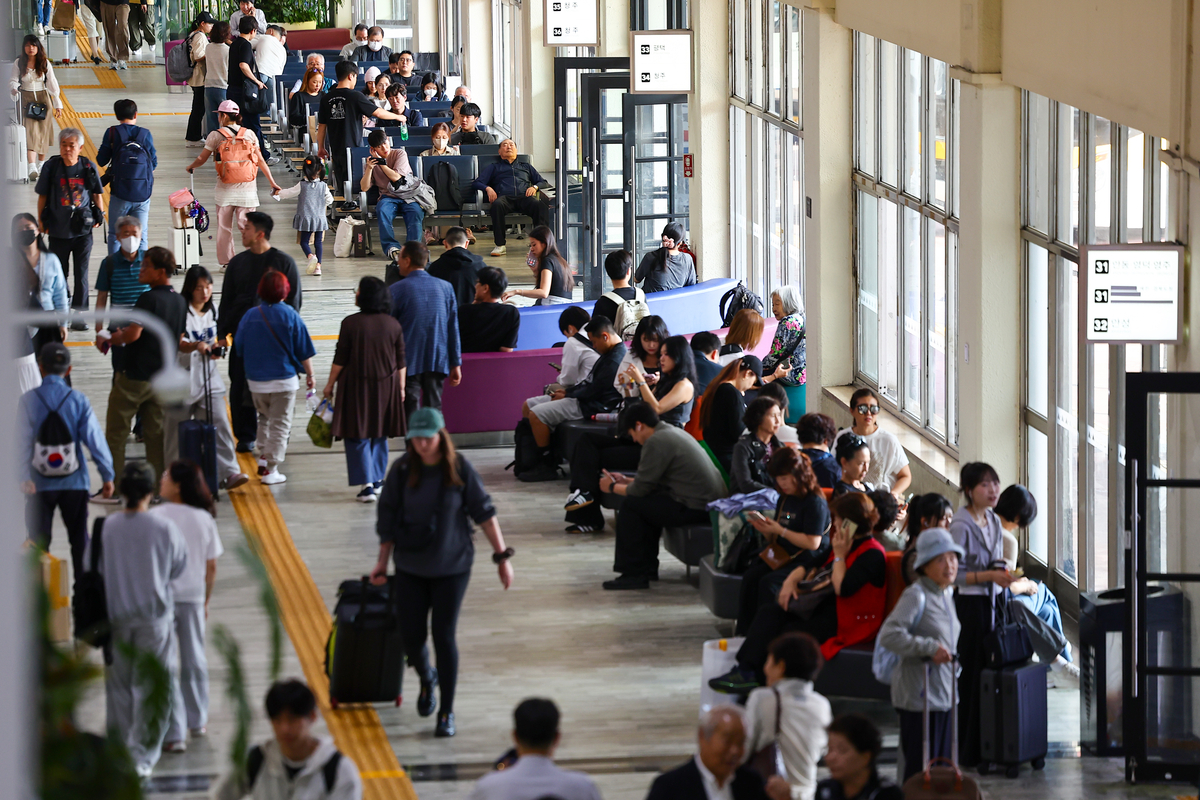 The gap in public transportation infrastructure between Seoul and other regions is widening. As population and jobs concentrate in the Seoul metropolitan area, local transit services have weakened, producing a feedback loop that draws even more people and investment to the capital region.
 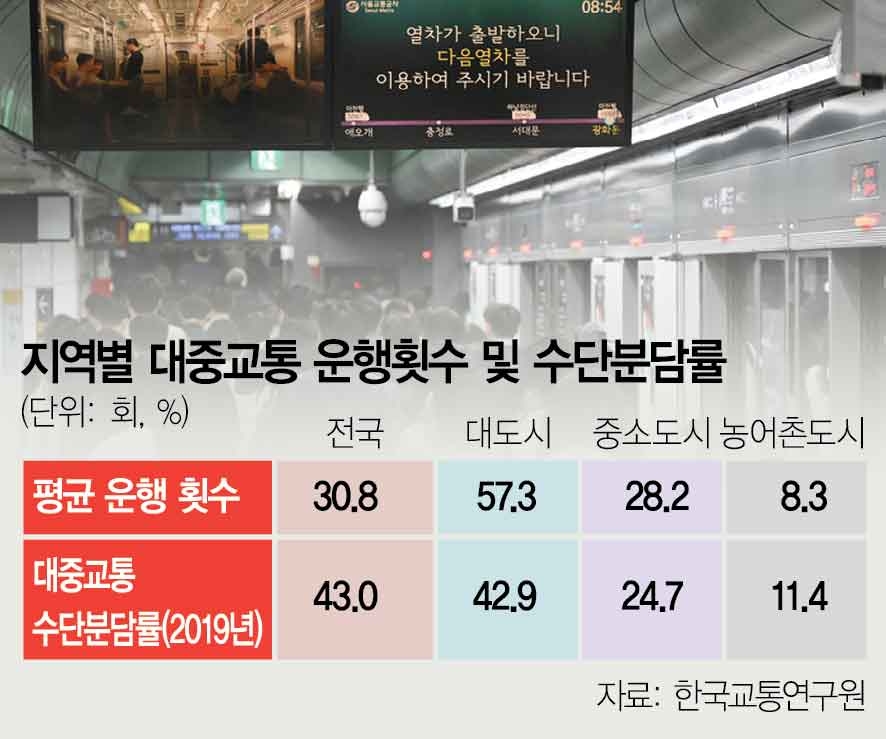 On April 17, the Korea Transport Institute compared transit-service levels across 249 cities, counties, and districts—classifying 74 as large cities, 99 as small-to-medium cities, and 76 as rural areas—and found that rural areas’ public-transit modal share fell from 22.3% in 2005 to 11.4% in 2019, a near halving. Over the same period, large cities saw a more modest decline from 51.0% to 42.9%. Modal share refers to the percentage of daily trips taken by a given mode of transport, and the drop signals a rapid erosion of the public-transit user base in rural communities.
 In practice, local public transit has contracted sharply. The Ministry of Land, Infrastructure and Transport’s Public Transport Survey reports that, as of 2024, city buses nationwide operated on 17,767 routes with 36,015 vehicles. Of those routes, 5,185 served county-level (rural) areas, but those routes had just 2,190 buses. Service-frequency gaps are striking: the national average was 30.8 runs per day, while large cities averaged 57.3, small-to-medium cities 28.2, and rural areas only 8.3. In short, even when rural residents want to ride the bus, service supply is often insufficient.
Those disparities translate into much poorer access to regional transport hubs and essential services such as medical care and retail. By public transit, reaching a regional transport hub took an average of 35.9 minutes in large cities but 62.5 minutes in rural areas—nearly twice as long. Small-to-medium cities averaged 48.5 minutes. Access to medical facilities averaged 12.5 minutes in large cities, 21.1 minutes in small-to-medium cities, and 44.9 minutes in rural areas. The farther from the capital, the more time and money residents must spend to reach hospitals, transport hubs, and commercial centers.
Experts say the concentration of people and resources in the Seoul area is deepening this transportation divide. As population and jobs cluster in the metropolitan region, gaps in transport, education, culture, and healthcare widen, prompting further migration toward areas with better services. Rural communities face an added structural challenge: low birthrates and an aging population, which accelerate the deterioration of the transit-demand base.
Calls are growing for targeted investment to ensure balanced national development and to protect citizens’ basic mobility rights. Kim Jeong-hwa, a professor in the Department of Urban Transport at Kyonggi University, said, “Domestic transport policy has emphasized how many people can be moved efficiently, which has left local areas relatively neglected. We need clear financial-investment criteria to guarantee minimum mobility rights.”
Analysts also urge moving away from one-size-fits-all route planning toward region-specific, tailored transit services. Park Kyung-ah, a senior researcher at the Korea Transport Institute, said, “We need approaches that raise efficiency by flexibly deploying limited staff and resources instead of relying solely on fixed-route systems.” She added that preliminary feasibility studies for roads and rail should strengthen regional-balance criteria and expand support for areas with lagging transport services.
- [Exclusive] Japan is easing capital rules too… South Korean banks face a KRW 40 trillion burden (about $30 billion)
- “They made 1 trillion KRW every day in March”… The country quietly profiting from the Iran war (1 trillion KRW ≈ $750 million)
- “After semiconductors: robots, space, defense… Pension fund flows could push KRW 500 trillion this year” (about $375 billion)
- “Who makes money in real estate these days?”… Newly wealthy households with KRW 6 billion tell a different story (KRW 6 billion ≈ $4.5 million)
- Fire-sale listings from multi-home owners flood the market… Seoul land-use permit applications rise for the seventh straight week [Real Estate Column]
- “How much did I give for the wedding gift?”… The mystery of a 40-year-old coworker’s invitation without a wedding
- “A 582% spike in a single day”… A company pivoted from shoes to 'AI' and then ignited a stock rally
- “Even if you have a baby, there’s nowhere to leave them”… 'Zero-age exams' spread in new towns
- “These days, everyone’s invested in stocks” — Soldiers who lost their pay to margin trading: the government stepped in
- “Home prices move with Samsung and SK Hynix bonuses”… Housing near tech campuses heats up [Housing Guide]