|
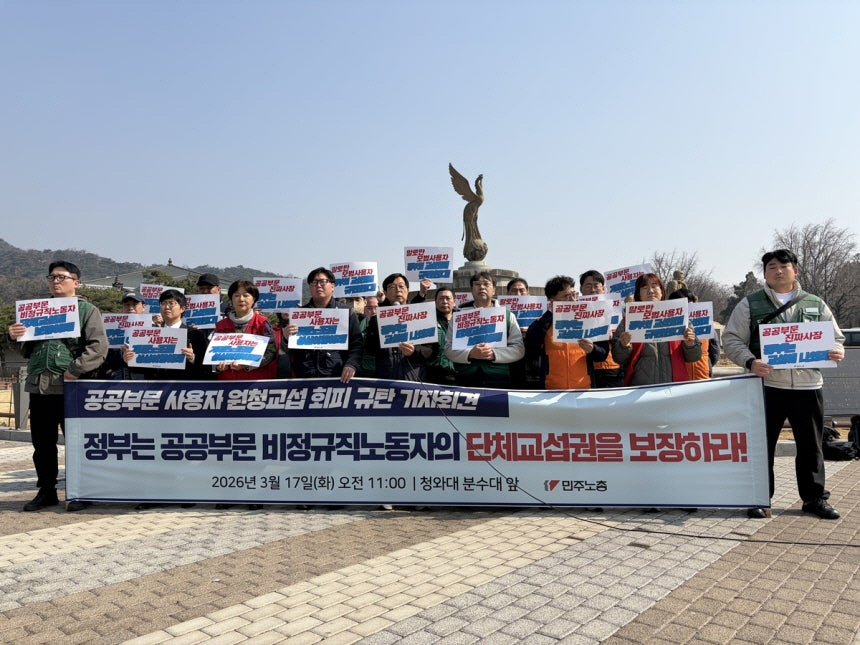
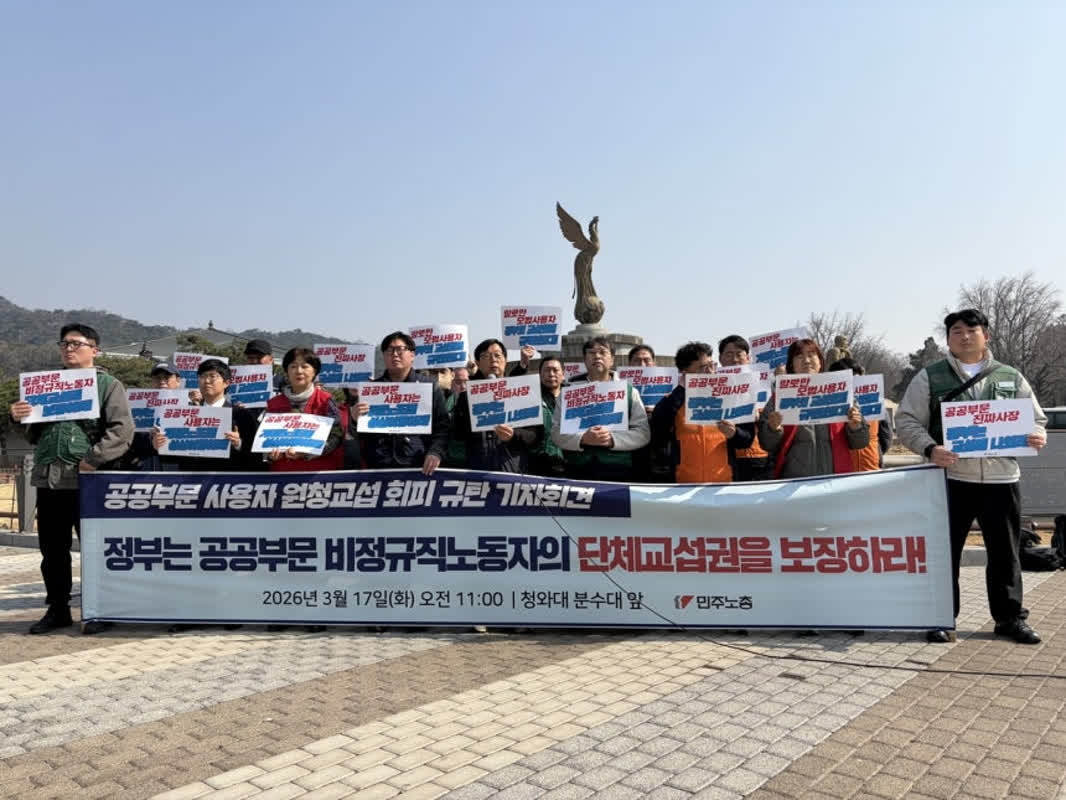
On the morning of March 17, the KCTU held a press conference in front of the Blue House and urged the government to fully implement the amended Trade Union Act (commonly known as the Yellow Envelope Law), which requires public-sector employers to guarantee subcontracted workers' right to collective bargaining.
According to the KCTU, subcontracted public-sector workers represented by the union and employed through subsidiaries of public institutions sent formal notices this month requesting collective bargaining with government agencies and local governments after the law took effect. Some public institutions that received those notices began exploring ways to avoid bargaining, and some local governments instructed subordinate agencies to deny employer status.
The KCTU said Gwangju sent official letters to five district offices and to subordinate entities — including public institutions, public corporations and foundations — asserting that, under the Local Public Enterprises Act and the Local Public Investment and Contribution Act, it would be difficult to establish employer status if workers demanded bargaining with the principal employer; effectively, the letters instructed those bodies to deny employer status. The union also said the National Tax Service, the Ministry of Climate and Energy, Korea Post, and the Ministry of Culture, Sports and Tourism replied that they would seek the opinion of the Employment and Labor Ministry's Collective Bargaining Assessment Support Committee before reviewing the issue.
The KCTU emphasized that this series of actions by those agencies appeared intended to avoid principal-employer bargaining. It criticized moves by some public institutions to dodge bargaining, noting that the amended Trade Union Act requires principal employers to conduct collective bargaining and to sign collective agreements when they exercise substantial influence and authority over subcontracted workers' terms and conditions.
KCTU Vice Chair Lee Yang-su said most public institutions are not responding to contingent workers' bargaining requests as employers. Instead, he said, they are spending large sums of taxpayer money on legal consultations to find ways to avoid compliance, making them indistinguishable from abusive private-sector employers. Lee demanded that the government stop standing by: it must either engage directly in bargaining or hold public-sector employers who evade bargaining accountable through strong measures.
Before the press conference, the KCTU also held a news briefing at its education center in Jung-gu, Seoul, calling for joint bargaining with the Ministry of Health and Welfare, the Ministry of Gender Equality and Family, and the Ministry of Education to improve caregivers' working conditions.