[iNews24 reporter Kim Da‑un] Comedian Lee Soo‑ji, who drew attention with a parody highlighting the harsh working conditions of early‑childhood caregivers, has again struck a chord with a second video portraying a day in the life of a kindergarten teacher.
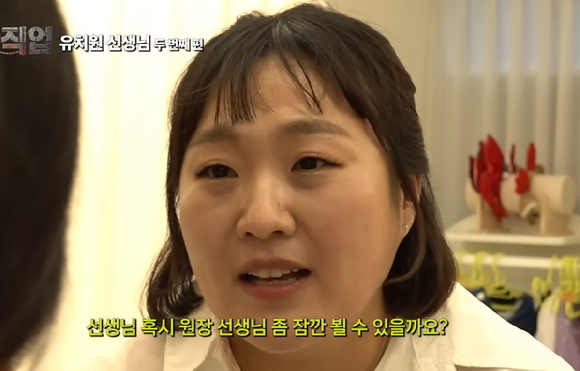
On the 29th, Lee uploaded a follow‑up to her YouTube channel 'HotIssueJi' titled Spring of Kindergarten Teacher Lee Min‑ji (feat. Mosquito).
In the video, a parent brings a child who has COVID to the kindergarten, explaining, “My child begged so much because they wanted to see the teacher.” The parent then instructs teacher Lee Min‑ji, “If the child coughs up yellow phlegm, give them this medicine.”
The parent adds, “My child told me you played rock‑paper‑scissors with them and won. When I heard that, my heart started pounding, my hands and feet trembled, and I couldn’t sleep.”
Lee clarifies, “We always call results a draw,” but the parent storms off saying she needs to speak with the director.
During a mini sports day, Lee suddenly shouts, “Someone call an ambulance!” only to discover the child had been bitten by a mosquito.
When a producer brushes it off as “just a mosquito bite,” Lee reacts dramatically: “Just a mosquito? The child looks like they’re going to die—itching so badly.” She sobs while telling the child not to scratch and to stay calm.
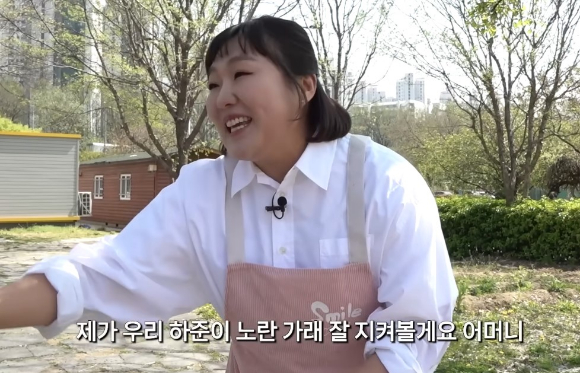
Lee also demonstrates the lengths teachers go to meet parents’ individual requests during nap time, from playing white noise to streaming hip‑hop for the children.
The video resonated with industry insiders and viewers online.
A commenter identifying as the spouse of a childcare worker wrote, “This is exactly what my wife always tells me.” He added that parents often give antipyretics to children with contagious illnesses—COVID, the flu, hand‑foot‑and‑mouth disease, or gastroenteritis—to mask fevers and send them to school.
Another commenter said a child became enraged and kicked after losing at rock‑paper‑scissors, and reported the child’s mother telling them, “You shouldn’t let them experience defeat before age five.”
An on‑duty police officer who commented said many parents come to the station to file complaints alleging child abuse, often crying that their child suffered emotional harm.
A viewer claiming to live in the United States noted, “Here they won’t accept the child anywhere—not even kindergarten—if parents behave like that. My colleagues sprint to pick up kids at 4:30 p.m. because late pickups cost extra, charged by the minute.”
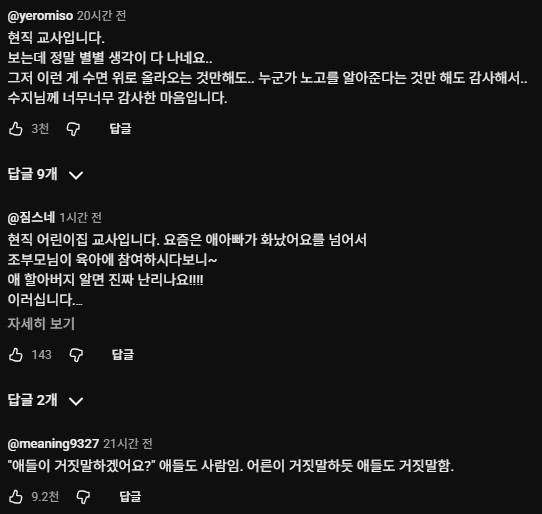
Current teachers who commented described a range of reactions: “This brings up so many thoughts,” “I’m just grateful this is coming to light,” “It’s much worse than this—this video is the mild version,” and “There are people who blame the daycare teacher as if a mosquito bite were their responsibility.”
The debate over workload intensified after a kindergarten teacher who contracted the flu recently died, prompting renewed scrutiny of the demands placed on kindergarten and daycare staff.
On the 23rd, the Korean Teachers and Education Workers Union (KTU) surveyed 6,689 teachers across kindergartens, elementary, middle, high and special schools. Among kindergarten teachers (3,547 respondents), 64.5% reported having gone to work while infected with the flu.
That rate is substantially higher than at elementary schools (49.3%), special schools (48.6%), middle schools (47.0%), and high schools (46.0%).
The rate was even higher among private kindergarten teachers, at 73.6%.
When asked why they worked while sick, the most common response was that they could not find substitute staff (68.6%).
Additionally, 59.6% said they felt pressured or feared repercussions from administrators if they did not come in.