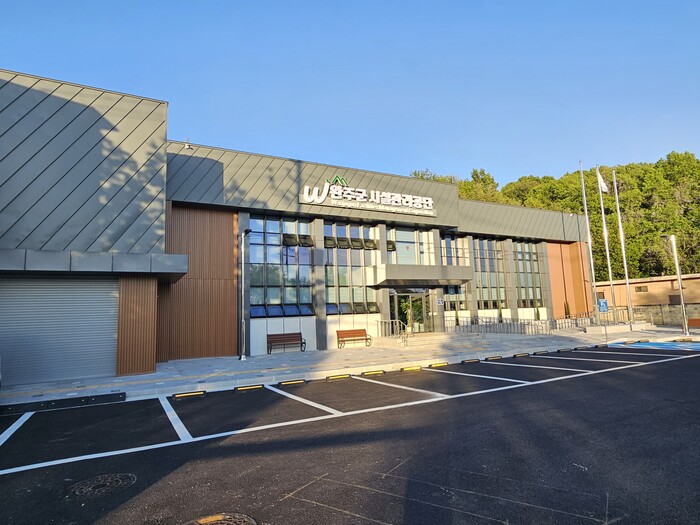
The Wanju County Facilities Management Corporation, an agency under Wanju County, completed its headquarters relocation to Yongjin-eup about 1 year and 8 months after its founding and has begun a phase of expanded public-facility operations. Analysts say the move signals a shift beyond a routine office relocation toward a regional public enterprise that integrates management of everyday public services.
The corporation launched in October 2024 in the former Bongdong-eup town office. After roughly seven months of renovation, it recently moved into the former town office building in Yongjin-eup and started full operations.
At launch, the corporation was contracted to manage five county projects. This year, the county broadened the corporation’s responsibilities significantly in the areas of sports and community facilities.
The newly contracted sites include four swimming facilities: Wanju National Sports Center, Samnye Youth Training Center, Bongdong Workers' Welfare Center, and Iseo Culture & Sports Center. To oversee these additions, the corporation established a dedicated sports facilities team.
Staffing has grown from about 110 employees at launch to 198 today, reflecting a move from basic maintenance to operating a wider range of sports, welfare, and everyday public services.
Locals view the headquarters relocation as a symbolic step toward centralizing what had been a fragmented public-facility management system. With the headquarters now closer to Yongjin-eup’s administrative core, observers are watching whether service access and on-site response times improve.
\"In the past, people were often confused about whom to contact about facility issues,\" said a Yongjin-eup resident near the new headquarters. \"Now that the corporation is centralized, residents feel the system is more organized. The key will be how quickly they address problems at pools and other sports facilities.\"
Another resident added, \"A move alone isn’t meaningful unless it brings operational changes residents can actually feel. We expect to see improvements in safety management and user convenience at local sports facilities.\"
Chairman Lee Hee-su said, \"Relocating the headquarters is an important opportunity to strengthen the corporation’s future competitiveness. We will deliver public services that directly affect residents’ lives more safely and efficiently and establish ourselves as a trusted local public enterprise.\"
Local officials and analysts say the corporation is likely to continue expanding its role in public sports and community infrastructure. They warn, however, that securing the necessary professional expertise and maintaining service quality that residents notice—at a pace that matches organizational growth—will be the corporation’s central challenges going forward.