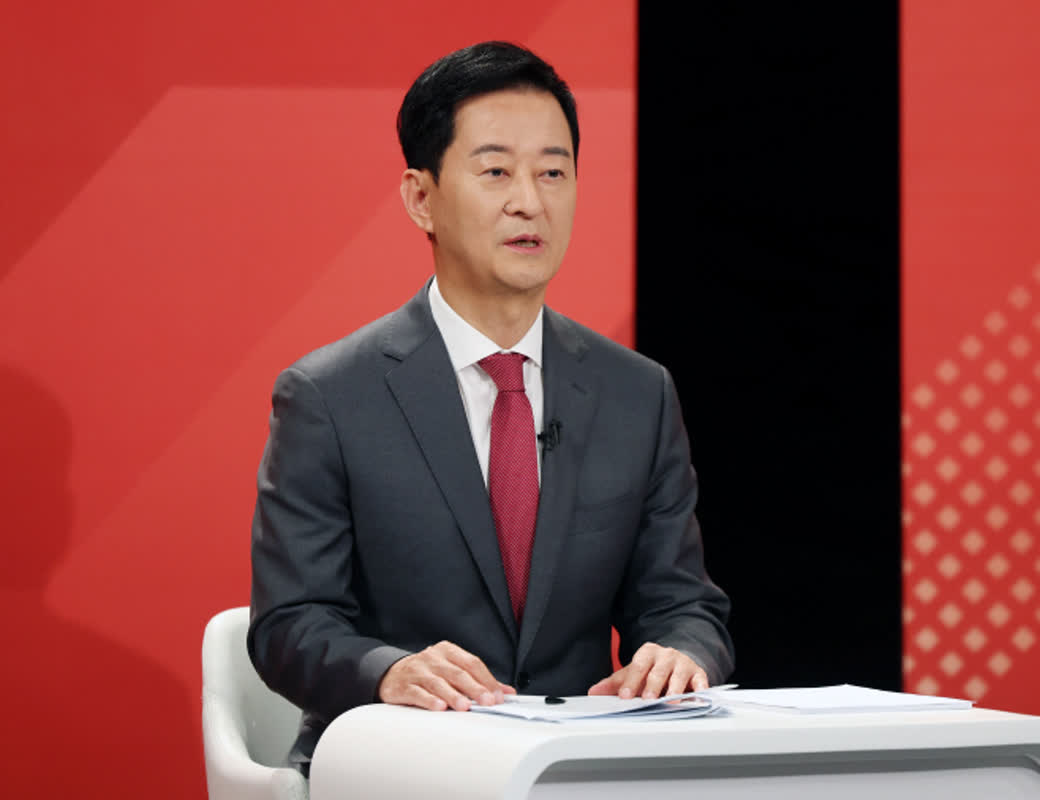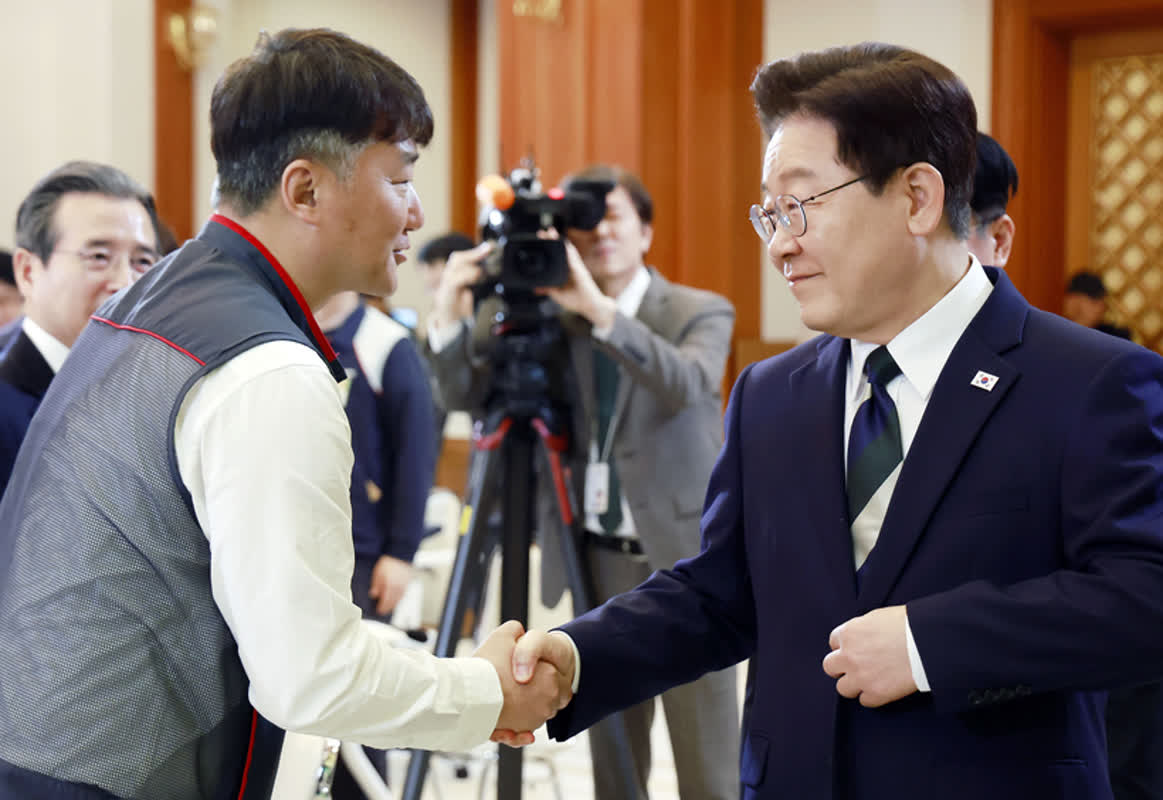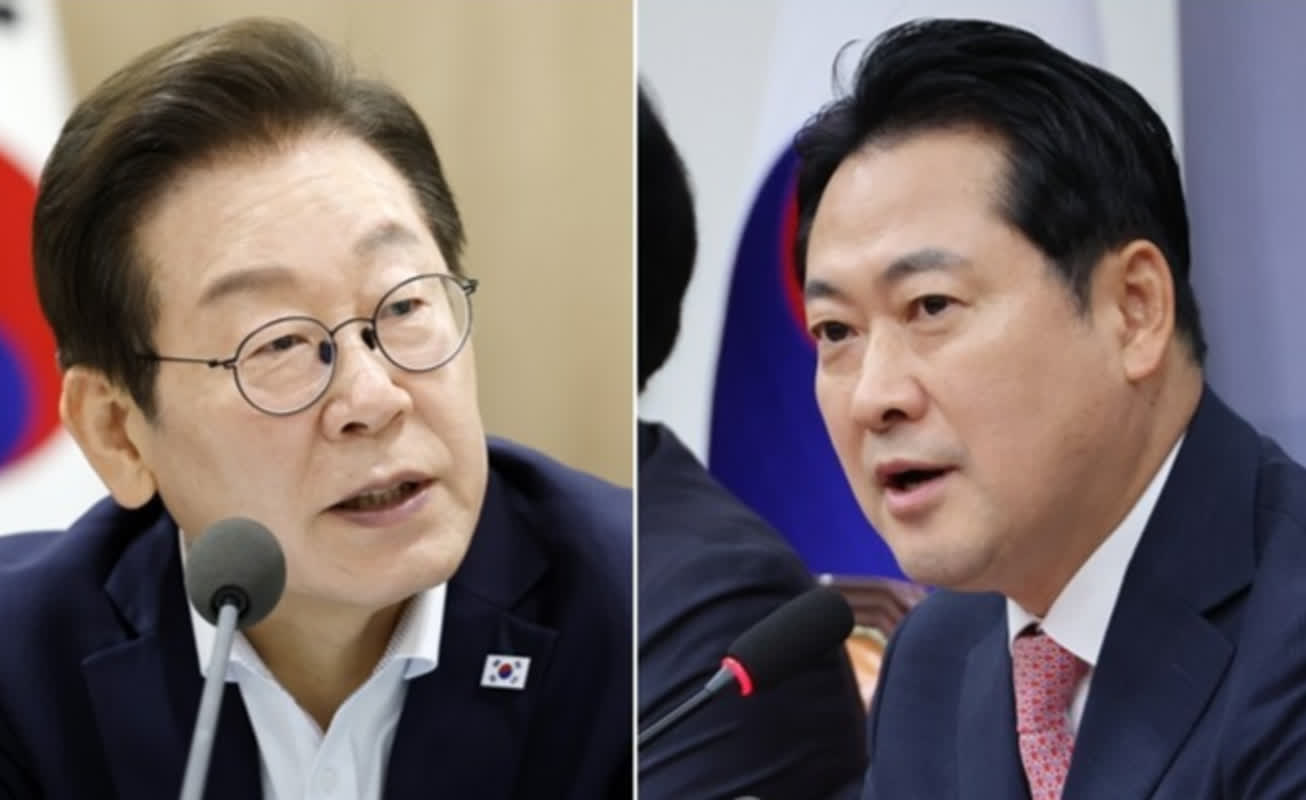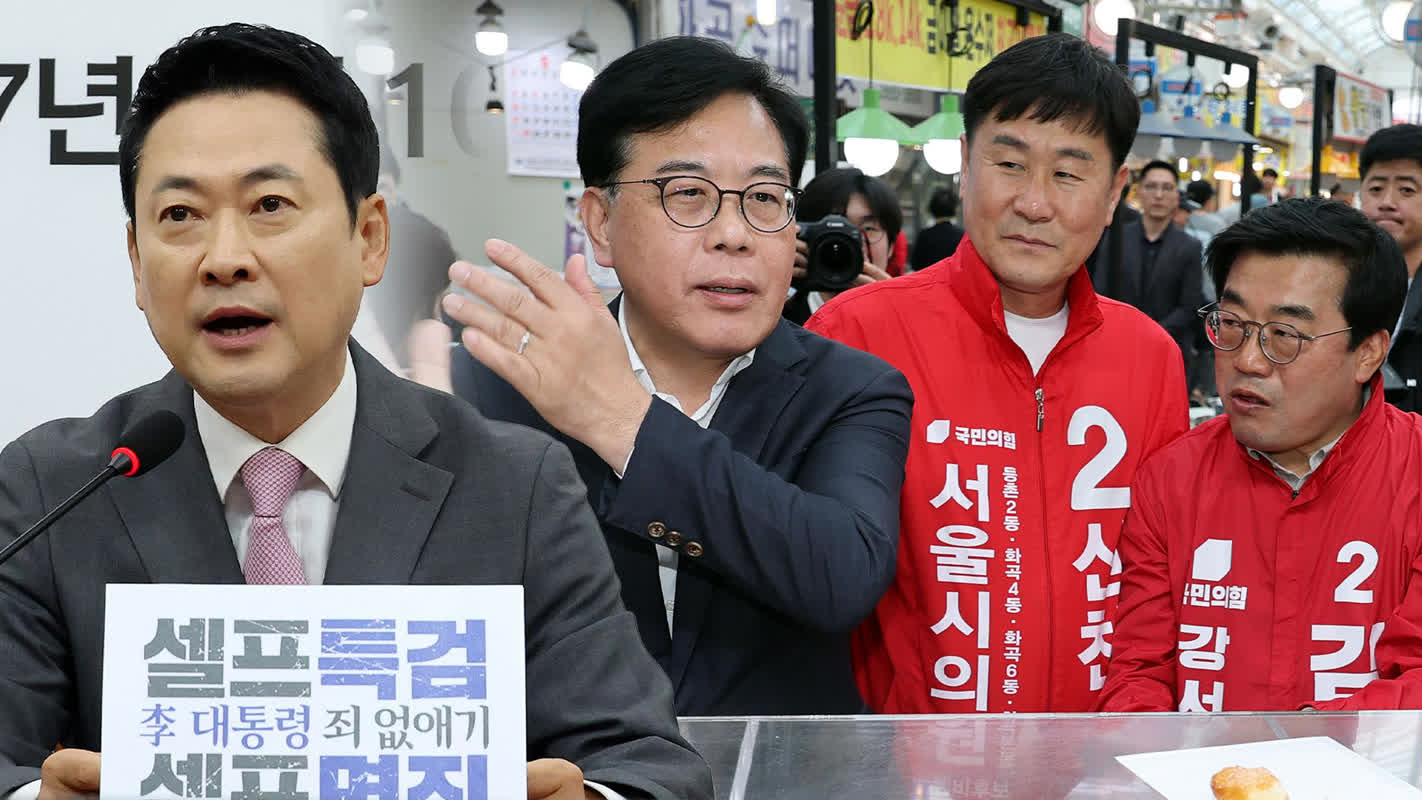
President Lee Jae-myung urged the ruling Democratic Party to decide the timing and procedures for handling the special-prosecutor bill on alleged fabricated indictments only after soliciting public opinion and holding deliberations. Blue House policy chief Kim Yong-beom used social media to criticize the credit-rating system and call for measures to reduce financial polarization. Media responses to their remarks were mixed. Below is a roundup of major newspapers’ coverage on the 5th.
Kim Yong-beom’s “cruel finance” remarks draw mixed press reactions
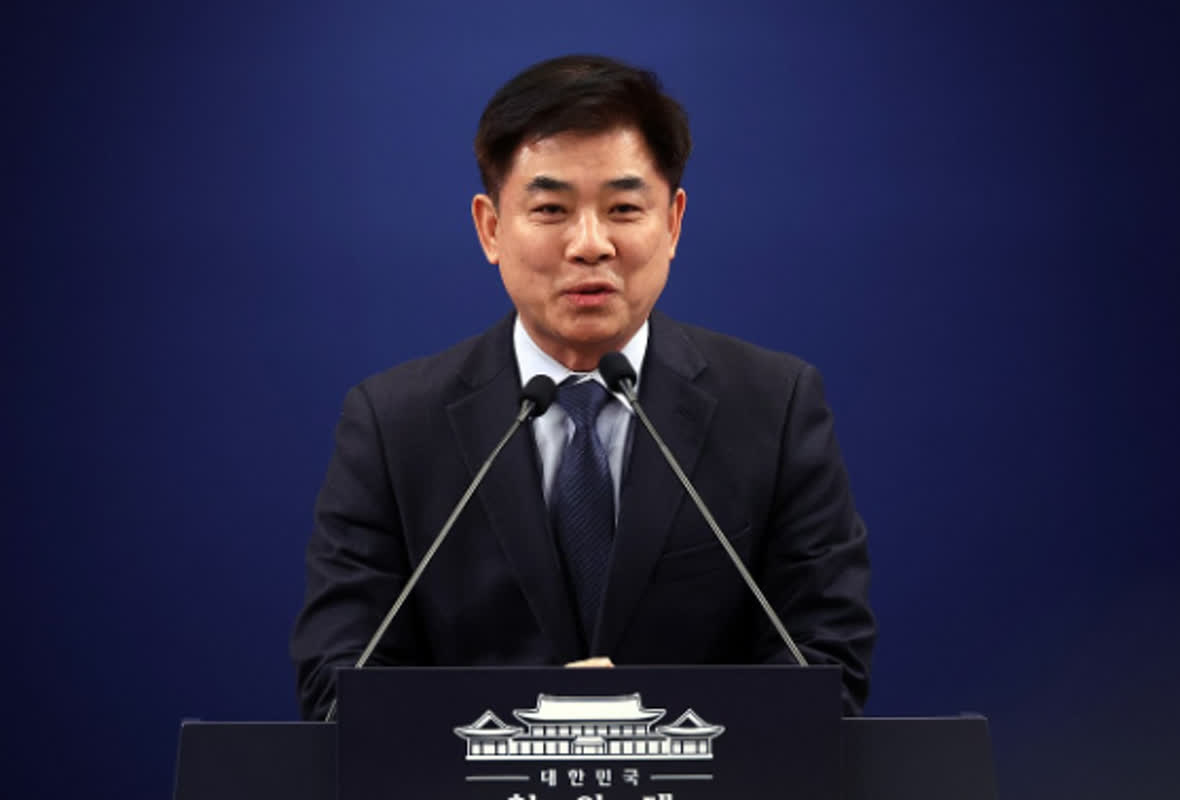
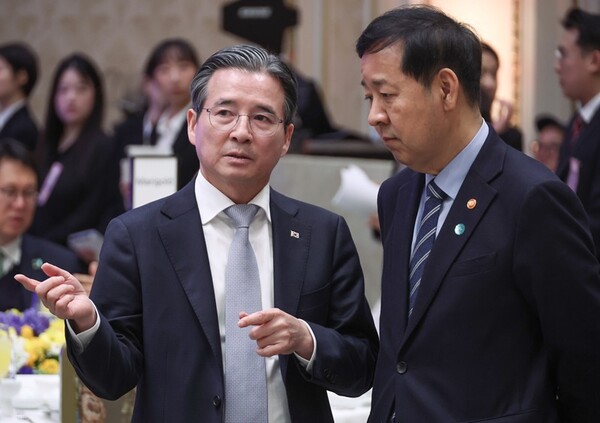
Blue House policy chief Kim Yong-beom used social media to criticize the credit-rating system and to call for steps to ease financial inequality. He said top-rated borrowers secure funds comfortably at low interest rates, while those just below them face a steep cliff of high rates, likening the structure to “a big doughnut with an empty center.”
The Kyunghyang Shinmun, in “Kim Yong‑beom’s confession of ‘cruel finance’ — may it lead to alternative credit assessments,” quoted Kim saying that a one‑point difference in credit scores that separates first‑tier banks from high‑cost markets is “less a product of statistical science than a simplification for operational convenience.” The paper noted that, as a former financial regulator who called himself a “clear accomplice,” Kim argued that banks and authorities must share responsibility. Kyunghyang added that the critique is valid and that producing precise alternatives will require a deep and broad public deliberation process.
By contrast, the JoongAng Ilbo warned in an editorial titled “Crack down on illegal private lending, but don’t undermine the foundations of the financial system” that equating credit ratings with social class and shaking the discipline of credit could leave financial institutions confused about risk management. The paper noted that delinquency and nonperforming loans are already showing warning signs and argued that protecting vulnerable groups should not threaten systemic stability. It pointed out that layered protections for vulnerable borrowers are already in place: the statutory maximum interest rate, which once exceeded 60% annually, has been lowered to 20% since 2021, and the government has implemented sizable, targeted, conditional debt restructurings.
The Hankook Ilbo, in “We need inclusive finance, but don’t destroy the essence of the credit system,” cautioned that labeling the credit system as a “class” and rejecting market order and interest-rate principles is dangerous. The paper argued that credit functions like prices in goods and services markets: it incentivizes positive behavior and helps allocate resources efficiently. Just as one would not deny prices exist because of some market failures, the existence of flaws in the credit system does not justify imposing disadvantages on high‑credit borrowers. Hankook recommended strengthening financial institutions’ social responsibilities and expanding support programs for ordinary citizens rather than undermining the credit system itself.
Daily criticism of Samsung strikes
Samsung Biologics has been on strike since the 1st. The walkout is scheduled to run five days through tomorrow, and the company estimates the damage at 640 billion KRW (480 million USD). The Samsung Electronics cross‑company union has announced plans for an 18‑day strike beginning on the 21st to demand bonuses in the semiconductor (DS) division. Many outlets have taken a critical stance toward the strikes rather than primarily amplifying union positions.
The Kookmin Ilbo, in “Big‑company unions mired in collective selfishness — where are coexistence and solidarity?,” accused some large‑company labor unions of succumbing to collective selfishness and diverging from traditional labor movement values. The paper said the Samsung Electronics union has refused to join broader federations and prioritized its members’ interests. It added that, despite President Lee Jae‑myung’s warning, the Samsung union leader dismissed his concerns by offering the odd defense that the issue was “something reported by (LG U+).” The paper warned that if organized workers make excessive demands that draw public ire, they risk harming not just their own unions but workers more broadly, and it suggested the Samsung union has not heeded those concerns.
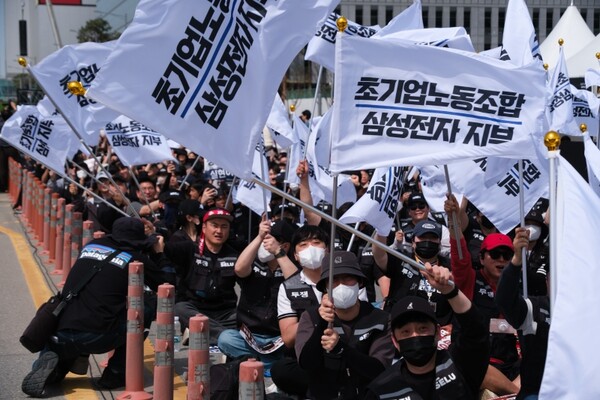
The Seoul Shinmun, in “‘Ecosystem of coexistence’… Without restraint from big‑company unions it’s just empty rhetoric,” noted that the Samsung cross‑company union emphasized “an ecosystem of coexistence where labor and management respect one another and can engage in dialogue” during a May Day ceremony on the 1st. The paper warned that if unions damage corporate competitiveness or deepen divisions among labor groups, public resentment will grow. In a labor market bifurcated between first‑tier jobs at major firms and second‑tier jobs at small firms and nonregular workers, solidarity among first‑tier participants is essential. The paper urged unions to actively pursue a “coexistence path” that includes suppliers and subcontracted workers instead of remaining an “insiders‑only league.”
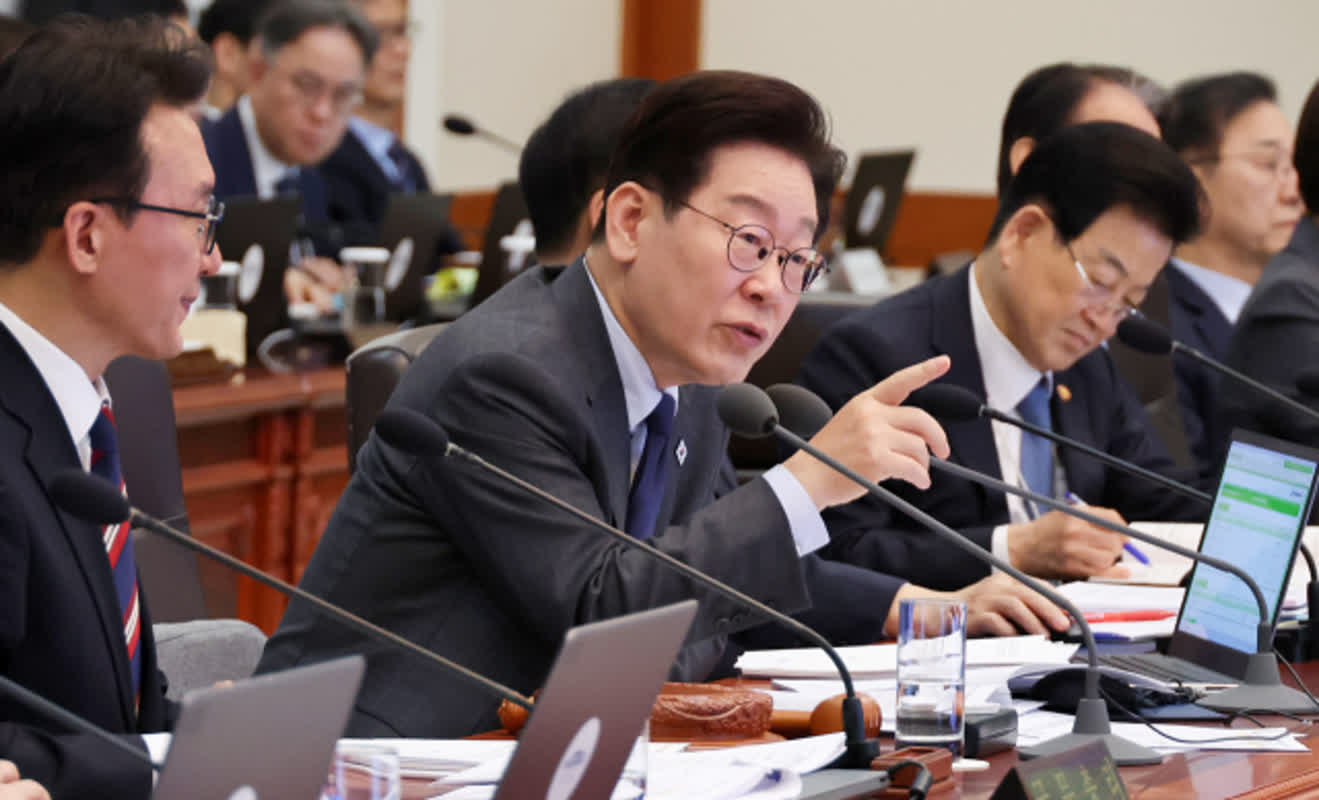
Conservative papers call President Lee’s call for deliberation on the special‑prosecutor bill a “campaign tactic”
Media coverage split over President Lee’s call for deliberation on the special‑prosecutor bill. While many outlets agreed there are legitimate concerns about the bill’s clause allowing cancellation of prosecutions, conservative papers also attacked the president’s call for more deliberation.
The JoongAng Ilbo editorial, “Delaying the special‑prosecutor bill for campaign purposes dupes the public twice,” argued that the move looks like an attempt to deceive the public. Lee Jun‑seok, leader of the Reform New Party, called it “a stall to deceive the public.” The paper summarized opposition as rooted in the view that the bill would create “a special prosecutor of the president, by the president, and for the president,” granting the special prosecutor authority to cancel prosecutions and thereby effectively offering the president a path to exoneration while punishing alleged perpetrators.
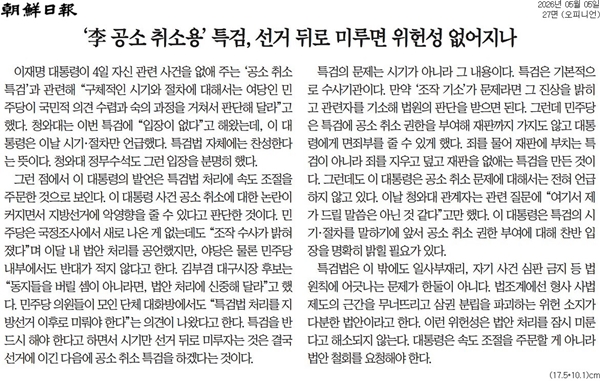
The Chosun Ilbo asked, “Does delaying the ‘to‑cancel‑Lee’s‑prosecutions’ special prosecutor make it any less unconstitutional?” and argued the core problem is substance, not timing. If fabricated indictments are at issue, the paper said, investigators should expose the truth and let courts decide. It criticized the Democratic Party for proposing to give the special prosecutor the authority to cancel prosecutions, which the paper said could allow the president to obtain exoneration without trials, and urged President Lee to clarify whether he supports granting that power before debating timing and procedures.
By contrast, the Hankyoreh, in “Democratic Party should fully gather public opinion on timing and substance of the special‑prosecutor law,” supported deliberation. The paper said that if the parliamentary probe into alleged fabricated indictments reveals prosecutorial abuse under the Yoon Suk‑yeol administration, a special prosecutor should fully expose the facts, and that if the evidence shows politically motivated fabricated prosecutions, cancelling charges could be warranted.
The Kyunghyang Shinmun also wrote that overcoming internal strife is a historic task entrusted to the Lee administration and the Democratic Party, and that arguing over canceling the president’s indictments now does little to advance that mission. Still, it urged the party to review timing and procedures and to remove from the bill the provision that grants the special prosecutor the power to cancel prosecutions, calling on lawmakers to take responsibility.
Other issues the media highlighted
The Segye Ilbo, in “Today is Children’s Day — toward a society where kids can run free,” reported that more than 90% of elementary schools nationwide designated May 4 — the discretionary holiday between Sunday, May 3, and Children’s Day — as a school holiday, a move welcomed most enthusiastically by private academies. Citing a 2023 child well‑being survey by the Ministry of Health and Welfare and the Korea Institute for Health and Social Affairs, the paper said 42.9% of children wanted to play with friends after school at playgrounds or PC bangs, but only 18.6% managed to do so. It argued that parents send children to academies because they lack time to play with them and called for expanded work–family balance policies so both parents and children can be happier.
The Hankyoreh, in “North Korea’s women’s soccer team visit should be used to reopen communication,” welcomed the news that North Korea’s women’s team will come to South Korea for an AFC tournament, noting this comes after nearly six years without meaningful exchanges since Pyongyang destroyed the Kaesong inter‑Korean liaison office in June 2020. The paper recalled that in 2021 North Korea boycotted a key remaining second‑round qualifier for the 2022 Qatar World Cup that South Korea was to host, and argued that since North Korea began framing relations as between “two hostile states” and asserting itself as effectively a nuclear power, inter‑Korean ties have faced major difficulties.
The Korea Economic Daily, in “Trump: We’ll extract ships from the Strait of Hormuz… expecting safe return of our 26 vessels,” reported that the U.S. has launched “Project Freedom” to rescue third‑country ships trapped in the Persian Gulf by Iran’s blockade. The paper said roughly 2,000 vessels and about 20,000 crew members have effectively been held hostage in the Gulf for more than two months, including 26 South Korean ships, and that shortages of food and drinking water have become serious with no clear timeline for release.
The Dong‑A Ilbo, in “‘Terminally ill refugees’ — 60,000 people… the long road to a ‘dignified death,’” noted that this is the seventh year South Korea has been a “many‑deaths” society, where annual deaths outnumber births, yet a peaceful, pain‑free death remains difficult to secure. The paper said 81,220 patients had life‑sustaining treatment withdrawn last year after recovery was deemed impossible, but only 30% died while receiving palliative care in hospice facilities. The remaining roughly 57,000 died after discontinuing life‑sustaining treatment while moving among nursing hospitals, their homes, and emergency rooms, experiencing pain and anxiety.
Media Today brings you an “AI News Briefing.” Knowledge‑content startup Underscore used generative AI to compare and recompile articles from major domestic media by issue. The article underwent review and editing by Media Today’s newsroom and received support from the Korea Press Foundation. (Editor’s note)