President Lee Jae-myung proposed limiting free public transit during rush hours as a way to encourage public transportation use and conserve energy amid fallout from the Middle East crisis. The Blue House said the idea was only a temporary measure and that officials had not discussed extending it as a long-term policy beyond the crisis.
Blue House spokesperson Kang Yoo-jung told reporters at a Chunchugwan press briefing on the 24th that energy-saving and austerity measures, including staggered work schedules for public agencies, were being considered with the ongoing repercussions of the Middle East war in mind.
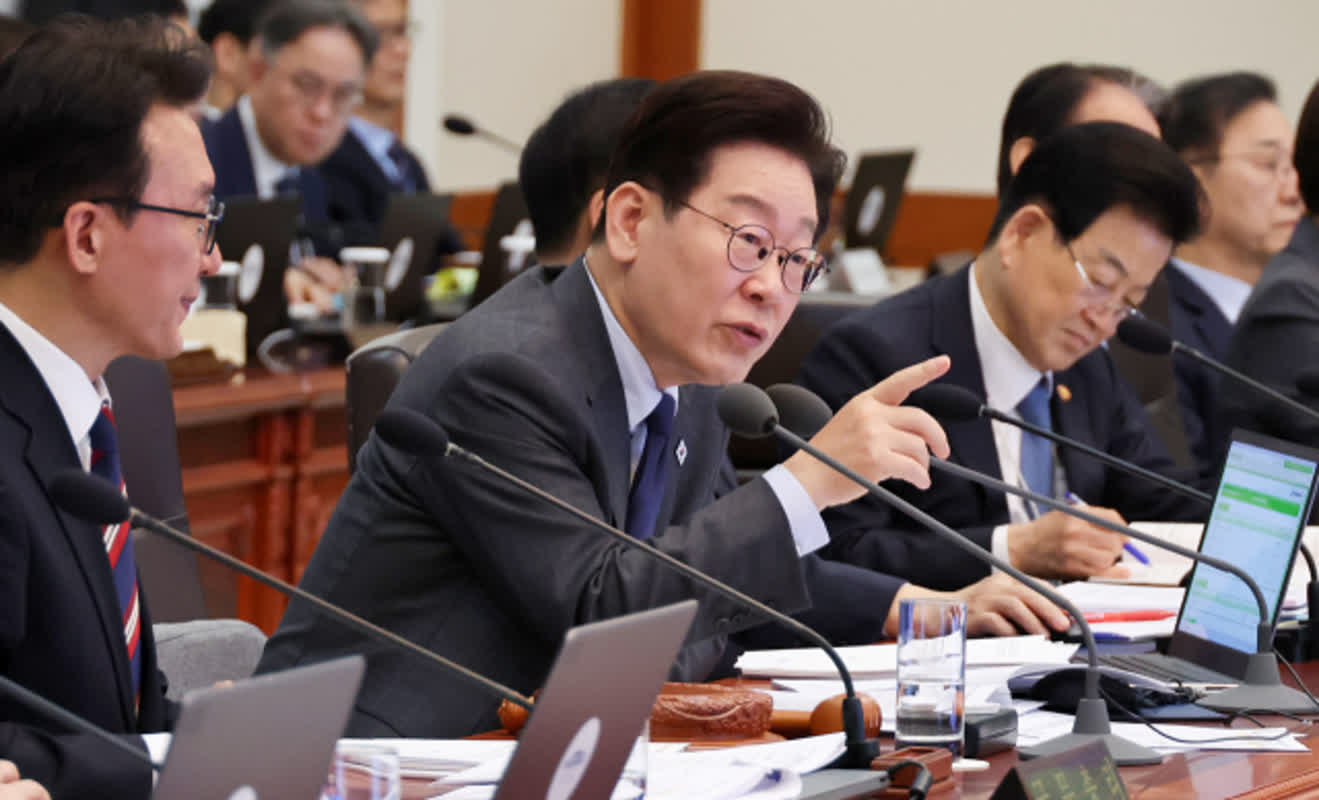
Earlier, at a Cabinet meeting, President Lee — while receiving a briefing on energy-saving measures from Minister of Climate, Energy and Environment Kim Seong-hwan — asked, "Commuter density is high during rush hour. Isn't that hard on office workers? What if we limited free rides for one or two peak commuting hours?"
When Minister Kim asked, "Do you mean seniors who ride for free?" the president replied, "For example." He added that some elderly people still commute to work, but suggested studying restrictions for those who travel just for leisure.
Kang said the president's comment was intended to explore options for reducing travel during fixed commute periods, and emphasized that "this was not discussed today as a permanent policy."
After the president's remarks at the Cabinet meeting became public, criticism emerged. Former Labor Minister and People Power Party presidential candidate Kim Moon-soo attacked the president on social media, saying, "The president doesn't ride the subway and doesn't understand the reality, yet he wants to restrict seniors' subway use." The Blue House's clarification appears to be a response to that backlash.
At the same Cabinet meeting, the president ordered a review of a comprehensive overhaul of the family-business inheritance deduction, saying large bakery cafés have been exploiting the system to avoid inheritance taxes. Kang said the president instructed relevant agencies to study whether a full reform and tighter rules are needed and to report back, noting that some large bakeries obtain tax breaks through loopholes in real estate inheritance.
Kang said the president questioned whether a 10-year threshold should qualify as a family business and raised concerns that tax benefits are being used to engineer tax reductions, citing examples involving major bakery chains.
He added that the president's remarks were not aimed solely at large bakeries but at a broader pattern of tax-avoidance tactics in business succession. He suggested the minister of SMEs compare family-business succession with corporate succession to assess whether lowering inheritance tax is justified and to tighten the system with careful, precise reforms.
On the size of the supplementary budget, a Blue House official said that if the government submits about a 25 trillion KRW package to the National Assembly, the Assembly will make the final decisions, and added that he expects it will remain at roughly the 25 trillion KRW level (approximately $18.75 billion).