The government has unveiled a national health promotion plan that adds new measures to monitor young people’s health and respond to the climate crisis.
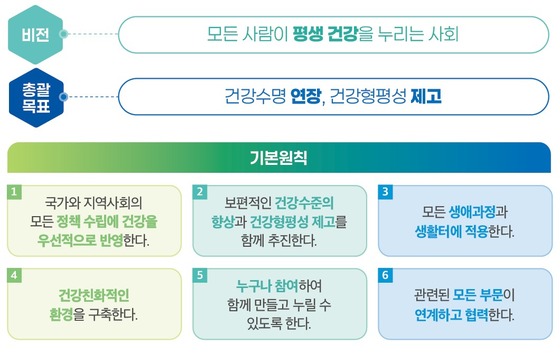
On the 27th, the Ministry of Health and Welfare said it convened the National Health Promotion Policy Deliberation Committee and approved the “6th National Health Promotion Comprehensive Plan.”
The comprehensive plan sets the government’s mid- to long-term health policy agenda. It is prepared on a 10-year basis and updated every five years. The previous, 5th plan—released in 2021—outlined policy directions and tasks through 2030.
The 6th plan was developed after a midterm review of policies implemented over the past five years and supplements those efforts with newly identified priorities.
According to the ministry, of the 64 core indicators in the 5th plan, 31 improved between 2018 and 2024. Improvements included smoking rates, participation in aerobic physical activity, and the share of households meeting food safety standards.
By contrast, 16 indicators deteriorated over the same period, including the suicide mortality rate, the prevalence of diabetes and obesity, and income-based gaps in older adults’ self-rated health.
In response, the ministry created seven subcommittees and identified 32 priority tasks focused on: guaranteeing young people’s health rights and reducing health disparities; establishing an integrated chronic disease management system; strengthening health management for the climate crisis; and designating health equity tasks and expanding indicators.
First, the ministry elevated youth health to a standalone priority. The plan expands mental health promotion, strengthens chronic disease prevention and management for young people, and establishes an integrated support system.
Concretely, the ministry will broaden mental health screening and coverage for initial treatment costs for all young people and provide services such as one-on-one online counseling for socially isolated or withdrawn youth.
Chronic disease has been designated as a separate priority as well, with plans to build a national integrated management framework. Measures include piloting primary care innovation projects for prevention and management and considering the formation of a Chronic Disease Management Committee.
To address climate change, the plan establishes a “Climate Crisis Health Management” subcommittee. It expands the scope of climate-related health impacts beyond infectious and heat- or cold-related illnesses to encompass chronic disease, mental health, and other areas, and seeks cross-government collaboration.
The ministry also plans joint interagency responses under the 6th plan, including risk assessments of novel tobacco products such as synthetic and non-nicotine variants.
For suicide prevention, local governments will designate suicide prevention officers and increase dedicated personnel. The plan also provides for a comprehensive psychological autopsy program covering all suicide deaths to inform prevention policy.
The government will expand the national network of dementia care primary physicians and develop a Korea-specific diagnostic tool.
Health management tasks will be tailored by population group: for infants and young children, the plan strengthens severity-based clinical care, transfer, and transport systems at maternal and child medical centers; for women, it will consider health promotion policies targeting underweight individuals.
Based on this plan, ministries will prepare implementation strategies and coordinate them with local governments’ regional health care plans and community-based integrated health promotion projects.