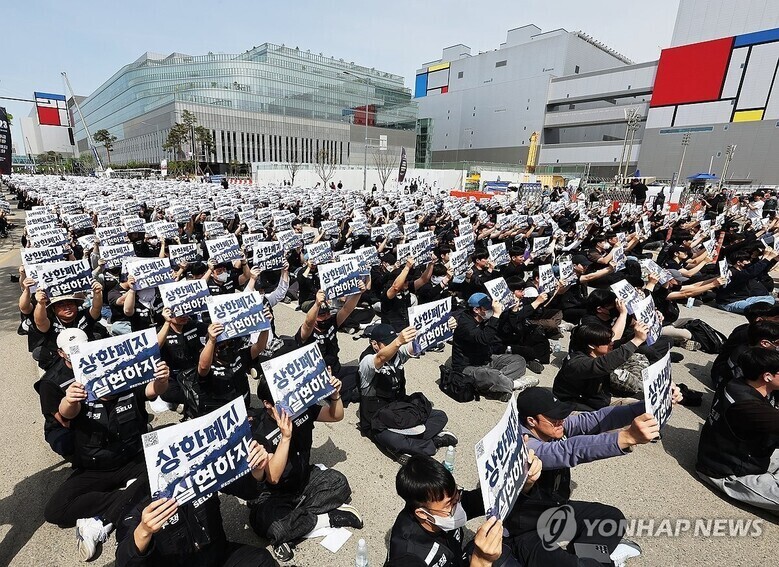
As concern mounts over the potential national economic fallout from a possible Samsung Electronics strike, critics argue that union leadership is avoiding accountability.
Choi Seung-ho, chair of the Samsung cross-company union for Samsung Electronics, responded on a members’ online community when asked whether the president’s comments were aimed at Samsung’s union: “He was referring to LG (Uplus).” Choi said the LG Uplus union is demanding 30% of operating profit, and that his union’s proposal of 15% is comparatively reasonable.
Earlier, at a senior aides meeting, the president said, “If some organized workers receive public criticism for excessive or unfair demands, it harms not only the union in question but other workers as well.” He did not name a specific company, but industry and political circles have largely interpreted the comment as referring to a potential strike by the Samsung Electronics union.
A Realmeter poll found that 69% of respondents considered a Samsung Electronics union strike “inappropriate,” citing concerns about excessive demands and weakened industrial competitiveness.
The government has also acknowledged the seriousness of the situation and moved to respond. The Blue House policy office is preparing an analysis of how a strike would affect South Korea’s economy, and Trade, Industry and Energy Minister Kim Jeong-gwan urged restraint, saying, “A strike in the semiconductor industry is hard to imagine.”
The union strongly rejected the characterization. Hong Gwang-heum, chair of the Samsung Group-wide union, sent a protest letter to Minister Kim Jeong-gwan, saying, “I express deep anger at the unbalanced view of labor-management relations in private companies,” and accusing the government of demonizing semiconductor workers.
Given Samsung Electronics’ weight in South Korea’s economy and the semiconductor sector’s strategic importance, the union’s demands and any move to strike risk escalating beyond a simple labor dispute into a national issue. With government and union positions still far apart, tensions across the industry are rising.
Most Read
- Samsung Electronics vows to “minimize production disruptions” after union warns of a general strike
- LG Electronics partners with Nvidia on AI robots, pushing for commercialization by 2028
- Public cool to Samsung strike: 7 in 10 say it’s “inappropriate”