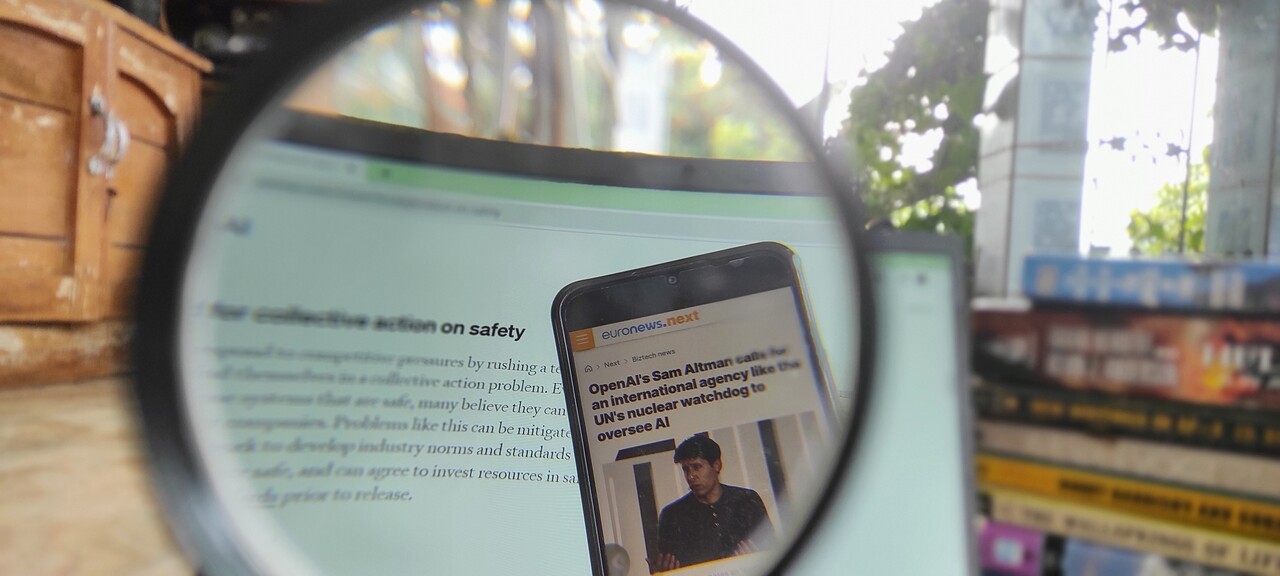
Sam Altman, CEO of OpenAI, referenced a New Yorker profile shortly after a Molotov cocktail was thrown at his home, drawing renewed attention to the piece. The New Yorker questioned Altman’s credibility and asked: can a technology that could shape humanity’s future be entrusted to someone who is hard to trust?
On April 6 (local time), The New Yorker published a feature titled “Moment of Truth” about Altman. The roughly 6,000-word article—more than 15 A4 pages—draws on interviews with more than 100 people close to him and more than 12 conversations with Altman himself.
Ronan Farrow, who won a Pulitzer Prize for reporting that exposed sexual-abuse allegations against Harvey Weinstein, co-wrote the story with Andrew Marantz, a writer focused on technology and politics.
The piece is structured in three sections. First, it presents an internal, previously undisclosed report detailing how board members—including Chief Scientist Ilya Sutskever—moved to remove Altman in November 2023. Next, it outlines how Altman allegedly rolled back the company’s alignment efforts intended to make AI safer. Finally, it raises concerns that the episode surrounding his firing led him to concentrate power to a degree that left him largely unchecked.
The article also highlights recent government contracts and OpenAI’s push to build expansive AI infrastructure.
It goes so far as to describe Altman as “unconstrained by truth.” The authors argue he is adept at using psychological tactics to charm people and recast his ambitions as a vision for humanity, but in doing so he abandoned many colleagues and core principles.
According to the article, numerous interviewees characterized Altman as driven by an unparalleled, relentless hunger for power. One anonymous board member said he combines a strong desire to please and win favor in any situation with an antisocial indifference to the consequences that can follow from deceiving others.
On that basis, The New Yorker asked whether Altman — who may play a defining role in our future — can be trusted.
.@RonanFarrow and @AndrewMarantz interviewed more than a hundred people with firsthand knowledge of how Sam Altman, the head of OpenAI, conducts business. They also obtained closely guarded documents that have not been previously disclosed.https://t.co/ZKsw6odyKw
— The New Yorker (@NewYorker) April 6, 2026
Altman reacted strongly to the article. In a blog post he cited the piece twice shortly after the Molotov attack.
“Words have power,” he wrote. “A few days ago an incendiary article about me appeared. Someone told me yesterday that publishing such a piece at a time when anxiety about AI is rising could make me more dangerous; I brushed off that warning.”
He also acknowledged that his conflict-avoidant personality contributed to the turmoil, adding, “I don’t take pride in failing to handle disputes with the previous board, which caused great turmoil at the company.”
San Francisco police have not released the suspect’s identity or motive. OpenAI declined to comment on the report.
Reporter Daejun Lim ydj@aitimes.com