Content every music lover will appreciate
Power and resistance, resistance and liberation
[Herald Economy = Juri Kim] Power builds discipline in the name of stability, and society endorses compliance with that discipline as maturity or reason. Yet history makes clear that social change rarely comes from conformity alone. Movements for women’s suffrage, labor rights, civil rights and antiwar protest were sometimes labeled disruptive or disorderly, but they ultimately forced the excluded into the public sphere.
For example, the 1848 Women’s Rights Convention in Seneca Falls, New York, challenged rules that confined political participation to male citizens and helped set the course for the ratification of the 19th Amendment in 1920, which institutionalized women’s suffrage. The May 1886 Haymarket protests in Chicago, where workers demanded an eight-hour day, rejected the imposed order of production and later became a symbol that reframed workers as bearers of rights rather than mere labor. And the Montgomery bus boycott, which began in 1955, undermined the system that justified racial segregation as “order” and became a decisive moment in the civil rights movement, repositioning Black citizens as equal public actors.
In that sense, resistance differs from simple rebellion. If rebellion is an immediate, irrational refusal of the existing order, resistance is the act by which subjects without a recognized language or place attempt to reposition themselves within society.
Resistance inevitably produces social discomfort. It disturbs the language of what is presumed stable and forces voices relegated outside the norm back into public hearing.
Popular music has often been one of the quickest arenas for that form of resistance to appear. Music frequently detects a period’s grievances and fractures before institutional politics or public discourse do. Blues, formed in Black southern communities from the late 19th century into the early 20th, voiced the fatigue of oppressed life. Folk music rose with 1930s labor struggles and the civil rights and antiwar currents of the 1960s to question war and state power. Rock, emerging in the mid-1950s, translated youth conflict with the establishment into sound and pushed it into public life. By the mid-1970s, punk compressed that conflict into a shorter, rawer, more immediate language. In these moments, music functioned not merely as an auditory sensation but as a medium through which generations and groups made their sensibilities visible.
But resistance does not always end in liberation. Efforts to break the old order can assume self-destructive or violent forms. The angrier the response to oppression, the more immediate and aggressive the expression; yet destruction does not automatically produce a new language. If resistance is a refusal and an incursion into the existing order, liberation requires acquiring a new language and a new position after that refusal. Resistance shakes the door; liberation builds a place to stand beyond it. To move from resistance to liberation, another element is always required beyond mere destruction.
I am an Antichrist
I am an anarchist
I wanna destroy the passersby
'Cause I, I wanna be anarchy
- Sex Pistols, \"Anarchy in the U.K.\" -
I am an anarchist
I wanna destroy the passersby
'Cause I, I wanna be anarchy
- Sex Pistols, \"Anarchy in the U.K.\" -
Punk, the most immediate way to disrupt discipline
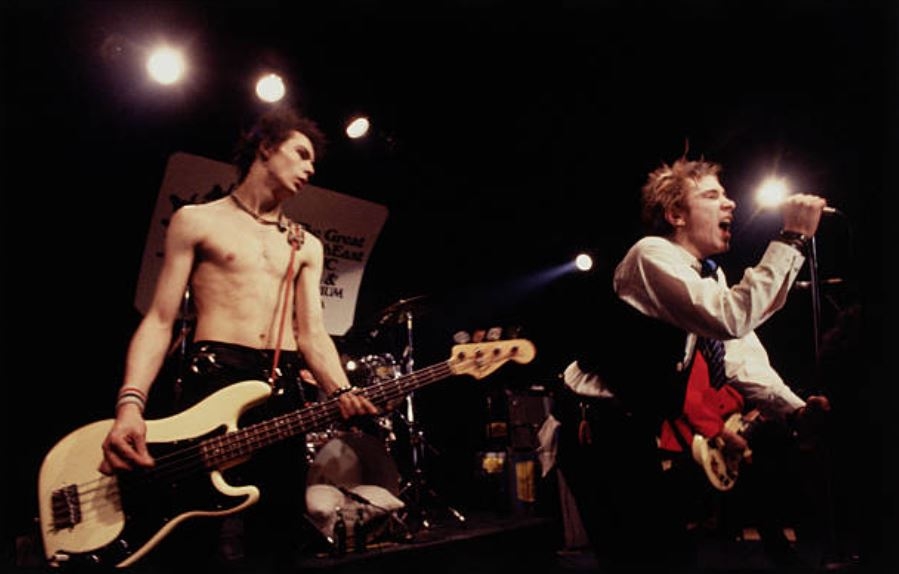
At the center of the late-1970s British punk movement stood the Sex Pistols. Despite a short career, the Sex Pistols became the rawest, most immediate example of alienated youth resistance in music history. Britain at the time suffered economic decline, youth unemployment, class resentment and deep distrust of established politics; the band’s music channeled that accumulated anger into sound.
The Sex Pistols attacked the accepted norms—decorum, restraint, patriotism, morality and musical virtuosity—head-on. They provoked controversy with coarse remarks on air, and their live shows could be violent and primal. Their resistance manifested as mockery, desecration, profanity, dissonance and rough physicality. For them, resistance was not about proposing an alternative view; it was a refusal to adopt the grammar of the existing order and a declaration that they would no longer remain within it. Their music valued shock over polish and invasion over persuasion.
They also upended the dominant trends represented by bands such as Led Zeppelin and Pink Floyd. In an era when technical perfection, elaborate arrangements, long running times and philosophical concepts served as markers of musical superiority, punk answered with raw chords, simple rhythms and blunt language. The crucial question became not how well you played but what you said in the here and now. Punk refused to make music the preserve of experts and returned the right to speak to the youth below the stage.
Yet that resistance also revealed punk’s limits. Punk exposed the falsity of order, the pretense of decorum and the hollowness of authority, but destruction is only the first act. Breaking a door carries force and urgency, but it does not automatically create a world beyond it. Rejecting an order and then constructing a sustainable new language are different tasks. When anger fails to translate into a sustaining language, resistance can easily slide into burnout, self-destruction or masochistic protest.
Punk’s raw energy clearly met a need among the youth of the time. The issue was what remained after the destruction. Mockery and wreckage can topple authority, but they do not by themselves build a grounded identity. Those who reject the old order need a language beyond negation to stand again.
Patti Smith occupies a distinctive place in that transition. She shared punk’s raw energy and the era’s ruptures but did not let resistance end in self-destruction. By disrupting the submissive image women were expected to project, challenging the male-dominated assumptions of rock, and blurring the boundaries between poetry and music, she showed that resistance can continue after destruction. If the Sex Pistols tore apart rules, Patti Smith built a grammar outside them that allowed her to exist.
Jesus died for somebody's sins, but not mine
Thick, heart of stone, my sins, my own
People said, “Beware”, but I don't care
Their words are just rules and regulations to me, me
- Patti Smith, \"Gloria\" -
Thick, heart of stone, my sins, my own
People said, “Beware”, but I don't care
Their words are just rules and regulations to me, me
- Patti Smith, \"Gloria\" -
Patti Smith: resistance as subjectivity against discipline
Patti Smith stood within the same ruptures as early punk but refused to push that energy toward destruction or self-consumption. Her resistance did not stop at smashing the established order; she invented a language the order had denied her.
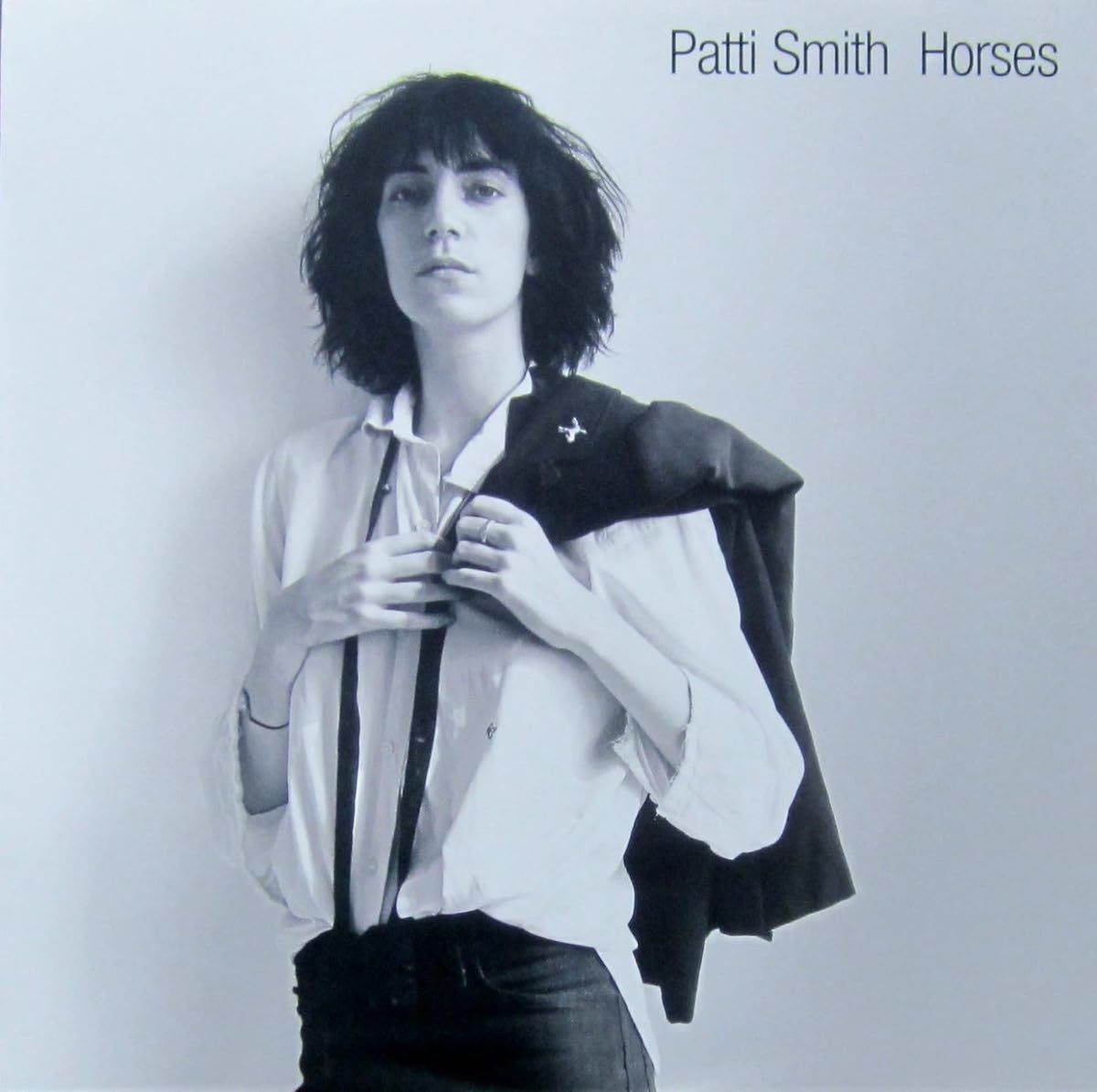
Her 1975 debut, Horses, marked the start. The album fused New York’s underground rock scene with poetry readings, spoken word and raw rock ’n’ roll energy. The U.S. Library of Congress describes Horses and Patti Smith as “the high priestess of punk” and “the laureate of rock,” noting the album’s literary, poetic and radical approach to rock and roll. Smith stepped aside from the masculine postures rock often demanded and from the compliant image expected of female singers. The striking black-and-white Horses cover, which presented Smith as neither clearly male nor female but as another kind of presence, is cataloged by the Library of Congress as an “unglamorized, androgynous image.”
Her voice likewise refused to conform to existing rules. Patti Smith did not aim to “sing well” in the conventional sense. Her vocals moved between song and recitation, shout and murmur, prayer and proclamation. In “Gloria” she pushes phrases like speech—shaping rhythm by force and turning sentences into musical energy rather than following a standardized rock melody. On “Birdland,” that approach becomes even more extreme: the track does not follow tidy melody but functions as a single utterance where speech, screams, rhythm and hallucination collide. Her voice was not meant to sound conventionally beautiful; it existed to bring into being a language the musical order had not allowed.
This strategy was disruptive without being violent. Patti Smith dismantled genre boundaries, unsettled gender norms, and brought religious imagery, street language, poetic lines, rock’s physicality and the voice of social resistance onto the same stage. But she did not destroy herself in the process; she constructed a new grammar that allowed her to exist. For her, resistance did not end in shouting “no.” It asked, “If not that, in what language will I exist?”
In this respect, Patti Smith surpassed punk’s limits through self-constituted subjectivity. While the Sex Pistols ripped the order to expose the violence of norms and oppression, Patti Smith reorganized what the order had denied into a new artistic language. She rewrote the role of the female rock vocalist, proved that poetry could be rock and that rock could be a manifesto, and showed that a single voice can unsettle a genre’s boundaries.
Fundamentally, her resistance resembled self-construction more than self-destruction. Smith gathered languages pushed outside discipline and rearranged them into a place for herself. If punk broke the door, Patti Smith built the sentence she could stand on beyond it. At that moment resistance takes on the contours of liberation: liberation occurs when someone can speak without borrowing society’s language and refuses to let their voice be consumed by destruction.
the shepherds and the soldiers
lay beneath the stars
exchanging visions and laying arms
I awakened to the cry
- Patti Smith, \"People Have the Power\" -
lay beneath the stars
exchanging visions and laying arms
I awakened to the cry
- Patti Smith, \"People Have the Power\" -
 Resistance’s social role begins with cracking the established order. It unsettles rules society treats as natural and pulls those pushed outside the rules back into the public arena. In that sense, resistance is uncomfortable, rough and subversive from the old order’s perspective, but it can also propel society forward.
That is why the Sex Pistols’ punk mattered. They directly challenged the social conformity the establishment demanded and exposed Britain’s fractures in the 1970s. That shock was necessary: someone had to tear the surface of order so the simmering anger and exclusion beneath could become visible.
But when resistance remains only shock, it quickly burns out. Rejecting the old language and then crafting a new language to explain oneself are not the same. Destruction can reveal structures of oppression, but it will not automatically create a place for a person to stand again. Resistance therefore always requires what comes next: composition after negation, form after anger, a place after the incursion.
Patti Smith reached that “what comes next.” She channeled punk’s energy to target worn social norms without driving it into self-destruction. Instead, she rearranged poetry and music, recitation and song, femininity and masculinity, the sacred and the profane—creating conditions for her own speech. Her music was both a refusal of the old rules and a form that could endure beyond that refusal.
Patti Smith’s example highlights the gap between resistance and liberation. Resistance opposes the established order; liberation comes when, after opposition, someone no longer relies on others’ definitions and refuses to let even their voice be consumed by destruction. Smith did not collapse inside the cracks punk opened; she used language and music to build her place.
That is why her legacy is more than a punk legend or intense music. Patti Smith showed that resistance need not consume a person. Rather than destroying herself, she resisted by refusing to conform and asserted subjectivity to challenge oppression and outdated norms.
The moment resistance approaches liberation is when someone aligns themselves with a language the powers did not permit.