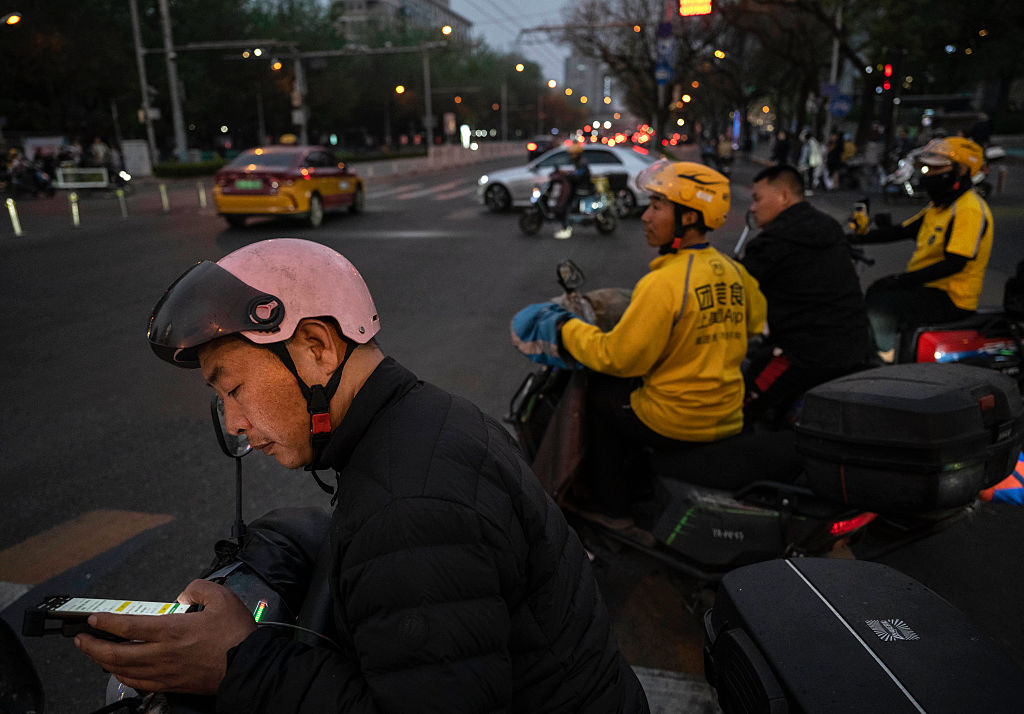
 [Herald Economy reporter Doh Hyun-jung]“Platform fees are too high. Some services charge a base fee and then a separate delivery surcharge, so even for an 8-yuan delivery (about 1,700 KRW), drivers take home only 5.1 yuan (about 1,000 KRW).”“When disputes arise, platforms often punish drivers without properly hearing their side. Not every complaint should be decided solely from the passenger’s perspective.”Those are typical grievances from online platform workers—the most visible segment of the gig workforce, made up of short-term laborers hired per task or under brief contracts. As youth unemployment has soared in China, the number of platform workers has surged, but pay and protections have not kept pace. Chinese authorities have moved to address those gaps.Local media, including Xinhua, reported that the State Council and the Communist Party Central Committee recently published a plan to protect nonstandard workers on online platforms. The 12-point plan emphasizes timely and fair wage payments, stronger social security coverage, reinforced protections during severe weather, and greater transparency in how platforms assign orders, set fees, and impose time limits.Xinhua said authorities aim to standardize labor practices across the platform economy by next year.Officials stepped in because the gig economy has rapidly become a major pillar of the broader economy, yet unreasonable labor practices have provoked growing public discontent. China’s youth employment situation is acute: as of March, the urban youth unemployment rate reached 16.9%. The unemployment rate for 25- to 29-year-olds—those typically finishing higher education and entering the job market—hit 7.7%, the highest since the metric was revised at the end of 2023.With young people struggling to find stable jobs, many have turned to so-called flexible work on online platforms. Official data indicate that more than 200 million people—over 27% of China’s labor force—are now engaged in gig work through online platforms.But the rapid expansion has produced distorted compensation systems on major tech platforms. Chronic problems cited by workers include low pay, weak protections, and heavy workloads.Niu, a ride-hailing driver in Mengzi, Yunnan Province, told the South China Morning Post, “Even if I stay online waiting for orders for 10 hours a day, I only earn 130–150 yuan (about 28,000–32,000 KRW). After paying for charging and other expenses, the platforms’ fee rates are just too high.”The SCMP also quoted Wu, a driver in Hangzhou, who said platforms often set unreasonably low per-order fees and move too quickly to penalize drivers in disputes.Under the new protection plan, authorities require platforms to improve dispute-resolution procedures. When customers file complaints, platforms must conduct fair appeal processes and correct structures that disadvantage workers. Officials also pledged to address the distorted income models that emerged as food-delivery services engaged in aggressive low-price competition in recent years.
Gig Economy in China: How New Labor Protection Plans Will Change the Game for Workers in 2026
Dohyun Jeong | 2026.05.02
[Herald Economy reporter Doh Hyun-jung]“Platform fees are too high. Some services charge a base fee and then a separate delivery surcharge, so even for an 8-yuan delivery (about 1,700 KRW), drivers take home only 5.1 yuan (about 1,000 KRW).”“When disputes arise, platforms often punish drivers without properly hearing their side. Not every complaint should be decided solely from the passenger’s perspective.”Those are typical grievances from online platform workers—the most visible segment of the gig workforce, made up of short-term laborers hired per task or under brief contracts. As youth unemployment has soared in China, the number of platform workers has surged, but pay and protections have not kept pace. Chinese authorities have moved to address those gaps.Local media, including Xinhua, reported that the State Council and the Communist Party Central Committee recently published a plan to protect nonstandard workers on online platforms. The 12-point plan emphasizes timely and fair wage payments, stronger social security coverage, reinforced protections during severe weather, and greater transparency in how platforms assign orders, set fees, and impose time limits.Xinhua said authorities aim to standardize labor practices across the platform economy by next year.Officials stepped in because the gig economy has rapidly become a major pillar of the broader economy, yet unreasonable labor practices have provoked growing public discontent. China’s youth employment situation is acute: as of March, the urban youth unemployment rate reached 16.9%. The unemployment rate for 25- to 29-year-olds—those typically finishing higher education and entering the job market—hit 7.7%, the highest since the metric was revised at the end of 2023.With young people struggling to find stable jobs, many have turned to so-called flexible work on online platforms. Official data indicate that more than 200 million people—over 27% of China’s labor force—are now engaged in gig work through online platforms.But the rapid expansion has produced distorted compensation systems on major tech platforms. Chronic problems cited by workers include low pay, weak protections, and heavy workloads.Niu, a ride-hailing driver in Mengzi, Yunnan Province, told the South China Morning Post, “Even if I stay online waiting for orders for 10 hours a day, I only earn 130–150 yuan (about 28,000–32,000 KRW). After paying for charging and other expenses, the platforms’ fee rates are just too high.”The SCMP also quoted Wu, a driver in Hangzhou, who said platforms often set unreasonably low per-order fees and move too quickly to penalize drivers in disputes.Under the new protection plan, authorities require platforms to improve dispute-resolution procedures. When customers file complaints, platforms must conduct fair appeal processes and correct structures that disadvantage workers. Officials also pledged to address the distorted income models that emerged as food-delivery services engaged in aggressive low-price competition in recent years.
Recommended Posts
Why 95% of Koreans Support Agricultural Cooperative Reforms: Key Findings Revealed

How Sunchang County is Revolutionizing Transport for Seniors and Disabled: A 2025 Guide
15 Billion Won Special Grant Secured: How Imsil County Enhances Disability Support and Disaster Response
Inside the Samsung Biologics Stalemate: Key Demands and Future Implications

Should South Korea Raise the Age for Basic Pension? 60% Say Yes!
Incheon Labor Abuse: Special Oversight Launched After Assault on Foreign Worker
Latest Popular Posts
Real-time TOP