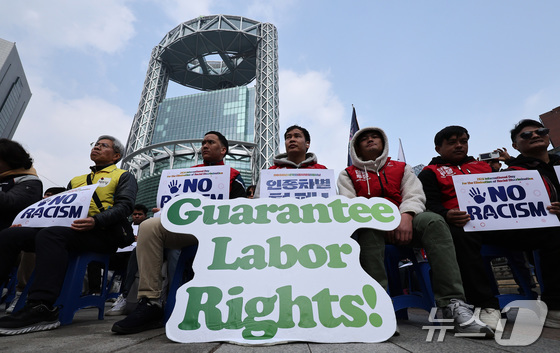
With the U.N.-designated International Day for the Elimination of Racial Discrimination approaching on March 21, migrant rights groups nationwide called for a comprehensive anti-discrimination law to end bias and guarantee basic rights.
Civil society organizations, including the Coalition for Enacting an Anti-Discrimination Law and migrant-rights groups, held a rally and march on the afternoon of March 15 in front of Boshingak in Jongno, Seoul, to mark the 2026 observance.
Udaya Rai, chair of the Migrant Workers’ Union (MTU), said legal and institutional discrimination, employers’ profit-seeking, and society’s indifference perpetuate bias against migrants and leave migrant workers’ basic rights entirely unprotected.
“Dangerous and poor working conditions, unfair treatment by employers, harassment, forced low-wage labor and repeated industrial accidents continue,” he said. “Seasonal programs administered by the Ministry of Justice, E7-3 visa holders and seafarers face huge sending fees and ongoing trafficking because of manpower agencies and brokers.”
Ko Gwang-min, a lawyer at the Migrant Center Chingu, argued that bringing in seasonal workers only when needed and sending them home after harvests is not simply a labor-policy failure but a form of racial discrimination. “Tying workers to debt, controlling them through passports and restricting their freedom resembles human trafficking,” he said.
He urged authorities to recognize seasonal workers as rights-bearing individuals rather than objects of control and to guarantee migrants’ freedom of movement and labor rights.
The groups warned that recent remarks by politicians and prominent public figures targeting Chinese nationals and ethnic Chinese migrants have served to legitimize and amplify hate, threatening migrants’ daily lives and personal safety. They stressed that the most serious problem is the absence of basic legal instruments defining and prohibiting racial discrimination in South Korea.
Noting that international bodies have repeatedly urged Korea to adopt a comprehensive anti-discrimination law, the groups said the country has yet to implement those recommendations. They demanded full freedom for migrant workers to change workplaces, legal protections for migrant women and children and adolescents, and passage of a comprehensive anti-discrimination statute.
After the rally around Boshingak, participants marched past Gwanghwamun and the Government Complex Seoul, then proceeded toward the Blue House.