Targeting real estate pledges… Lacks realism vs. Distorts facts
Clash over the 'Success Bus'… Heated exchanges on trash policy and other issues
All three candidates court 'Myung's endorsement'… Main primary begins on the 7th
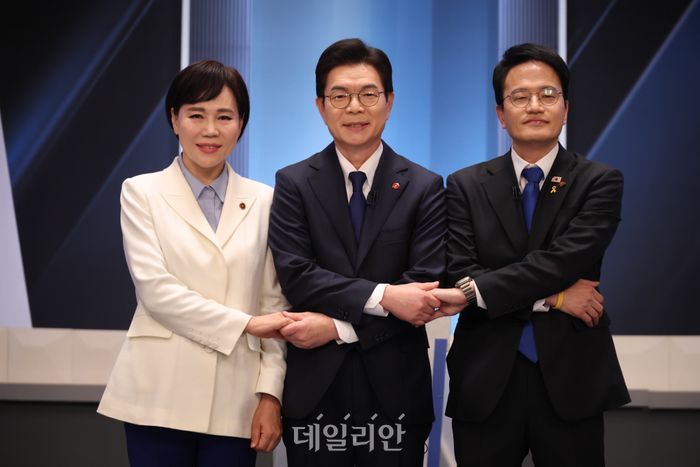
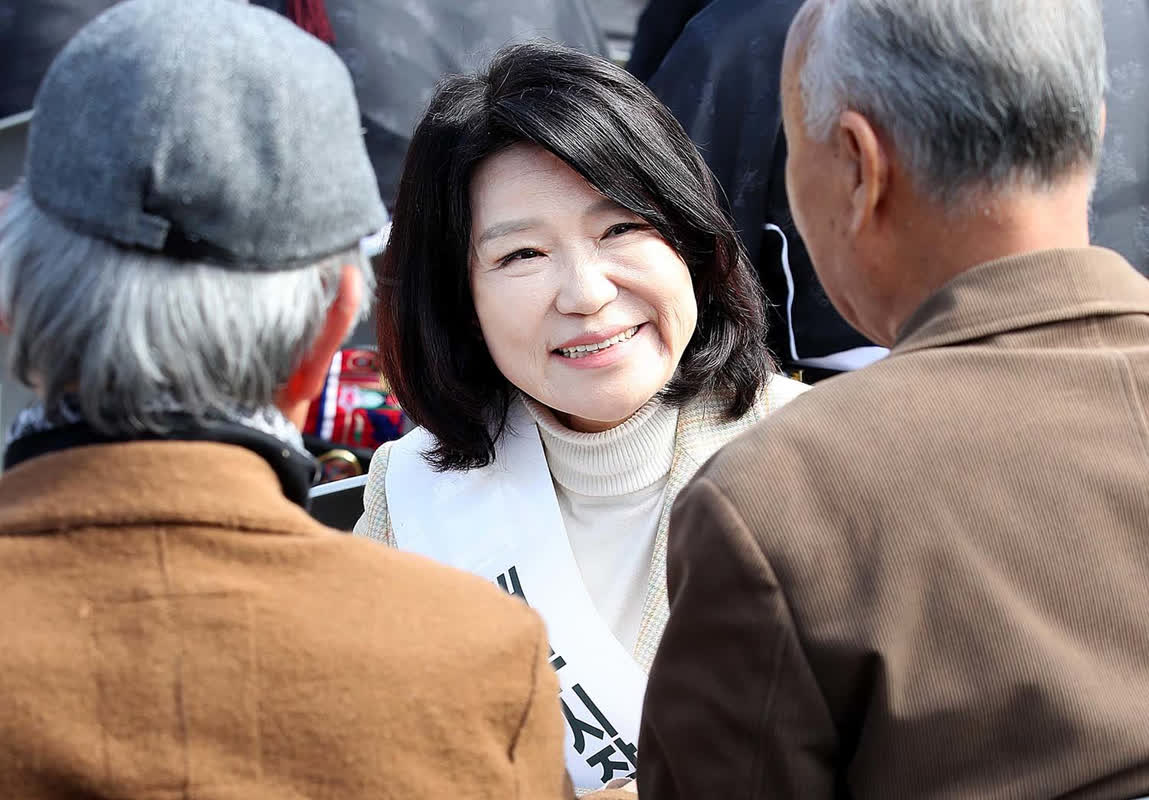
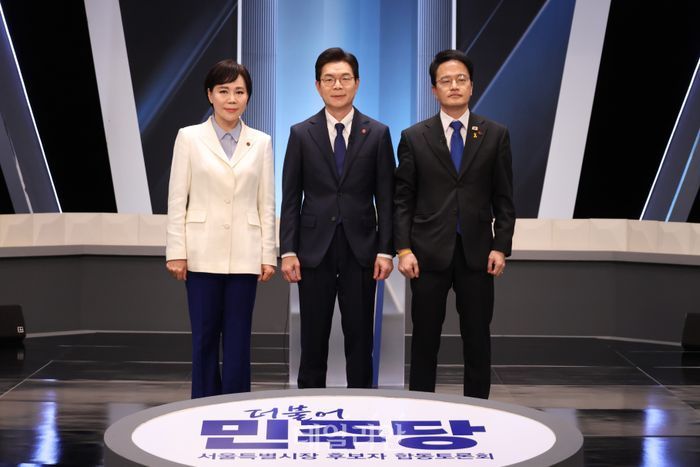
In the final TV debate to select the Democratic Party’s nominee for Seoul mayor, candidates Jeon Hyun-hee and Park Joo-min launched sharp attacks at front-runner Jung Won-oh. The two intensified their challenge to block Jung — who leads several polls and is viewed by some as President Lee Jae-myung’s preferred choice.
Jeon, Park and Jung (in ballot order) each told the KBS audience on April 3 that they were the party’s best option for the June 3 local elections, emphasizing their competitiveness in the general election.
The debate’s most heated battleground was housing policy. Jeon targeted Jung’s signature proposal for “practical private apartments,” arguing that residents in Seoul reconstruction projects would be unlikely to choose those units and that private developments often take more than a decade to complete. “It’s a nominally ‘practical’ plan that lacks realism,” she said.
“There aren’t many announced pledges,” Jeon added. “We need concrete policies to debate and evaluate — that’s disappointing.”
Park joined the criticism, asking whether selling units that the public sector could hold and rent runs counter to President Lee’s or the Democratic Party’s philosophy.
Park also questioned Jung’s pledge to supply 23,000 public rental homes during his term, noting that Mayor Oh Se-hoon plans to provide more than 24,000 public rentals in 2026 alone. “Jung is promising fewer units across four years than Mayor Oh plans to deliver in a single year,” Park said, suggesting Jung’s housing philosophy and policy direction differ from the party’s and appear weaker than Oh’s.
Jung swiftly rebutted: “The 23,000 figure refers only to youth housing; the total is 140,000 households.”
They also clashed over Jung’s “Success Bus” (a Seongdong-style public bus). Jeon called it a populist, law-skirting gesture indistinguishable from Mayor Oh’s Han River bus proposal, while Park raised concerns about overlap with existing routes. Jung defended the plan as a model for revitalizing public transit and said it does not violate the law.
On metropolitan-area waste management, the candidates offered divergent solutions. Jeon proposed district-level responsibility for waste and collaborative models with neighboring districts. Park advocated a metropolitan resource-circulation strategy negotiated among Incheon, Gyeonggi Province, and the central government. Jung highlighted Seongdong District’s waste-reduction achievements and said he would expand that recycling-centered “Seongdong model” across Seoul to reduce overall waste generation.
Because this is a party primary, candidates also competed to emphasize ties with President Lee in what they framed as “Myung-endorsement” messaging. Park cited his record of working with the president to deliver results. Jeon argued that President Lee’s vision of a fairer society aligns with her idea of a basic, inclusive Seoul. Jung sought to distinguish himself, saying, “For me, the mayor’s office is not a stepping stone to the presidency. I will focus solely on serving citizens.”
The Democratic Party’s Seoul mayoral primary will proceed from April 7 to 9 after two debate rounds. The outcome will be determined equally by party-member votes and public opinion polls (50% each). If no candidate secures a majority, the top two will advance to a runoff from April 17 to 19 to decide the final nominee.
© Dailyan Co. All rights reserved. Unauthorized reproduction and redistribution prohibited.