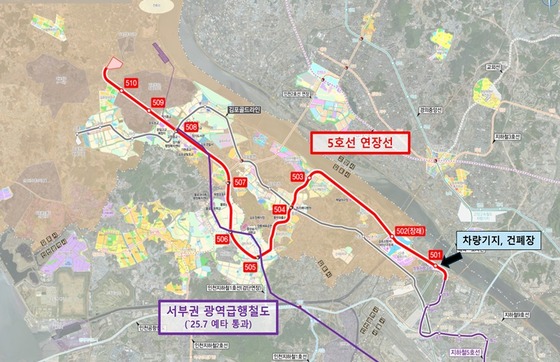
The Ministry of Land, Infrastructure and Transport announced on the 10th that three projects — the Seoul Line 5 extension to Gimpo and Geomdan, the Gadeokdo New Airport rail connection, and the Wirye–Sinsa Line construction — have secured feasibility and passed the preliminary feasibility study (예타), and will now proceed in earnest.
Seoul Line 5 extension to Gimpo and Geomdan will ease transit demand
The Seoul Line 5 extension is a regional rail project that will link Banghwa Station (Line 5) in Seoul through Incheon’s Geomdan New City to the Gimpo Hangang 2 Compact City district, covering roughly 25.8 km with 10 stations. Designated as a presidential regional pledge to strengthen west‑side links to Seoul, the project is expected to relieve pressure on the crowded Gimpo Goldline.
After the project was included in the 2024 4th Metropolitan Area Wide-area Transport Implementation Plan, authorities launched the preliminary feasibility study in September of that year. The ministry played an active role mediating route disagreements among local governments and identifying ways to improve the project’s economic viability, and those efforts culminated in the 예타 approval.
Once completed, the Line 5 extension should reduce travel time between Gimpo Hangang 2 New Town and Banghwa Station by about 31 minutes (from 57 to 26 minutes) and between Gimpo Hangang 2 New Town and Seoul Station by about 31 minutes (from 87 to 56 minutes). Congestion on the Gimpo Goldline is projected to ease to below 160% capacity.
With the preliminary feasibility study cleared, Gyeonggi Province plans to begin the basic planning study within the year and will move quickly through subsequent steps such as detailed design and construction.
Gadeokdo New Airport rail link will improve access from Busan and Ulsan
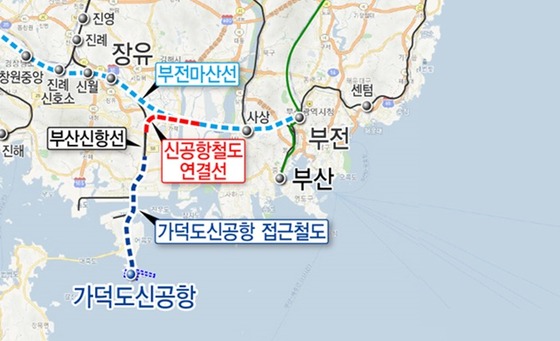
The Gadeokdo New Airport rail connection will directly link Ulsan and downtown Busan to the new airport without transfers, significantly improving access to Gadeokdo New Airport.
After the project was included in the 2021 4th National Railroad Network Construction Plan, officials launched the preliminary feasibility review in February 2024. The project passed the review following comprehensive evaluations, including cost‑benefit (B/C) and policy analyses.
The plan calls for a new 6.58 km connecting line (a triangular link) to join the under‑construction Bujeon–Masan double‑track line with the existing Busan New Port line. Total project cost is estimated at 602.5 billion KRW (approximately 451.9 million USD).
If implemented, ITX‑Maeum trains will operate the 101.7 km section from Ulsan’s Taehwagang Station to Gadeokdo New Airport Station at 25‑minute intervals. Travel time from downtown Busan (Bujeon Station) to the new airport will be about 26 minutes, and from downtown Ulsan (Taehwagang Station) about 92 minutes, materially improving airport access for residents of Busan and Ulsan.
Wirye–Sinsa Line will improve access between Wirye New Town and Gangnam
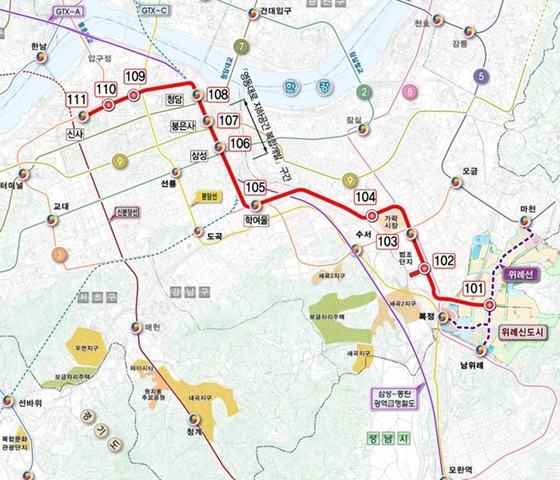
The Wirye–Sinsa Line is a 14.8 km urban light‑rail project that will run from Wirye New Town through Samseong Station (the Gangnam central business district) to Sinsa Station (Seoul Line 3).
Initially planned as a private investment project under Seoul’s 2015 urban rail network plan, the scheme was converted to public funding after conditions changed. Officials launched the preliminary feasibility review last May.
The project is listed among presidential regional pledges and Wirye New Town’s metropolitan transport improvement plan as a core measure to improve public transit convenience and reduce congestion.
Once operational, the line will link Wirye New Town directly to Seoul’s Gangnam area, including Samseong and Sinsa stations. Travel time from Wirye Jungang Station to Samseong Station is expected to fall by about 34 minutes (from 48 to 14 minutes), and to Sinsa Station by about 32 minutes (from 56 to 24 minutes).
The project will also enhance transfer connectivity with Seoul’s transit network (the Wirye Line and Lines 2, 3, 7, 8, and 9) and the Shinbundang Line. Through connections with GTX‑A and GTX‑C, it should help expand a regional rail network linking the entire Seoul metropolitan area.
Seoul plans to commission the basic planning study it prepared alongside the 예타 process and will rigorously prepare remaining steps such as detailed design and construction to avoid any gaps in implementation.
Kim Yong‑seok, chair of the Ministry’s Metropolitan Area Wide‑area Transport Committee, said, “With this 예타 approval, we expect public‑transit convenience to improve in the northwest of the Seoul metropolitan area, including Gimpo and Geomdan, and in the southeast, including Wirye New Town.”