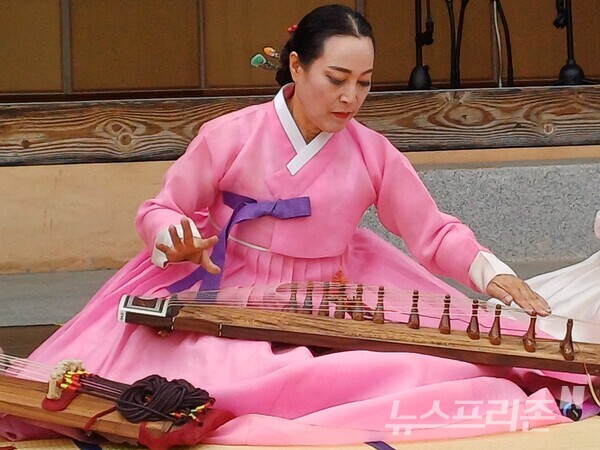
A clear gayageum melody spills across the wooden floor of a hanok in Jeonju, a city with a thousand years of history. A phrase that begins at the fingertips soon becomes voice, and the rhythm moves with the performer’s breath.
We sat down with Joo Jeong‑su, the designated holder of the National Intangible Cultural Property for Gayageum Sanjo and Byeongchang, who has devoted his life to gayageum byeongchang—a tradition that fuses Korean vocal and instrumental music.
“Tradition shouldn’t be confined to museums; it must live on stage and in our everyday lives,” Joo told me. He described the allure of byeongchang—the act of playing the gayageum while singing—as, in his words, “a conversation with oneself.”
“Sound and melody don’t go their separate ways; they must become one. The hands, the voice and the heart must move together,” he said.
His path into gugak began with the resonance of traditional sound he heard as a child. What started almost by chance became his life’s work. Through relentless practice and years of inner cultivation, he said, he found his own musical voice.
“At first, even touching the strings felt like a struggle. Then, at some point, the gayageum began to lead me. It was then I realized that tradition isn’t learned intellectually but embodied,” he recalled.
Gayageum byeongchang resembles pansori but carries its own distinct appeal. “If pansori is the force of storytelling, byeongchang is the balance of melody and breath,” he explained—adding that because instrumental and vocal elements unfold within a single body, the form demands intense focus and discipline.
Working from Jeonju, he emphasized the strength of local culture.
“Jeonju is a place of hanok, hanji and song. It’s a city with deep traditional roots. The gayageum that sounds here gains a certain solidity because of that,” he said.
Asked about his most memorable performance, he smiled briefly.
“There are moments when the audience’s eyes change. I feel the deepest reward when I sense my sound has reached their hearts,” he said.
He stressed that preserving tradition is not merely about conserving the past.
“True succession, I believe, is not fearing change while never forgetting your roots,” he said.
He also made clear his commitment to training the next generation, saying his role is to ensure gugak does not feel foreign or inaccessible to young people.
“Gayageum byeongchang is by no means old‑fashioned. It’s a living art. I hope younger generations can encounter and enjoy our tradition naturally,” he added.
Closing the interview, he offered a short but weighty observation.
“Pop and trot dominate the charts these days, but if we listen for the roots of our culture and the rhythms of life, we can find answers there. Tradition must keep breathing—on stage and in our daily lives.”