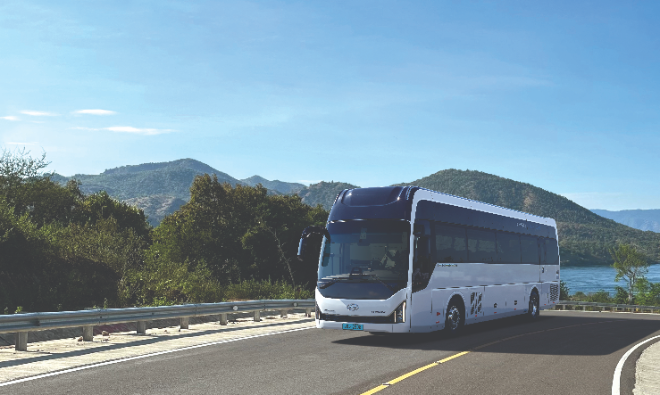
Hyundai announced on April 2 that its cumulative domestic sales of eco-friendly hydrogen-electric buses reached 3,062 units as of the end of March 2026, surpassing the 3,000 mark.
Hyundai began hydrogen-related R&D in 1998 and has since developed competitive hydrogen mobility technologies. Building on that foundation, the company has led the hydrogen commercial-vehicle market with the world’s first city hydrogen-electric bus, the Elec City FCEV (2019), and the highway-focused Universe FCEV (2023).
Hyundai’s hydrogen-electric bus sales reached 1,000 units domestically in 2024, passed 2,000 in 2025, and exceeded 3,000 this month.
The rise reflects growing demand for hydrogen buses across city routes and commuter services, combined with strong commitments from local governments to expand hydrogen-bus fleets.
The Elec City FCEV is equipped with a 180 kW hydrogen fuel-cell system, a 180 kW motor with peak torque of 4,500 N·m, and a 78.4 kWh high-output lithium‑ion battery.
With an efficient motor, a high-performance fuel-cell system, and class-leading hydrogen tank capacity, the Elec City delivers up to 751.2 km (about 467 miles) on a single fill under official efficiency standards.
The Universe FCEV pairs a 180 kW hydrogen fuel-cell system with a 350 kW motor producing up to 1,800 N·m of torque, backed by a 48.2 kWh high-output lithium‑ion battery.
It is the world’s first to use an MR (magneto‑rheological) damper and control logic that reduces lateral and longitudinal body sway, improving stability and ride comfort. Its single-fill range is up to 960.4 km (about 597 miles).
To broaden hydrogen mobility, Hyundai Motor Group is also increasing hydrogen-bus adoption internally. The group currently operates 74 hydrogen-electric commuter buses across its nationwide business sites and plans to add 55 more this year. Hyundai aims to convert its entire commuter-bus fleet to hydrogen-electric vehicles by 2030.
Hyundai plans to expand commercial electrification after-sales and service centers to more than 40 locations to support wider deployment of hydrogen-electric buses.
Policy and infrastructure support for hydrogen-bus expansion is also progressing. National subsidies for hydrogen-electric buses in 2026 cover 1,800 units. There are currently 80 large-capacity hydrogen refueling stations in operation, with 21 more scheduled for completion in 2026.
A Hyundai spokesperson said, “We will lead the eco-friendly commercial-vehicle market by expanding domestic deployment of hydrogen-electric buses, and we will continue working to grow the hydrogen mobility ecosystem.”
{vi27}