|
Seoul announced on April 26 that it had finalized the integrated plan for the Sillim-dong 306 site in Gwanak-gu.
The site has remained an aging, low-rise residential area since it was developed in the 1970s, and there have been persistent calls to improve living conditions.
Although the neighborhood was designated as the Sillim Redevelopment Promotion District in 2006 and saw housing-improvement projects from 2016 to 2023 — including road paving and new community centers — it continued to suffer from substandard conditions.
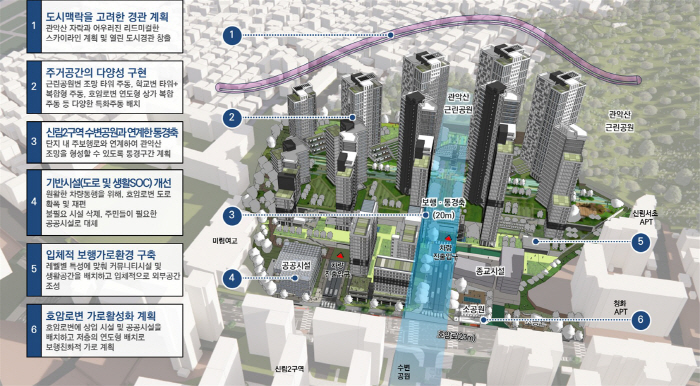
To transform the area into a forested, restorative residential district, the city established three planning principles: (1) integrate Gwanaksan’s greenery with urban vitality; (2) create multi-level living spaces that harmonize with surrounding areas; and (3) build a community-centered complex shared by local residents.
First, the city will create parks and pedestrian paths that link the green corridor along Gwanaksan’s foothills to the Dorimcheon stream, reconnecting the district’s green and pedestrian networks that were severed by Hoam-ro.
A 20-meter-wide visual corridor running from Dorimcheon through Hoam-ro to Gwanaksan, together with open-layout sections within the complex, will allow residents to enjoy mountain views from many vantage points.
Planners will locate mid-rise residential buildings of 10 to 15 stories along the school, with a high-rise of about 32 stories at the complex’s center, crafting a skyline that fits the surrounding environment.
Area-specific architectural plans were developed to harmonize with Gwanaksan, Mirim Girls’ High School, and nearby residential neighborhoods. The design also includes community facilities, parking, and deck parking that take advantage of the site’s topography.
Access routes were planned with adjacent Sillim Zone 2 in mind, and the city will upgrade the local transportation system by widening Hoam-ro and improving bus stops.
Public facilities and retail will be concentrated along Hoam-ro to activate the street, and education- and culture-focused community facilities — such as after-school classrooms and daycare centers — will be introduced along routes to local schools.
Along Hoam-ro, officials will cluster public services to expand day-care centers and education centers for people with developmental disabilities, while strengthening education and childcare functions through community facilities like after-school programs and daycare.
Seoul plans to hold public displays and solicit resident feedback on the Sillim Zone 4 redevelopment project and aims to designate the zone within the year.