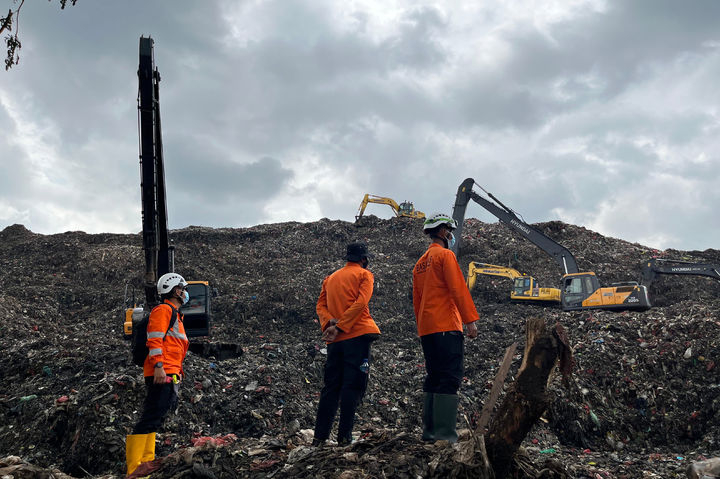
On the 10th (local time), AFP and other outlets reported that at about 2:30 p.m. on the 8th, a trash pile in Block 4 of the Bantargebang landfill in Bekasi — a suburb of Jakarta — gave way, burying trucks and food stalls. Seven people, including garbage-truck drivers and street vendors who were working or resting on site, died. Authorities initially reported five fatalities; search teams later recovered two more bodies. Desiana Kartika Bahari, head of Jakarta’s search-and-rescue agency, said, “All victims have been found,” and added that the search was suspended because no further missing-person reports were received.
The collapse followed continuous heavy rain over the weekend and occurred while garbage trucks queued to unload. At the time, about 55,000 tonnes of waste sat on a 2.74 million–square–meter site — roughly the size of 380 soccer fields (2.74 million m² ≈ 677 acres) — equal to approximately 60,600 short tons.
Bantargebang handles most of the household waste for the greater Jakarta area and is among the world’s largest open landfills, receiving about 7,400–8,000 tonnes from Jakarta each day (≈ 8,150–8,820 short tons/day).
As the site exceeded its designed capacity, landslides at Bantargebang have recurred in recent months. In December, a similar collapse sent three vehicles into a river. Across Indonesia, landfill fires and slope failures have been repeatedly reported: in 2023 a landfill in Bandung burned for about a week, and in 2005 a collapse near Bandung buried or damaged roughly 60 houses, killing 31 people and leaving dozens missing.
Environment Minister Hanif Faisal Nurrofik criticized Jakarta’s provincial government for allowing open dumping despite a 2008 ban on such operations. At the scene, he told local broadcaster KompasTV, “Bantargebang falls under Jakarta’s administrative area, so they (the Jakarta provincial government) must take responsibility.”
Last month, President Prabowo Subianto warned that most of Indonesia’s landfills — many of which are being phased out — will exceed capacity by 2028. He pledged to invest $3.5 billion (about 4.67 trillion KRW) to build 34 waste‑to‑energy facilities over the next two years to incinerate trash and produce electricity.
{vi13}