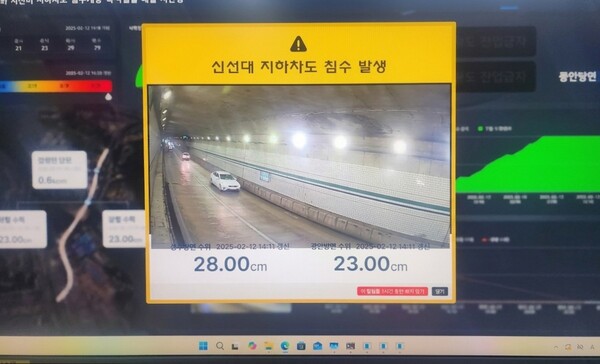
[Point Economy] Busan Facilities Corporation has completed an intelligent response system that detects underpass flooding during the monsoon season in advance and automates vehicle control.
On March 26, Busan Facilities Corporation said it has finished research and development and field deployment of the AIX-based Underpass Flood Response Decision Support System, which integrates artificial intelligence (AI), the Internet of Things (IoT), and extended reality (XR). The project ran from June 2024 for roughly 18 months.
The system gathers real-time data from sensors installed inside underpasses—flood-level gauges, rain gauges, and CCTV—and uses AI analysis to forecast flood risk. When a hazardous condition is detected, the system is designed to automatically block vehicle entry and trigger other responses.
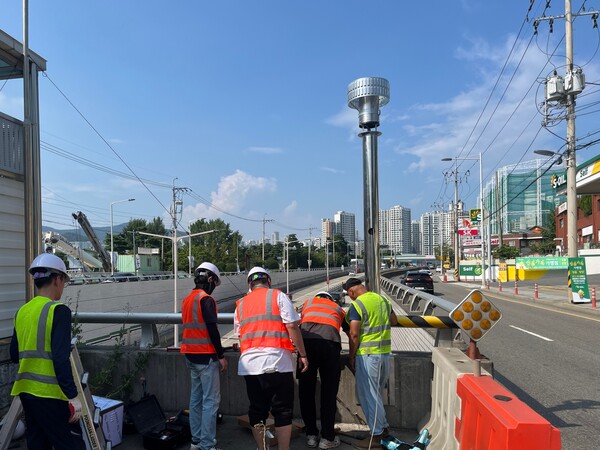
Notably, the system incorporates an XR-based 3D digital twin that allows operators to inspect underpass conditions remotely in three dimensions. It goes beyond mere detection by supporting both situational assessment and response decision-making.
The pilot was conducted at the Centum City and Sinseondae underpasses, which face elevated flood risk. The project cost about 900 million KRW (approximately $675,000), financed with 700 million KRW (about $525,000) in national funds and 200 million KRW (about $150,000) in private investment. The corporation developed a rain- and flood-measurement–linked control system, an AI-based prediction model, an XR visualization module, and step-by-step response guidelines.
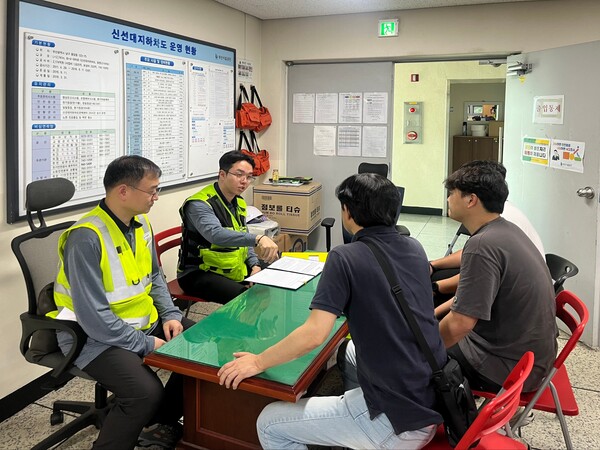
The team also lowered the maximum flood-depth threshold to 5 cm (about 2 inches) to strengthen early-stage response. In a survey of relevant agencies, more than 95% of respondents rated the system’s necessity and effectiveness positively.
The corporation expects the system to yield roughly 900 million KRW (approximately $675,000) in cost savings and to provide proactive response capabilities during heavy rains, improving public safety.
Director Lee Seong-rim said, “We applied advanced technologies such as AI and XR to disaster safety to build an intelligent response system. We will continue research and development to create facilities that let citizens feel secure.”