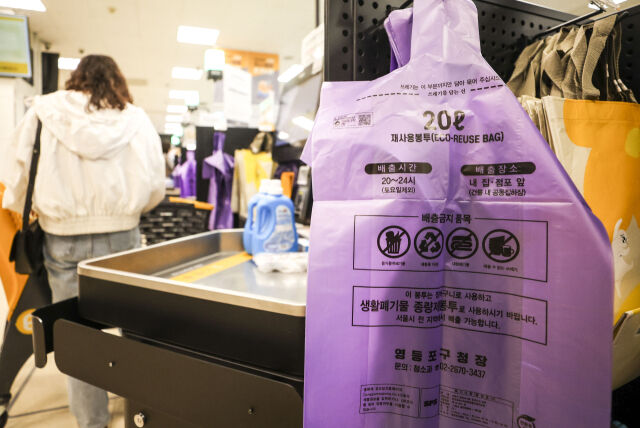
[MyDaily = Reporter Lee Hobin] Minister Kim Seong-hwan of the Ministry of Climate, Energy and Environment said the government has prepared contingency measures — including allowing ordinary bags in a worst-case scenario — so residents will not have to accumulate garbage amid supply concerns for volume-based trash bags raised by the conflict in the Middle East.
According to government officials on March 31, Kim posted on Facebook the previous day that "I will take full responsibility and manage the situation to ensure there is no disruption to people's daily lives."
He also emphasized the stability of both supply and pricing for the volume-based trash bags.
Kim said, "We have sufficient supplies of volume-based trash bags and no plans to raise prices. Bag prices are set by local government ordinances, so manufacturers cannot arbitrarily increase them at the production stage."
After inspecting municipalities and production plants nationwide, the government found that many local governments have secured ample inventories.
Officials said more than half of the municipalities hold at least six months' worth of stock, and manufacturers can use recycled feedstock, meaning they could supply for more than a year without problems. A comprehensive survey indicated supplies could meet demand for at least three months.
Some municipalities have only one to two months' worth of inventory, but the government plans to reallocate raw materials among producers to resolve supply imbalances. Because manufacturers have contracts with local governments, officials will encourage firms with spare raw materials to shift production to areas facing shortages.
Naphtha, the key feedstock for these volume-based trash bags, is a hydrocarbon produced during crude-oil refining and is used to manufacture plastics and vinyl. South Korea produces some naphtha domestically but relies on imports for about 45% of its needs.
Rising tensions in the Middle East have heightened supply concerns after the Strait of Hormuz — through which a significant share of imported naphtha passes — was blocked. That development has spurred increased consumer stockpiling.
Seoul reported that average daily sales of volume-based trash bags rose to 2.7 million per day from March 21 to 27, roughly 4.9 times the recent three-year daily average of 550,000.