The National Assembly has passed the Life Safety Basic Act, which defines the responsibilities of the state and local governments for responding to disasters, accidents and large-scale social tragedies. Families of Sewol ferry victims had been pressing for this law for 12 years.
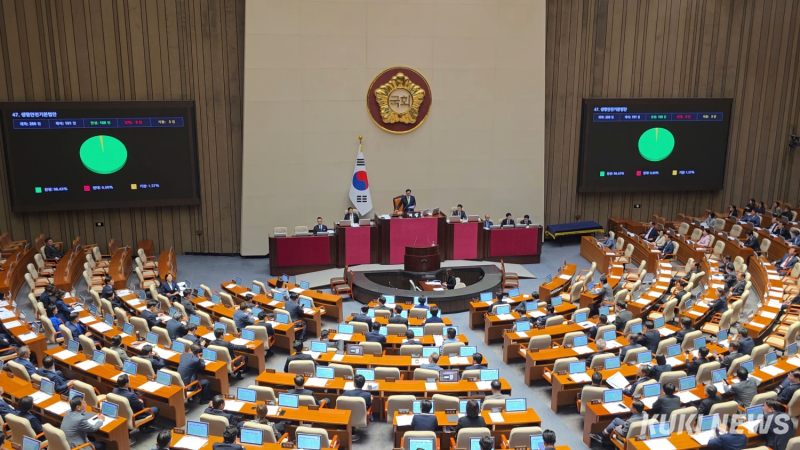
The bill, brought before the plenary session on May 7, passed with 188 votes in favor and 3 abstentions out of 191 members present.
Jointly introduced by Democratic Party lawmaker Park Ju-min, Basic Income Party leader Yong Hye-in and Social Democratic Party leader Han Chang-min, the Life Safety Basic Act requires the establishment of independent investigative bodies to carry out professional and objective inquiries when tragedies occur.
It also creates a National Life Safety Committee under the president and requires the government to adopt a comprehensive plan every five years to strengthen citizens’ safety rights. The law establishes a National Safety Accident Investigation Commission under the prime minister and mandates support measures to aid the psychological recovery of affected residents and help restore their communities after safety incidents.
Yong Hye-in said, “After the Sewol disaster, I — Yong Hye-in — began the ‘stay still’ silent march and decided to enter politics from the streets. The state must accept full responsibility for citizens’ lives and safety. Only then can we break the chain of political and social conflict that obstructs full recovery from disasters and tragedies.”
She added, “I hope this law helps make South Korea a country where families no longer lose loved ones to preventable tragedies and where no one has to doubt their safety.”
Speaker Woo Won-sik said, “By passing the Life Safety Basic Act today, the National Assembly has taken the first step toward turning the constitution’s declaration of state responsibility into concrete institutions.” He added that he felt a heavy heart for not enacting the legislation sooner.
He also noted, “The Itaewon tragedy occurred while this bill was being proposed and debated in the Assembly. I offer deep condolences and my thanks to the victims’ families who have persevered through prolonged suffering.”
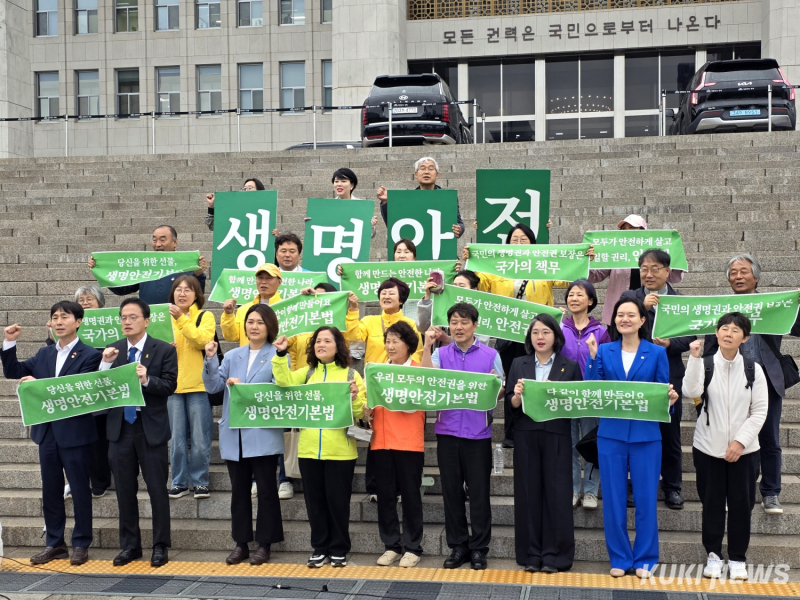
At a press conference in front of the main hall after the bill passed, families of disaster victims spoke with a mix of relief and sorrow.
Kim Sun-gil, secretary-general of the 4.16 Sewol Family Council and the mother of the late Jin Yun-hee, said, “We waited a very long time. There was no state response when the Sewol disaster occurred 12 years ago. If a basic law guaranteeing safety rights like this had existed, we might not have had to fight on the streets for 12 years. I’m deeply grateful it has finally passed.”
Yoo Hyung-woo, vice chairman of the 10.29 Itaewon Disaster Victims’ Family Council and the father of the late Yu Yeon-ju, said, “I feel overwhelmed and pained. The roughly three years and six months of fighting the government — crawling, falling and getting back up — flashed through my mind.” He added, “With the passage of the Life Safety Basic Act, I believe people like us who campaigned in the streets and demanded full investigations from the state will no longer have to do so.”
Park Mi-sook, mother of the late Jang Deok-jun, who died from overwork during a night shift at Coupang’s Chilgok logistics center, said, “My emotions are mixed today. We are still campaigning to expose Coupang’s orders to conceal industrial accidents.” She urged lawmakers to refine the law in detail, saying, “Because our struggle is ongoing, I hope the law will be detailed enough so families like ours do not have to wander the streets for long periods, carry out sit-ins or hunger strikes, or give up their daily lives.”
The National Assembly plans to follow the Life Safety Basic Act with a series of related bills and regulatory adjustments.
Han Chang-min said, “The situation faced by Coupang workers shows that this problem is still ongoing. Several follow-up bills and tasks remain, and we will do our best to address them thoroughly.”
Park Ju-min said, “There is a great deal to do. We must draft effective enforcement decrees and revise subordinate laws related to disaster safety. The Lee Jae-myung administration has made this a national priority and has set up a task force at the Ministry of the Interior and Safety. We will monitor the process closely to ensure proper implementation.”{vi34}