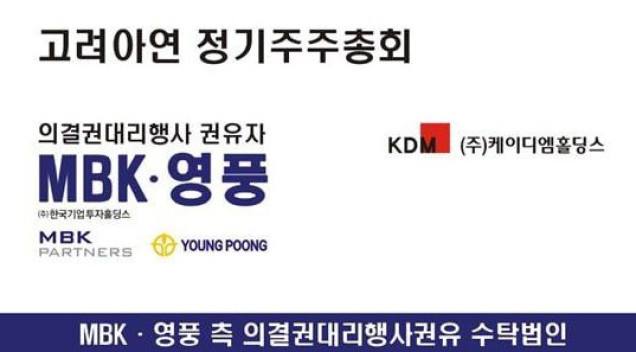
Young Poong and MBK Partners rejected Korea Zinc’s accusations that they solicited proxy votes, calling the claims one-sided and factually distorted.
On the 9th, Korea Zinc filed a complaint with Seoul’s Jongno Police Station, accusing several employees of the proxy-solicitation firm retained by Young Poong and MBK of violating the Capital Markets and Financial Investment Services Act and obstructing business. Korea Zinc alleges those employees collected proxy forms by impersonating company staff or otherwise misleading shareholders.
Young Poong and MBK said the allegations misrepresent the facts and emphasized that the proxy-advisory firms they engaged operate in strict compliance with the Capital Markets and Financial Investment Services Act and related regulations when conducting proxy-solicitation activities.
The companies said all solicitation procedures are carried out under legal counsel and internal controls, and that illegal actions such as forging ID badges or impersonating company personnel cannot occur structurally. They added that suggestions implying such conduct may constitute the serious dissemination of false information.
According to Young Poong and MBK, the retained proxy-advisory firm is a specialist that has long conducted proxy-solicitation for numerous listed companies. The firm handled the same work for Korea Zinc at last year’s January extraordinary shareholders’ meeting, the March regular meeting that year, and at this year’s regular shareholders’ meeting. Given the firm’s experience and expertise, Young Poong and MBK said Korea Zinc’s sudden accusations are difficult to accept.
They also said proxy agents clearly indicate “MBK–Young Poong joint agent” on their business cards to prevent confusion among those who delegate their votes.
Young Poong and MBK explained that the business cards they disclosed simply identify the meeting as the “Korea Zinc shareholders’ meeting” to specify the event, and that this notation is a standard and necessary practice in proxy-solicitation work.
They added that any portrayal suggesting the use of Korea Zinc business cards to impersonate company employees is a clear falsehood. They rhetorically asked whether Korea Zinc expects agents not to identify the target company, calling the allegation indicative of a basic misunderstanding of the law and established practice.
Young Poong and MBK argued that unfounded suspicions and criminal complaints only chill legitimate proxy-solicitation activity and serve as pressure tactics intended to interfere with shareholders’ free decision-making.
They warned that such conduct disrupts capital market order and infringes on shareholders’ rights, and said it could itself amount to business obstruction and violations of the Capital Markets and Financial Investment Services Act. They cautioned that spreading false information could trigger civil and criminal liability.
They also accused Chairman Choi Yoon-beom’s camp of depriving the largest shareholder of its rights. Young Poong and MBK said that at last year’s January extraordinary meeting and the March regular meeting, Choi’s side restricted Young Poong’s voting rights through illegal reciprocal-share arrangements, thereby usurping the majority shareholder’s rights.
With a shareholders’ meeting scheduled for the 24th, Young Poong and MBK said that spreading baseless allegations about proxy solicitation and filing criminal complaints against proxy agents amounts to a smear campaign intended to evade responsibility for illegal acts and shift attention. They said that until Choi’s camp explains and takes responsibility for the unlawful restriction of the majority shareholder’s voting rights, it has no moral or legal legitimacy to press these claims.