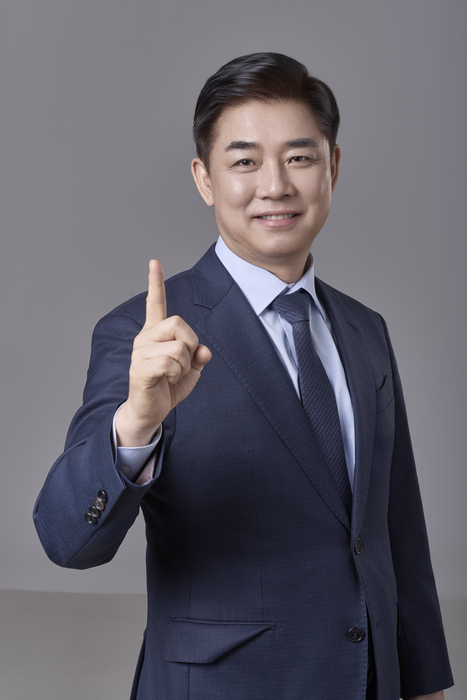
Kim Byung-wook, the Democratic Party’s preliminary candidate for mayor of Seongnam, said he will prioritize fast-tracking reconstruction and redevelopment, and expanding the city’s transportation network, drawing on hands-on experience he accumulated while serving two terms as a lawmaker representing Bundang.
He pointed to his role in passing the special law for first-generation new towns as evidence he can quickly advance reconstruction in Bundang and redevelopment in Seongnam’s older downtown. He also pledged to boost the city’s competitiveness by beginning construction promptly on the Sinsa–Wirye–Samdong Line and by securing early approval to extend Subway Line 8 to Pangyo. He said creating a quantum and artificial intelligence (AI) innovation cluster would raise housing, transit and industry together through practical, results-driven administration.
“I will move quickly to deliver changes citizens can feel and be a mayor who secures Seongnam’s future economic engines,” Kim said. The following is an edited Q&A.
His main goal is to leverage Pangyo Techno Valley’s strong IT infrastructure to attract a global quantum R&D hub. He wants to make Seongnam a center for quantum software and algorithm development.
He also plans to integrate quantum computing power with Seongnam’s biohealth cluster to drive innovation in fields that require massive computing capacity—such as new drug development—helping local biotech firms advance.
He said he will establish industry–academia partnerships with major universities like KAIST and Sungkyunkwan University to train specialized talent. With expanded regional transit—such as the Line 8 extension—industry, talent and company attraction can reinforce one another and create a virtuous cycle.
He said he will marshal Seongnam’s full administrative capacity to create an ecosystem where advanced companies can innovate freely.
He plans to remove local regulatory barriers where possible and reorganize Seongnam’s administrative structure into a support system that backs companies’ new ventures.
He added the city will go beyond fiscal incentives to build the foundations for local talent to grow alongside companies.
Ultimately, he said, his aim is to position Seongnam as a core hub leading South Korea’s industries of the future.
His governing philosophy centers on pragmatic administration focused on solving citizens’ everyday economic concerns. He said he will rise above ideology and partisan fights to prioritize citizens’ interests and Seongnam’s growth.
His operating principles are field-centered communication, data-driven decision-making, and leadership that takes full responsibility for outcomes.
Drawing on the broad networks he built in national politics, he pledged to deliver competent administration that advances Seongnam’s long-standing projects. He promised to implement policies rapidly so residents can feel real improvements in their daily lives.
The youth basic income is a matching program in which Gyeonggi Province covers 70% and Seongnam City covers 30%.
He argued the current mayor suspended the program for political reasons despite Seongnam’s relatively small fiscal burden, which he called unfair. Other municipalities run by officials from the People Power Party still operate the program, so it is unreasonable that Seongnam’s young people are excluded. The youth dividend began in Seongnam in 2016 and spread across Gyeonggi Province. It gives 24-year-olds 1,000,000 KRW per year (approximately 750 USD) to ease financial pressures and support self-development and social entry. He said he will restore the benefit so Seongnam’s youth can once again receive it.
He said he’s running to restore Seongnam’s pride as a symbol of South Korean innovation and as President Lee Jae-myung’s political hometown, and to revive stalled urban growth so the city can leap toward global competitiveness.
He argued the timing is right: the next mayoral term will overlap with the remainder of President Lee’s term, creating a strategic window for a major push.
The first priority, he said, is speeding up slow-moving administration. Regulatory bottlenecks are constraining reconstruction and redevelopment and, in turn, limiting citizens’ housing rights.
Drawing on his legislative expertise from two terms in the National Assembly, his experience as a political secretary in the presidential office, and his broad networks, he said he will turn Seongnam’s future vision into reality and lead a fundamental shift in the housing environment.
Having sought practical solutions while serving two terms representing Bundang, he said his top priorities are rapid reconstruction and redevelopment and expanding a comprehensive transport network. He plans to push quickly on downtown redevelopment and Bundang reconstruction using his experience drafting the special law for first-generation new towns.
He also pledged to ensure timely groundbreaking for the Sinsa–Wirye–Samdong Line and to secure early approval to extend Line 8 to Pangyo. By adding a quantum–AI innovation cluster, he said he will raise housing, transit and future industries together and be a mayor who delivers results.
He said a clear advantage is being aligned with the ruling party, which facilitates coordination with the national government to resolve Seongnam’s long-standing projects.
But he emphasized that proven competence matters more than party affiliation. Before entering politics, he ran businesses and worked in small-business settings, and he participated in the launch of the KOSDAQ, giving him practical economic experience.
He said no other candidate combines parliamentary legislative experience, presidential office experience, and hands-on economic insight in the way he does. He vowed to translate Seongnam’s future blueprint into reality with pragmatic, decisive administration.
He said the election will test whether the administration’s pragmatic innovation can be realized in local government.
He added that a victory in Seongnam—President Lee’s political hometown—would symbolically demonstrate citizens’ support for the government’s vision. He vowed to win and lead Seongnam’s transformation.
He said he will make Seongnam a model global advanced-industry city and a welfare city, completing the vision of making Seongnam South Korea’s economic capital.
Seongnam — Reporter Kim Dong-seong