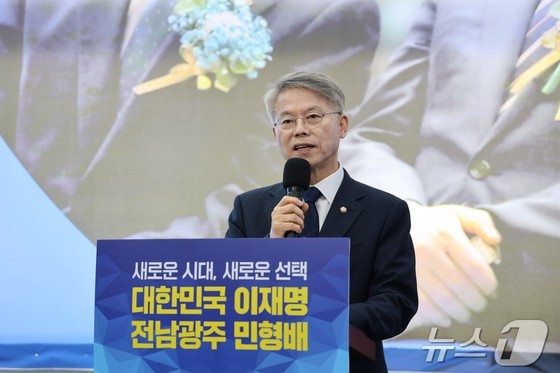
On the 22nd, Min Hyung-bae, the Democratic Party’s nominee for the integrated Jeonnam–Gwangju special mayoralty, pledged to establish a citizen-centered government in Jeonnam and Gwangju that places residents at the center of decision-making.
The Democratic Party’s central headquarters formally confirmed Min as its candidate for the Jeonnam–Gwangju special mayoralty that day.
In a written statement, Min described the result as a solemn mandate from citizens to wake a stagnant Jeonnam–Gwangju and to deliver tangible improvements to people’s lives. He said he will not forget that mandate.
He pledged to build a citizen-sovereignty government, revive struggling industries, create quality jobs, and transform the area into a vibrant city that retains young people.
Min also expressed his commitment to unity with the camp of Kim Young-rok, his rival in the final primary, offering deep respect for Kim’s spirited campaign.
He mentioned Kang Ki-jung and Shin Jeong-hoon, who allied with Kim; Joo Chul-hyun, who formed a policy alliance with him; and Jung Joon-ho, who competed in the preliminary round. He called all former contenders valuable assets for Jeonnam and Gwangju and pledged to pursue broader and deeper unity to lead a major regional leap forward.
Min, a native of Haenam in South Jeolla Province, worked for the regional daily Jeonnam Ilbo for 12 years and later served as co-director of the civic organization Participation and Autonomy 21.
He later served as social coordination secretary in President Roh Moo-hyun’s administration; as mayor of Gwangsan District during the fifth and sixth local-government terms; and as secretary for local development and social policy at the Blue House under President Moon Jae-in. He represented Gwangsan District (Eul) in the National Assembly during the 21st and 22nd legislatures.
During the Democratic Party primary ahead of the 2021 presidential election, he became the first politician in the Honam region (southwest Korea) to publicly back Lee Jae-myung. In 2022, he drew attention by leaving the Democratic Party to press for passage of legislation separating investigation and prosecution; he subsequently led efforts to introduce prosecutorial reform bills and to coordinate related special committee work.