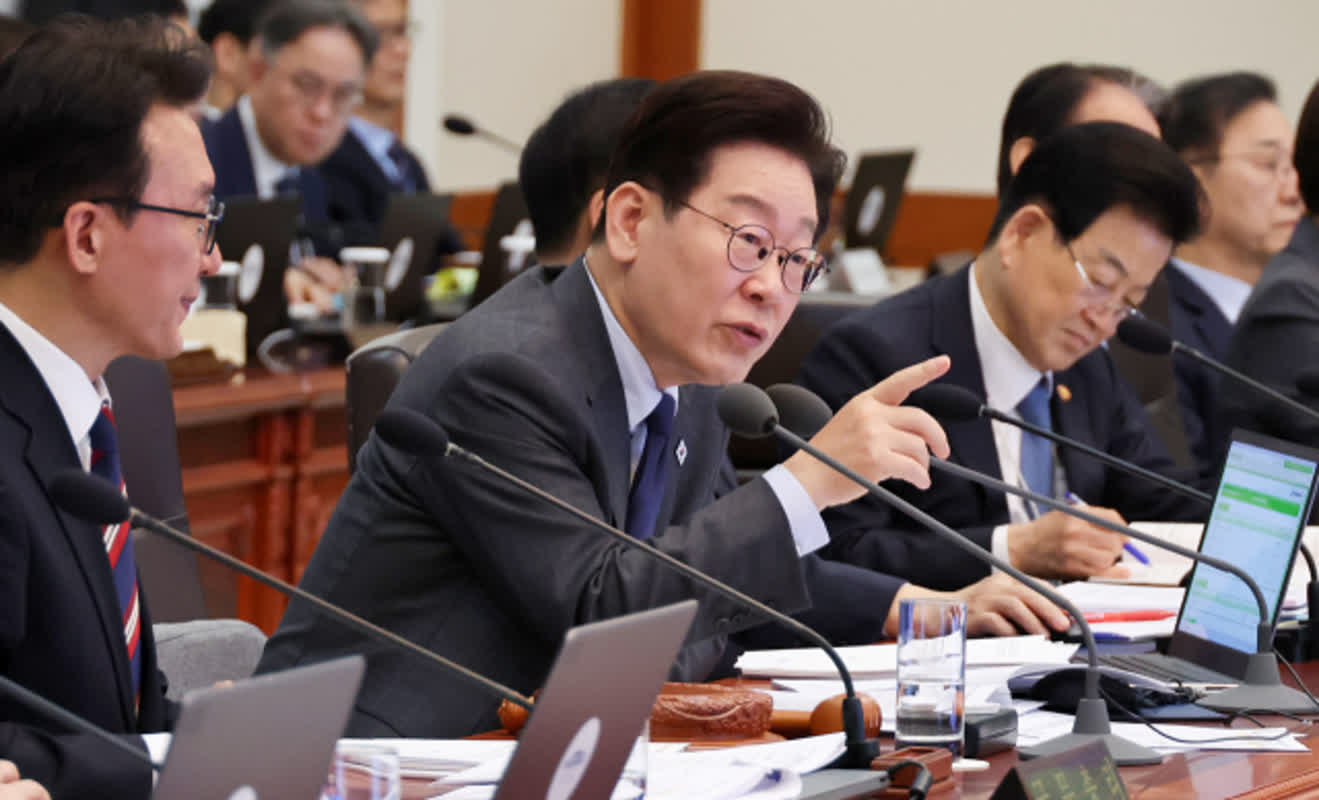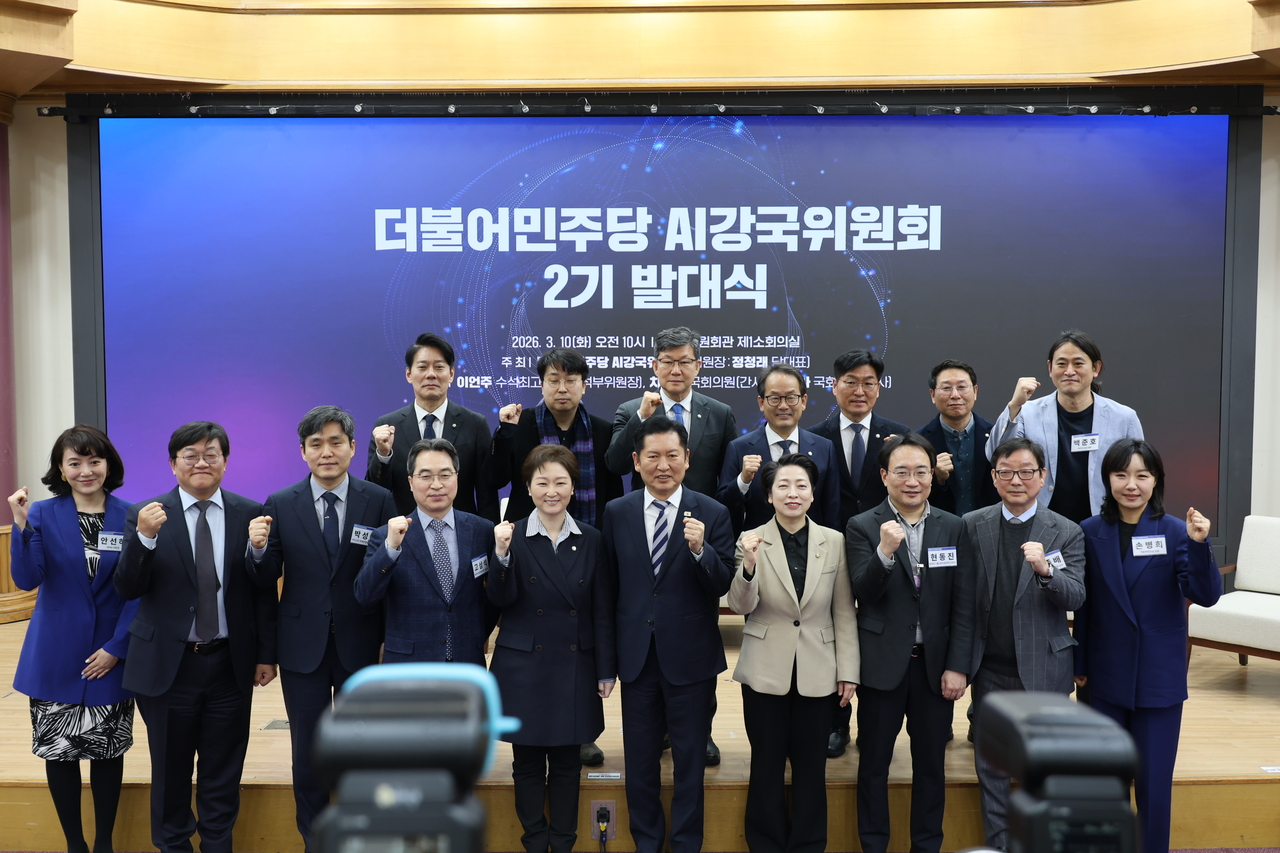
The AI Strong-Nation Committee was established last March with then-party leader Lee Jae-myung as chair to foster the AI industry and develop a roadmap for South Korea to become an AI powerhouse. The committee led early efforts on issues such as securing GPUs and streamlining AI regulations.
For the committee’s second term, party leader Jeong Cheong-rae will serve as ex officio chair. Lee Eon-ju will be senior vice chair; Hwang Jeong-a will chair the Science, Technology and Innovation Special Committee; and Cha Ji-ho will serve as secretary of the Future Strategy Office.
The vice chair team is composed of outside experts: Baek Jun-ho, CEO of FuriosaAI; Son Byung-hee, director of the Maum AI Research Institute; Hyun Dong-jin, executive director and head of the Robotics Lab at Hyundai Motor Group; Park Jong-bae, professor of electrical and electronic engineering at Konkuk University; Seo Jun-beom, professor at the University of Ulsan; Go Sam-seok, distinguished professor at Dongguk University’s School of Advanced Convergence; An Sun-ha, special advisor to the World Health Organization (WHO); and Park Sung-pil, dean of KAIST’s Graduate School of Future Strategy.
In his opening remarks, Chair Jeong said, “After the Industrial Revolution and the information era, we now face an AI era in which everything changes. South Korea dreams of becoming one of the world’s top three AI powers, and I’m confident that this dream can become reality.”
He added, “President Lee Jae-myung foresaw the AI era and served as the chair of our committee’s first term. I ask the AI Strong-Nation Committee to work energetically to support the Lee Jae-myung administration’s push to become a top-three AI power, and I hope you will take your place as patriots of the AI era.”
In her remarks, Senior Vice Chair Lee said the committee will present strategies to achieve both fairness and growth under two main visions: an “AX ultra-growth economy” and a “global AI foundational society.” She said these visions will deliver the strategies South Korea needs now.
“If change is unavoidable, we must lead it,” Lee emphasized. “As the ruling party, our responsibilities are heavy. The key is not a society where AI replaces humans, but one that uses AI to expand human capability.”
The committee outlined subcommittee tasks as follows: Baek Jun-ho will focus on AI infrastructure centered on data centers and semiconductors; Son Byung-hee will develop industry-focused AI policies and strategies for field data and data-factory infrastructure; Hyun Dong-jin will define physical AI and robotics and chart a path for the domestic ecosystem and co-growth; Park Jong-bae will address stable, timely power supply for AI data centers and advocate attracting data centers near non-capital power plants while easing power regulations; Seo Jun-beom will expand the concept of an AI-strong nation, advance healthcare AI innovation, and shape Korea’s global contributions; Go Sam-seok will propose a model for an AI foundational society, lead global AI governance discussions, and pursue an “AI civilization” that balances technological innovation with social inclusion; An Sun-ha will work on resolving structural vulnerabilities, articulating core governance values, and promoting a human-centered model; and Park Sung-pil will pursue anticipatory governance, resolve core intellectual-property issues, and elevate the country’s standing.
Baek Jun-ho, CEO of FuriosaAI, said, “To become an AI powerhouse, we must secure a strong, independent foundation model and robust AI infrastructure. Beyond bold government investment, we must internalize domestic AI semiconductors at scale.” He noted that, outside the United States, only South Korea and China have the comprehensive capacity to internalize semiconductors for data centers, making this area one of Korea’s key competitive advantages. “I will do my best to help Korea secure competitiveness in AI infrastructure,” he said.
Son Byung-hee of the Maum AI Research Institute said, “We’ve moved from an era that judged models by performance to a physical-AI era in which robots and AI operate together in the field. Robots need data to move, so industrial data is the most important resource.” He pledged to spare no effort in building data factories equipped with domestic infrastructure and semiconductors so Korean robots can operate at home and abroad.
Hyun Dong-jin, executive director and head of Hyundai Motor Group’s Robotics Lab, said, “The Robotics Lab’s mission is not just to produce product-level robots like Atlas. We want to apply AI and robotics to social problems and build a sustainable ecosystem.” He added, “Service solutions can scale across sectors such as healthcare and building management, and that scale will drive sustainability.” He said Hyundai’s Robotics Lab will coordinate with relevant sectors and bring case studies, necessary institutional proposals, and regulatory recommendations to the committee.
Professor Park Jong-bae of Konkuk University said, “AI data centers require massive infrastructure, and the most pressing issue is power supply. Both the U.S. and South Korea face large queued demand for AI data centers. In the U.S., roughly 44 GW — about the capacity of 44 nuclear reactors over the next three years — is in the pipeline, but only about 30 GW can be supplied.” He urged distributing AI data centers to non-capital regions with spare supply capacity, fast-tracking technical regulations in the power sector, easing power-trading rules for AI data centers, and pursuing co-location strategies.
Industry subcommittee secretary Hwang Jeong-a said, “Under the vision of an AX ultra-growth economy, we will build an AI supergrowth highway and push to become an AX leader. We will create hardware infrastructure (AI data-center construction, solutions to power-grid challenges) and software infrastructure (rationalizing AI regulations, one-stop resolution of physical-AI rules, expanding venture capital).” She added, “To achieve AX leadership, we will develop concrete, actionable policies for manufacturing AX and advancing physical AI.”
She warned that the AI revolution rivals the discovery of fire and that falling behind even a day can set a generation back. “We are entering a speed race to become one of the top three AI powers and will build a new engine of growth for South Korea,” she said.