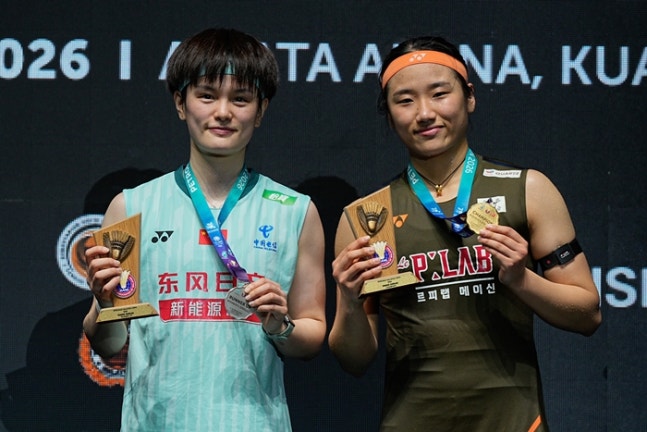
 ▲ South Korea’s run of victories began with An Se-young. She took control early with a decisive win over China’s Wang Zhiyi. Wang’s rapid recent rise had raised questions, but An made the gap unmistakable. ⓒ Yonhap News/AP
[SPO TV News=Reporter Jo Yong-un] World No. 1 An Se-young (24, Samsung Life Insurance) proved to be an even tougher obstacle than many expected. Wang Zhiyi (26, China) returned to challenge An after her All England Open triumph, but she unraveled under pressure and left with another defeat.
On May 3, in the first singles of the Uber Cup final against China, An dominated Wang 2-0 (21-10, 21-13), giving South Korea an ideal start in the team final.
For Wang, it was another bitter finale. She had shed tears four years ago after losing as the third singles player in the Uber Cup final against Korea. This time, even as China’s top gun in the opening singles, she suffered an even more crushing loss.
The matchup slipped back into familiar territory. An holds a commanding 20–5 edge in their head-to-head. From last year through February she ran off 10 straight wins, relentlessly pressuring Wang. The encounters have often felt less like a meeting of world No. 1 versus No. 2 and more like one player imposing her will.
Wang did deliver a major counterpunch in March, snapping An’s streak at the All England and sending Chinese fans into a frenzy. Local media hailed it as breaking An’s so-called jinx.
But momentum swung right back to An. She avenged that loss in April’s Asian Championships final, completed a career Grand Slam, and—just three weeks later—turned in another convincing performance in the Uber Cup final.
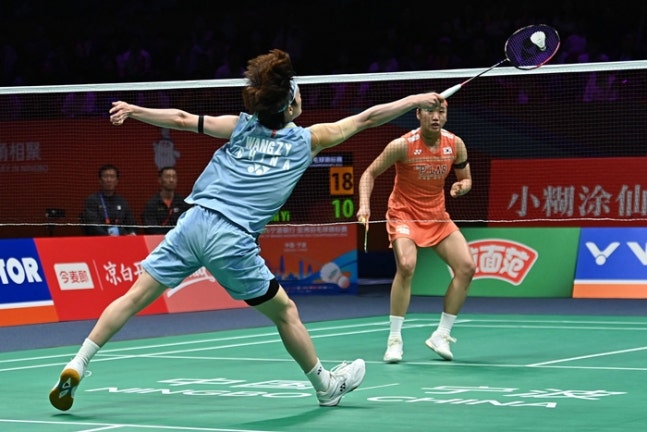 ▲ South Korea’s winning momentum started with An Se-young. She controlled the match with clinical shot placement and timing, exposing the gap between her and Wang despite concerns about Wang’s rapid development. ⓒ Yonhap/AFP
The tone back in China grew chilly. Sohu pointed to Wang’s psychological impatience rather than technical failings. “Wang lost her rhythm from the outset. Her usually reliable net play wavered, and service errors stopped her momentum,” the outlet wrote.
By contrast, analysts praised An’s tactical intelligence. Rather than outmuscling her opponent, An targeted the areas that made Wang most uncomfortable, repeatedly disrupting her balance. Every attack unsettled Wang’s stance and denied her a comfortable position on court.
Sohu added that An’s biggest weapon isn’t raw power but her relentless game management: low hand shots aimed at Wang’s high center of gravity and constant angle changes kept Wang off balance throughout the match.
Critics argued Wang’s All England victory may have backfired. Sohu suggested she abandoned the patient approach that worked there and tried to finish points too quickly in the Uber Cup. The result: more errors on hard smashes, and as rallies extended, her expression and movement visibly deteriorated.
Coaches reportedly warned her, “Don’t try to end it in just a few attacks,” but Wang couldn’t rein in her impatience.
The irony is that Wang had already named the remedy. After beating An at the All England, she said mindset was key and that she approached the match knowing she had to endure long rallies.
In the Uber Cup final, she abandoned that mindset and opted for haste. The result was the same: An reasserted her dominance, and Wang once again found her resolve broken against the world No. 1.