A woman in her 20s who had been subjected to repeated domestic violence and stalking by a man she lived with as a common‑law partner was stabbed to death.
Police received the emergency alert the victim sent from an issued smartwatch, but officers were unable to prevent the killing.
Despite multiple reports, authorities never took steps to detain the suspect or impose other physical restraints.
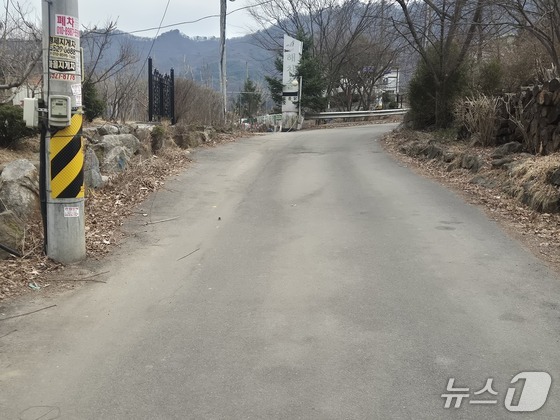
According to officials, at about 8:58 a.m. on the 14th, a man in his 40s identified as A stabbed and killed a woman in her 20s identified as B on a roadside in Palhyeon‑ri, Onam‑eup, Namyangju, Gyeonggi Province.
A had previously been ordered to wear an electronic location‑tracking device because of past sex‑offense convictions, and he damaged the anklet immediately after the attack.
He fled in a rental car but was arrested at about 10:08 a.m. the same day on a road in Yangseo‑myeon, Yangpyeong County.
Officials said he had taken an unidentified drug and attempted suicide inside the vehicle.
B had suffered repeated domestic abuse from A, her common‑law partner.
Authorities referred A to prosecutors in May last year on suspicion of aggravated assault, and they issued temporary domestic‑violence orders Nos. 2 and 3 against him.

Despite those measures, A continued to stalk B.
On Jan. 22, B visited a police station, received counseling and was issued an emergency‑contact smartwatch.
She filed stalking charges against A on Feb. 2, and authorities issued provisional measures Nos. 1–3 under the Stalking Punishment Act.
Those orders barred him from coming within 100 meters (about 328 feet) of her, from contacting her by phone, text or other electronic means, and from approaching her residence.
But those protections did not prevent the killing.
Officials say A picked up B after her early‑morning shift, drove her from the front of her workplace and carried out the attack.
B sent an alert via her smartwatch, but officers arrived only after she had already been killed.
A patrol officer said, “We treat smartwatch alerts as emergencies and dispatch immediately,” and added, “Sometimes the distance is great, so response can take longer.”
A similar case occurred in Uijeongbu on July 26 last year.
A woman in her 50s who worked alone at a senior welfare center was killed by a man in his 60s who had been stalking her.
She too was under protective measures and had been issued a smartwatch.
Critics say the police response to A’s stalking complaints was too passive.
They note that, despite repeated reports, authorities did not pursue aggressive measures such as detention to physically constrain the suspect.
The Gyeonggi Northern Police instructed Guri Police Station to apply for an arrest warrant and provisional measure No. 4 (detention), but Guri waited for the National Forensic Service to complete its analysis of the tracking device, and the attack occurred during that delay.
Given A’s prior conviction and heavy sentence for a sex offense, many argue that police should have acted faster and with greater force.
Kim Young‑sik, a professor of police administration at Seowon University, said authorities must assess a perpetrator’s risk of reoffending and, when warranted, limit certain rights — for example through location tracking or detention — because victim‑centered measures have limits.
Police said they will carry out a full review of the appropriateness of their actions in this case and will inspect other relationship‑based crimes for risks of recurrence.