A major restructuring of the petrochemical sector may be necessary, but we cannot abandon basic feedstock production.
Please state your clear position on establishing a medical school.
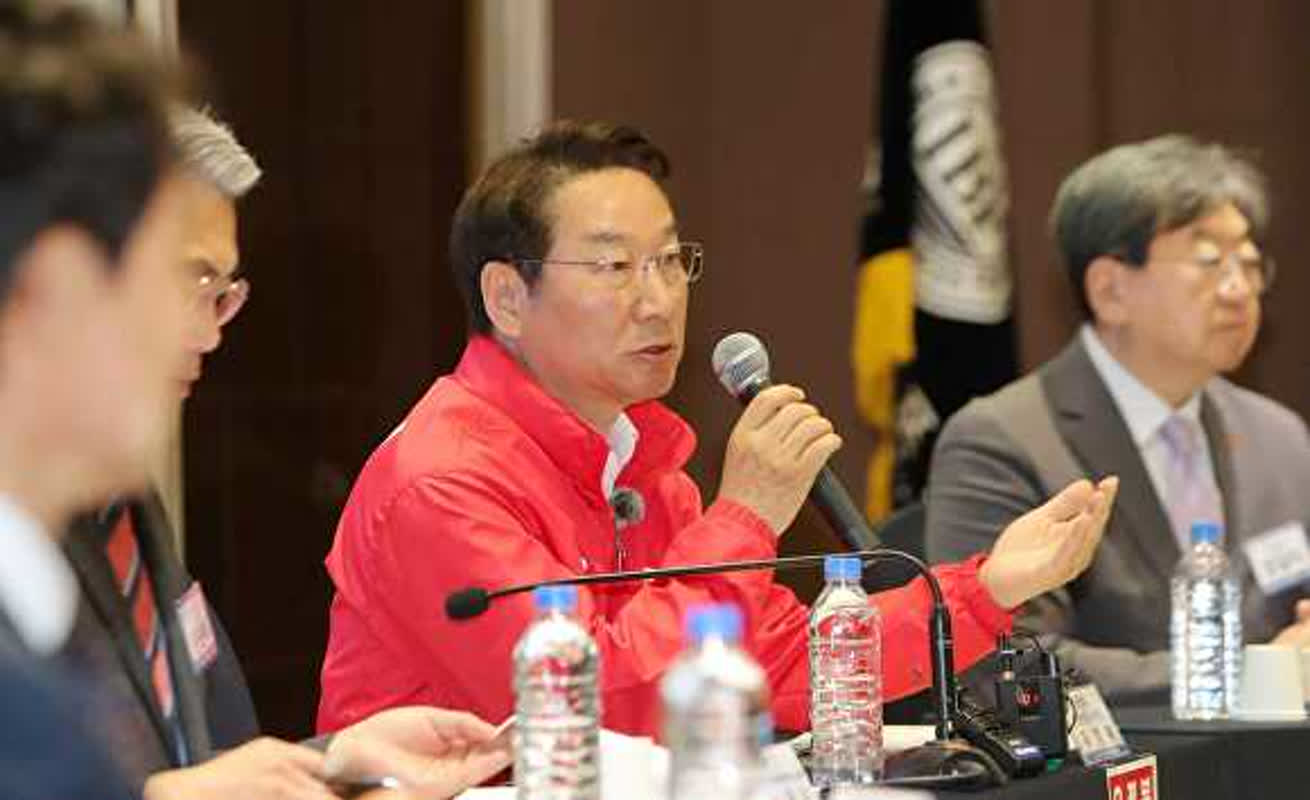
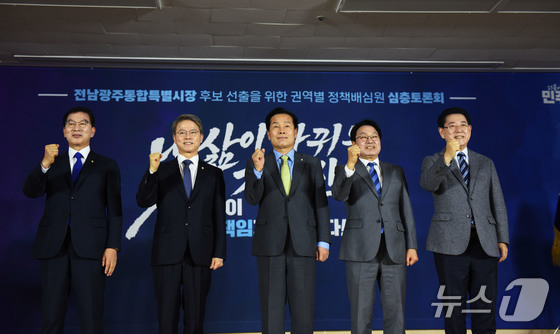
The Democratic Party staged an eastern Jeonnam primary debate using a citizen-jury format to select its nominee for the Jeonnam–Gwangju integrated special mayoralty, and candidates answered questions posed by local residents.
The session, held on the afternoon of the 28th at Choseok Hall on Suncheon University’s campus, featured candidates who advanced past the preliminary round: Kang Ki-jeong, Kim Young-rok, Min Hyung-bae, Shin Jeong-hoon and Joo Cheol-hyun. During a lottery-style jury Q&A, citizens raised questions about the proposed administrative integration of Jeonnam and Gwangju. With answers limited to one minute, candidates had little opportunity to offer in-depth responses.
Jury members were primarily concerned with whether the region should continue supporting existing petrochemical and steel industries and how to secure jobs by attracting new industries. One juror, who said they work at the Yeosu petrochemical complex, asked: “Petrochemicals underpin all industry and must be preserved for the future. How do you intend to overcome the current crisis?”
All candidates agreed the petrochemical complex should be supported, but they proposed different methods.
Shin argued that local and central governments must work together to identify and support new high-value sectors, including materials and components, stressing that technology and labor skills are intertwined and must be transitioned together.
Kim said he would deploy emergency economic measures exceeding 1 trillion KRW (approximately 750 million USD) to support Yeosu’s petrochemical industry. He proposed fiscal incentives for firms—such as employment-retention subsidies—and direct living-stability payments for workers.
Min called for upgrading the area’s status to an official employment-crisis zone and pursuing a long-term shift toward materials and component industries. He also proposed establishing a special economic crisis response fund of 2 trillion KRW (approximately 1.5 billion USD) as a medium- to long-term measure.
Joo emphasized that securing competitiveness while achieving carbon neutrality is the top priority. He pointed to small modular reactors (SMRs) as a realistic solution: the heat from SMRs could be used by petrochemical plants, and the byproduct carbon could be repurposed at the Gwangyang steelworks.
Kang referenced precedent, noting that when output was reduced in Daesan the government provided 3 trillion KRW (approximately 2.25 billion USD). He said if Yeosu can reach a similar agreement among companies, comparable government support should follow. Kang emphasized that coordinating output among firms should be the first step but that job protections must be maintained throughout any adjustment.
On the question of where the integrated special-city administration should be based, candidates agreed in principle on maintaining balance but differed on specifics. Joo called for fully balanced operations; Kang and Shin advocated elevating the eastern office as an industrial administrative hub; Kim sought to strengthen the eastern office’s functions; and Min proposed a full-time deputy mayor focused on new industries and the economy.
On the contentious issue of a medical school—one of the high-profile topics in the special mayoral primary—candidates largely stuck to their prior positions. Kang continues to advocate establishing a medical school with 100 students and an affiliated hospital in Suncheon. Min and Joo, who have formed a policy alliance, propose splitting admissions evenly—50 students for the eastern region and 50 for the western region.
When Kim pressed Kang, asking why Kang had previously agreed that the merged universities (Mokpo University and Suncheon University) would receive 100 medical seats and two university hospitals but now appears to say that is impossible, Kang responded that the merger remains unresolved because the location of the medical school has not been settled, producing a tense exchange.
Sensitive to public criticism that the primary has grown overly combative, candidates largely avoided raised voices and overt hostility at this event. Nonetheless, tensions surfaced during the lead-role debate: Kang and Kim questioned Joo’s standing as the eastern region’s representative, while Shin and Joo challenged Kim over what they described as failures in population policy.
As alliances among candidates have become more pronounced, some exchanges took on a collaborative tone, with candidates asking opponents about their policy proposals to find common ground. For example, when Min raised the need for an energy transition at the Yeosu complex and asked Joo for his view, Joo reiterated the need to secure competitiveness through measures like SMRs.
Although the debate proceeded smoothly overall, jurors criticized the brief answer times. A juror in his 50s said that with only 30 seconds to one minute for responses, discussions often ended before substantive views could be heard. He added that because the session was billed as an in-depth forum, it would have been preferable to devote more time to a few key topics for deeper debate.
The next citizen-jury in-depth debate for the Gwangju area is scheduled for the 29th at 2 p.m. in Seoseok Hall at Chosun University.