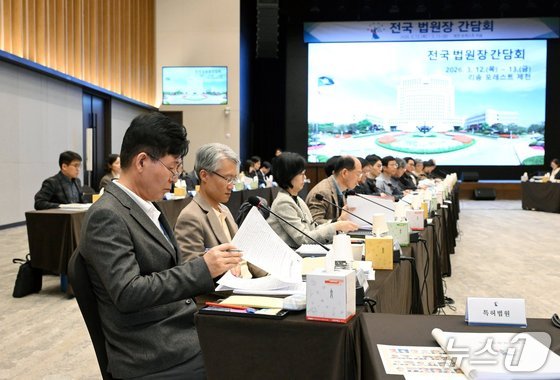
On March 12, after the three judicial reform bills were promulgated, chief judges from courts across the country met to discuss follow-up measures and to plan responses to anticipated practical challenges.
They agreed that statutory clarification is needed for procedures following judgments annulled when a judicial petition is accepted, and they called for measures to protect judicial independence—such as legal support for judges facing work-related litigation and stronger safeguards for personal information—under the new offense for distorting the law.
The Supreme Court’s Court Administration Office said that on the first day of the nationwide chief judges’ meeting, March 12, it omitted its usual reports on major administrative issues and moved directly to presentations and discussions to allow deeper debate on the three judicial reform bills (the new offense of distorting the law, the introduction of judicial petitions, and increasing the number of Supreme Court justices).
Before the meeting began, Ki Woo-jong, acting head of the Court Administration Office, opened with remarks urging the judges to pool their wisdom. He said the passage of the three reform bills changes the foundations of the judicial system and raises serious concerns, and he asked the judiciary to work to restore public trust and develop practical alternatives.
The first discussion topic that followed focused on “follow-up measures after the judicial system reforms.” At that session, chief judges voiced strong concerns.
They warned that, despite the profound impact the changes will have on the public and on the judiciary, key provisions in the amended Constitutional Court Act remain ambiguous and related statutes were not revised in tandem. That gap, they argued, could cause confusion in court practice and operations once the laws take effect.
Anticipated practical problems raised included: the procedure for transferring trial records at the judicial petition stage and how the judiciary should submit its opinions; follow-up procedures when acceptance of a judicial petition cancels a prior ruling; and the legal effect of enforcement actions carried out on the basis of a finalized judgment.
On the issue of increasing the number of Supreme Court justices, judges discussed potential changes to bench composition and hearing procedures, the need to prevent erosion of fact-finding in trials, and the requirement for improved physical infrastructure such as courthouse facilities. Specific proposals included adding judges and judicial research fellows to shore up fact-finding and increasing allowances tied to criminal trials.
The second discussion topic addressed “support measures for criminal judges under the new offense for distorting the law.” Chief judges said the rise in external burdens—such as complaints and accusations directed at criminal judges—could deepen avoidance of criminal panels and make criminal trials more difficult. They agreed that effective safeguards are necessary to prevent substantive restrictions on the public’s right to a speedy and fair trial.
Proposed measures included expanding the budget to support work-related litigation, establishing and operating a commission to safeguard judicial independence, strengthening protection of personal information, prioritizing placement of judicial research fellows, and introducing specialist criminal judges.
Following the meeting, the chief judges asked the Court Administration Office to compile the discussion outcomes, quickly prepare concrete follow-up procedures, and actively coordinate with external agencies.
On the second day of the meeting, March 13, chief judges are scheduled to exchange views on the third discussion topic—“the need to develop AI to improve public access to judicial services and the phased tasks for implementation.”
The meeting, held at the Forest Resort in Jecheon, North Chungcheong Province, was attended by Ki Woo-jong, acting head of the Court Administration Office, 45 chief judges from various courts, and department heads from the Court Administration Office.
That day, the government published in the Official Gazette amendments to the Criminal Code creating the new offense for distorting the law, to the Constitutional Court Act introducing judicial petitions, and to the Court Organization Act increasing the number of Supreme Court justices. The three bills—known collectively as the three judicial reform bills—had passed the Cabinet one week earlier, on the 5th.
Of the three, the new offense and the judicial petition system took effect immediately upon promulgation. The increase in the number of Supreme Court justices will take effect in 2028, two years after promulgation.