From Unitree’s Flagship Store to Hangzhou’s Robot Police
Robots Steal the Spotlight Over the May Day Holiday
China’s Robot Surge Presses On Despite a Youth Unemployment Crisis
Why We Can’t Simply Admire Its Rapid Advances
Robots Steal the Spotlight Over the May Day Holiday
China’s Robot Surge Presses On Despite a Youth Unemployment Crisis
Why We Can’t Simply Admire Its Rapid Advances
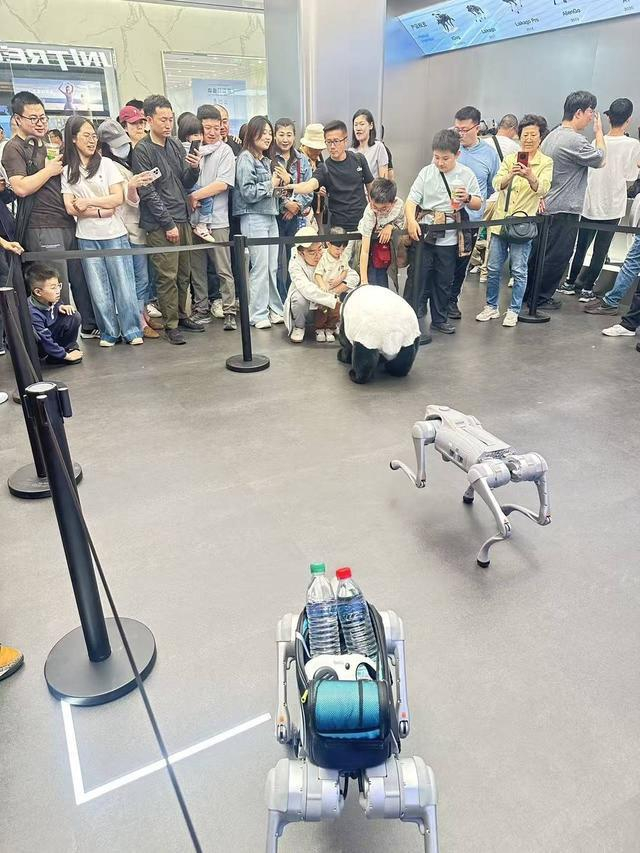 The five-day May Day holiday began this month on the 1st. On the ground floor of a large shopping mall in Wangfujing, a central Beijing shopping district, crowds packed the aisles. I followed the throng to one store and found people holding up phones to film a panda robot and a robot dog performing tricks. The show took place at Unitree’s first company-owned store, which had opened the day before to catch the holiday rush. For me the scene was familiar, but the children and parents gathered in small groups watched with bright, curious, awed eyes.
 Robots are booming across China. At trade fairs, robots often occupy the main booths, and events created specifically for robots — from robot marathons to robot “Olympics” — are increasingly common. During this same holiday period, Hangzhou deployed what was billed as the world’s first robot police unit in operational service, drawing media attention.
Even so, seeing robots take center stage during Labor Day reminded me of a comment from a Chinese reporter I met on a recent trip. He came from Shenzhen, the heart of China’s tech push. When I said I might cover a robot marathon soon, he interrupted and said bluntly, “I don’t like robots.” With jobs already scarce, he worried that accelerated automation would squeeze young people even further. He spoke quietly in a crowded room, but his tone left no doubt.
Although China proclaims itself a proletarian state, workers’ rights lag behind those in South Korea in many respects. The hukou household-registration system, introduced in 1958 and still functioning as a modern caste system, limits population mobility. Rural migrants working in cities such as Beijing and Shanghai are often excluded from social insurance, pensions, healthcare and housing benefits; their children face restrictions on enrolling in local high schools and taking the gaokao college entrance exam. As a result, it is common for parents to send young children back to their registered hometowns around middle-school age.
Working conditions are also harsh. Long-hours culture — commonly known as “996” (9 a.m. to 9 p.m., six days a week) — remains widespread. Employers frequently require make-up workdays to compensate for national holidays, meaning people often work the Saturdays before or after a holiday and end up with six-day workweeks.
Meanwhile, wealth concentration continues to deepen. There is no national inheritance or gift tax, and aside from a few regions, no broad property-holding tax. The state relies heavily on value-added tax, which places a proportionally heavier burden on ordinary households than on the wealthy. Labor is cheap: many shops won’t charge for delivery of a 20-yuan snack (about 4,400 KRW, approximately $3.30), yet a latte at a typical Beijing café can easily exceed the equivalent of about 8,000 KRW (approximately $6.00).
An even more serious problem is labor exclusion. Faced with intense job competition, many young people will take any work they can find — if they can find it at all. “Fake offices,” where people create the appearance of employment, remained popular this year after trending last year. The rise and spread of robots will only accelerate this dynamic.
In South Korea, debate over a possible full strike by the Samsung Electronics union is underway. While some view the union’s demands as excessive, living in China underlines how precious the freedom to speak out really is. Chinese authorities treat collective action as deeply subversive; content that displeases officials can lead to individual social-media accounts being blocked. Late last year, videos by “Xiao A,” who documented life surviving on part-time jobs and sleeping in internet cafés, were suddenly deleted. The Ministry of State Security even published a video claiming foreign forces were promoting “tangping” — “lying flat” or doing nothing — to corrode the minds of Chinese youth.
China’s dazzling technological advances, including its robotics surge, are often enviable. They reflect the raw capacity of a system that moves quickly. Yet after wrestling with unreliable VPNs several times a day to bypass the Great Firewall while reporting on the country’s science push, cognitive dissonance becomes inevitable. China is building the future at warp speed while denying its citizens the freedom to debate that future. That is today’s China.
- 2028? 2029? When Will Wartime Operational Control Transfer Happen…Lee: “We Must Be Ready to Operate Independently”[Lee Hyun-ho's Military! Talk]
- “5th-Generation Actual-Cost Insurance” Cuts Coverage for Minor Illnesses and Lowers Premiums…Launching on the 6th
- Sentenced to Life Without Parole and Says “Thank You”…A Man in His 50s Kills a Fellow YouTuber at Noon [Today’s Day]
- “I Took a Half-Day to Go to the Hospital—What a Waste”…Workers Now Split Vacation Time by the Hour
- Robot Umpires Flag Pitching Technique as a Violation…Walks at a 70-Year High [Park Si-jin’s Global Pick]
- “Even Combined, Japan’s Top 100 Companies Can’t Match Samsung?” Japan Turns Upside Down…What’s in Goldman Sachs’ Recent Report
- Retail Investors Plucked 4.6 trillion KRW (approximately $3.45 billion) from the KOSPI in a Week…Their Favorite Stocks? [Market Signal]
- “I Ate It Every Day for Brain Health”…The Betrayal of Trusted Omega-3 [Workplace Warning]
- “Hello?” — Then My Voice Gets Stolen…France Warns of a New ‘Silent’ Phone Scam
- U.S. Military Media’s Take on the KF-21: “Capable of Competing for Air Superiority Worldwide” [Lee Hyun-ho’s Military! Talk]