Voices of citizens to protect Incheon's status as a Northeast Asian hub | Government relocation policy sparks Incheon's backlash | President Lee Jae-myung must clarify his stance on perceived neglect of Incheon
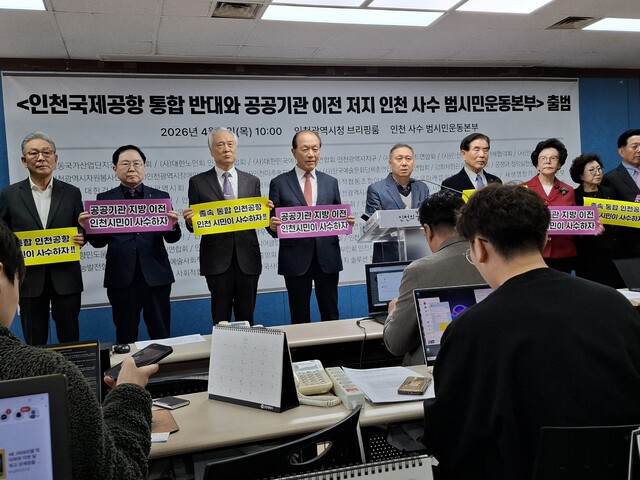
Civic organizations and civic leaders across Incheon have launched a broad citizens' movement aimed at blocking a proposed integration of airport authorities and preventing the relocation of several public agencies out of the city.
The coalition says it aims to amplify residents' concerns and preserve Incheon's position as a Northeast Asian hub city in opposition to current government proposals.
At a press briefing at Incheon City Hall on the 2nd, the Citizens' Movement Headquarters to Defend Incheon urged President Lee Jae-myung to publicly oppose measures that would weaken Incheon International Airport's role as a hub — including a proposed merger of airport authorities, consideration of moving the Overseas Koreans Office to Seoul, and discussions about a second round of agency relocations affecting Incheon.
They emphasized that successive administrations established Incheon as a Northeast Asian hub airport through a \"One-Port\" policy.
They warned that current talks to consolidate Incheon International Airport Corporation, Korea Airports Corporation, and the Gadeokdo New Airport Construction Authority risk undermining that policy.
The group also criticized the government's push to accelerate metropolitan administrative integration and to prioritize \"integrated\" special cities when selecting agencies for a second relocation, saying that move could place institutions such as the Incheon Polar Research Institute, the Korea Environment Corporation, and the Aviation Safety Technology Institute at risk of being moved.
Controversy over a potential transfer of the Overseas Koreans Office to Seoul remains unresolved, the activists said, because neither the Foreign Ministry nor the presidential office has offered a clear position.
To publicly declare opposition to the airport integration and agency relocations and to begin a broader civic campaign, the Citizens' Movement Headquarters held an inauguration press conference.
They outlined plans to meet with the Incheon mayor, relevant district mayors, and local council members; to urge political parties and national lawmakers to take action; to organize rallies; and to host public forums.
The movement reflects Incheon residents' concerns and aims to elevate public debate about the government's policy direction.
Organizers say they seek cooperation and dialogue with the government to protect Incheon's development and residents' rights. They called on President Lee Jae-myung to quickly state his opposition to the airport merger, to any plan to relocate the Overseas Koreans Office to Seoul, and to discussions about a second wave of relocations affecting Incheon public agencies.
Incheon’s lawmakers, across party lines, should formally oppose the integration of Incheon International Airport Corporation and any public-agency relocations. Both ruling and opposition parties should coordinate to press the president and the government to halt and rescind these proposals.
Discussions about merging Incheon International Airport Corporation, Korea Airports Corporation, and the Gadeokdo New Airport Construction Authority began after President Lee directed a consolidation of public agencies. The Ministry of Economy and Finance plans to consult with the Ministry of Land, Infrastructure and Transport and then report to the presidential office, and the government is expected to announce the list of agencies targeted for consolidation soon.
Ultimately, resolution of the airport integration controversy, the potential relocation of Incheon-based public agencies, and the Seoul relocation review of the Overseas Koreans Office depends on President Lee Jae-myung.
Incheon’s legislators must represent residents' interests and fulfill their role as a legislative check on the executive by stating official positions on these issues and working to reverse any policy that sidelines the city.
The Citizens' Movement Headquarters to Defend Incheon — formed to protect the city at this critical juncture — said it will unite with civic groups, neighborhood organizations, institutions, labor unions, political parties, and leading community figures to defend Incheon.
The campaign seeks to preserve the city's foundation for future growth, reflect residents' aspirations, and amplify civic voices about the government's policy direction.
Incheon’s political leaders from both camps must continue to act jointly to protect the city's future.
Incheon = Lee Chun-man, lcm9504@viva100.com