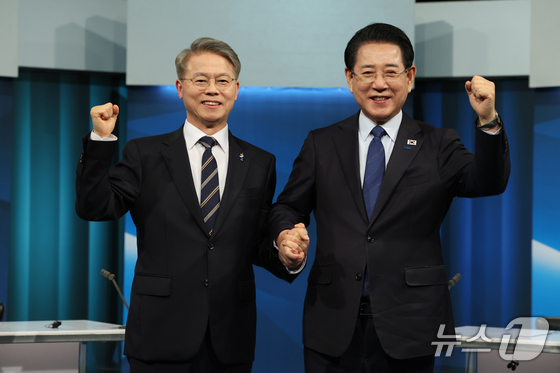
With the Democratic Party’s Jeonnam–Gwangju integrated special mayoral primary entering its final round, the debate between candidates Kim Young-rok and Min Hyung-bae opened on a cordial note but ended in a heated exchange.
Both candidates attended the debate at Gwangju MBC Public Hall on the afternoon of the 9th.
When moderators asked what each would sign first as the integrated special mayor, Kim said he would issue an emergency livelihood safety subsidy. Min said he would launch a 100-day emergency action plan to implement the integration.
On how to use the integrated city’s support fund — 5 trillion KRW per year for four years, totaling 20 trillion KRW (≈$15 billion) — Min proposed allocating 80% (16 trillion KRW, ≈$12 billion) to industrial investment. He would split that 80% into three equal parts to support AI semiconductors, renewable energy industries, and efforts to increase the value of agriculture, fisheries, and livestock — roughly 5.33 trillion KRW (≈$4 billion) for each. He said the remaining 10% (2 trillion KRW, ≈$1.5 billion) would fund talent development and another 10% would bolster the social safety net.
Min also suggested investing 200 billion KRW (≈$150 million) each in university hospitals in the east and west, to avoid concentrating a national medical school’s hospital in a single location.
Kim thanked President Lee Jae-myung for enabling the 20 trillion KRW package and laid out his own distribution plan: 5 trillion KRW (≈$3.75 billion) to attract AI, energy, semiconductor and secondary-battery companies; 5 trillion KRW (≈$3.75 billion) for power infrastructure and water supply; 3 trillion KRW (≈$2.25 billion) for regional development; 3 trillion KRW (≈$2.25 billion) for balanced development; and 4 trillion KRW (≈$3 billion) for welfare policies.
They then sparred over the philosophy and vision behind integration. Compared with earlier debates that turned negative quickly, this session started more calmly.
The two also clashed over how to use the 20 trillion KRW. Kim criticized Min’s proposal to spend 16 trillion KRW on equity investments in companies, arguing it would channel fiscal incentives to large corporations and that the integrated special city is not empowered to invest directly in firms.
Min defended the idea, saying he would establish an investment corporation. He stressed the plan was not for the city to invest directly but to attract private capital. He gave an example: if a semiconductor fab required 30 trillion KRW (≈$22.5 billion), a company might cover half, citizens and banks would finance the remainder, and the investment corporation could contribute about 1 trillion KRW (≈$750 million).
In the open debate segment, both candidates escalated their attacks.
Min challenged Kim’s record and intentions, noting Kim has served eight years as governor and could reach 12 years if re-elected. Quoting President Lee’s slogan that “new wine needs new wineskins,” Min asked whether Kim sought a 12-year tenure.
Kim responded with a wine metaphor of his own, saying he is like a well-aged wine who has fulfilled nearly all his pledges over eight years. Min countered that the “new wine” is the Jeonnam–Gwangju integration and the “new wineskin” is the leadership required to drive it forward, labeling Kim the “old wineskin.”
Min also raised Kim’s Yongsan apartment case. He thanked Kim for deciding to sell the property but argued the situation differed from President Lee’s. Min said Lee had sold below market value, while Kim listed his apartment at 2.9 billion KRW (≈$2.18 million), which, Min suggested, raises questions about sincerity.
Kim replied that he may have listed the unit below market and that the mixed-use building could take time to sell. He noted that he previously sold an overly lavish official hanok residence and deposited 1.6 billion KRW (≈$1.2 million) into the provincial treasury. He added that he lived in the apartment temporarily to care for a sick family member.
Kim then attacked Min over a series of investigations: the prosecution’s decision to transfer the “One Man Hundred” meeting meal expense case to the police; the police probe into alleged falsification of Min’s support-rate entries; and a bribery case involving a former Gwangsan district secretary during Min’s tenure as district mayor.
Min denied any involvement. He said the incidents were unrelated to him, argued that party-level failures to publish poll data had contributed to some issues, and appealed against abandoning comrades who were unfairly targeted during the MB administration’s era.
Kim closed by accusing Min of skipping campaign duties to play golf when President Lee visited three times to campaign for a Yeonggwang County by-election. Min said he had already offered a sufficient apology on that matter.