The Legend of the Supercar: How the Lamborghini Miura P400 Came to Be
The Lamborghini Miura P400 is a landmark in supercar history—an iconic model that captured the imagination of car enthusiasts worldwide. Its debut marked more than the arrival of a fast sports car; it announced a new automotive category: the supercar. The Miura P400 emerged from Ferruccio Lamborghini’s ambition and a period of bold experimentation in Italy’s car industry. Frustrated that contemporary high-performance cars leaned too far toward racing at the expense of everyday comfort and practicality, Ferruccio set out to build something unique.
By the early 1960s, Ferruccio Lamborghini was already a successful tractor manufacturer, but his falling-out with Ferrari made him a household name among car people. Dissatisfied with flaws in his Ferrari, he resolved to build a completely new sports car that could compete directly. The Miura P400 answered that challenge with a radical mid-engine layout, striking styling, and performance that reset expectations. Its arrival changed the industry’s paradigm, not just its product line.
Innovative Engineering Behind the Miura P400
The Miura P400 became legendary because its engineering pushed boundaries few had considered. Its most notable innovation was the mid-engine layout. Until then, most high-performance sports cars used front-mounted engines. Lamborghini placed a V12 transversely behind the driver to centralize mass, improving handling, cornering, and high-speed stability.
Under the rear deck sat a 3,929 cc V12 naturally aspirated engine that delivered 350 horsepower and revved smoothly to 7,000 rpm—a remarkable spec for its time. The Miura accelerated from 0–100 km/h (0–62 mph) in 6.7 seconds and topped out at about 280 km/h (174 mph), outpacing nearly every contemporary rival. Lamborghini also designed the engine and gearbox as a single, compact unit, improving packaging and weight distribution.
The chassis focused on lightness. A space-frame structure increased rigidity while extensive use of aluminum and other lightweight materials kept curb weight near 1,290 kg (2,844 lb). Those choices translated directly into sharper driving dynamics and a clear performance advantage over competitors.
Design and Aesthetics of the Miura P400
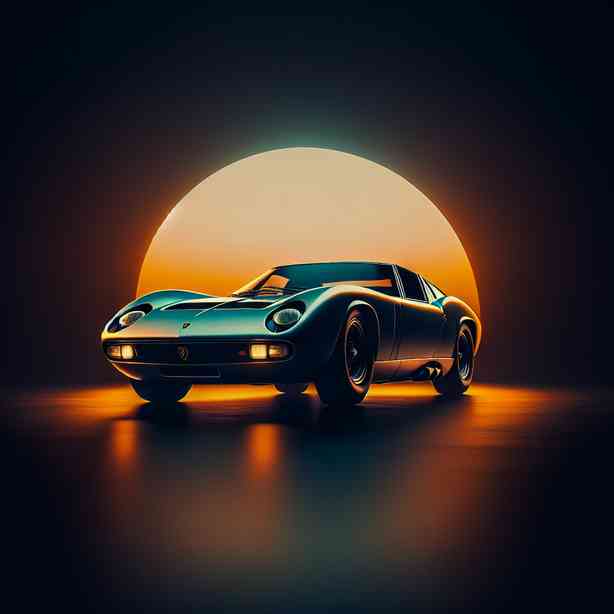
The Miura P400 is remembered as much for its looks as its speed. Marcello Gandini at Bertone shaped a body that balanced flowing curves with crisp edges to create an elegant yet aggressive silhouette. Distinctive details included pop-up headlights that gave the car a “frog-eye” appearance, sleek side profiles, and dramatically flared rear fenders.
Gandini’s design also considered aerodynamics. The car’s low, wide stance reduced drag at speed while addressing engine cooling and downforce. Inside, Lamborghini used premium materials such as aluminum and leather and crafted a driver-focused cockpit that heightened the sporting experience. The Miura’s interior was often regarded more as an object of design than a mere car cabin.
At launch, the Miura’s styling shook up automotive design and influenced generations of supercars. Even today, its silhouette remains a reference point for designers and brands worldwide.
Performance That Redefined the Supercar
The Miura P400 rewrote the performance playbook for supercars. Its 3.9-liter V12 produced 350 hp and roughly 283 lb·ft of torque (39.2 kg·m), mated to a five-speed manual that delivered potent acceleration and sustained high-speed performance. Its 0–100 km/h time of 6.7 seconds and 280 km/h top speed matched or exceeded many later supercars.
More important was the weight balance achieved by the mid-engine layout—about 44:56 front-to-rear—which sharpened agility and stability through corners. Double-wishbone suspension front and rear improved road-holding and ride control, while four-wheel disc brakes provided consistent stopping power at speed.
The Miura set a new benchmark. Competitors studied its layout and engineering when developing their flagship models, helping to define the supercar segment.
Historical Value and Cultural Impact
The Miura P400 elevated the automobile from transportation to art and a status symbol. At launch it attracted millionaires, celebrities, and race drivers. Icons like Frank Sinatra, Miles Davis, and Steve McQueen owned Miuras, boosting the car’s mystique.
The Miura also became a cinematic staple, reinforcing its status as the archetypal supercar. Its appearance in the opening sequence of The Italian Job remains one of cinema’s most memorable automotive moments. Since then, the model has appeared in films, ads, and music videos that reached global audiences.
Collectors and auction houses have valued the Miura P400 steadily higher over time. Limited production and well-preserved examples have commanded tens of billions of KRW (approximately several million USD) in top cases, underscoring its place as a premier classic.
Rarity and Collectability
The Miura was produced in very limited numbers, which drives its collectability. Lamborghini built 764 Miuras in total; roughly 475 were the original P400 produced between 1966 and 1969. Later variants like the P400S and P400SV increased overall numbers slightly, but the original P400 retains unique cachet.
Today, roughly 400 Miuras are known to survive worldwide, and truly original examples are rarer still. At auction, well-preserved P400s have sold for over 3 billion KRW (about $2,250,000). Collectors often call the Miura P400 the “holy grail of supercars.” Original parts, correct paint, and matching chassis numbers materially increase value.
The Miura P400’s Enduring Legacy
The Miura P400 did more than define an era—it redefined what a supercar could be. Its mid-engine architecture and engineering innovations set the template for later high-performance cars and influenced modern supercar development.
Marcello Gandini’s elegant yet aggressive silhouette remains a design masterclass. The Miura continues to draw attention at museums, private collections, and classic-car events. For Lamborghini, the Miura established the brand’s image as a maker of ultimate supercars and seeded the DNA found in later icons such as the Countach, Diablo, and Aventador.
Beyond tech and design, the Miura shows how cars can fuse human passion, artistic vision, and engineering ambition. It remains an enduring source of inspiration for collectors, enthusiasts, and future automotive designers.
How the Miura P400 Shaped Modern Supercars
The Miura P400 had a profound influence on how modern supercars are designed and engineered. When it arrived, mid-engine layouts were largely restricted to race cars. By introducing a mid-engine high-performance car to the public market, the Miura encouraged brands such as Ferrari, McLaren, and Porsche to adopt the layout for its handling and weight-distribution benefits.
Cars like Ferrari’s 512 BB, Porsche’s 918 Spyder, McLaren’s F1, and Bugatti’s Veyron all used mid-engine configurations to maximize performance—an industry trend that traces back to the Miura.
The Miura’s design language—low, wide stance; the play between curves and sharp lines; and driver-focused interiors—remains central to supercar aesthetics. Lamborghini continues that heritage in modern models like the Aventador and Huracán, keeping the Miura’s influence alive across the brand and the industry.
The Driving Experience and Ownership
Driving a Miura P400 is an encounter with automotive history. The V12 produces a deep, resonant idle and an immediate, explosive response when the throttle is opened. The mid-engine layout lowers the center of gravity and gives the car a direct, agile feel—steering feedback is immediate and rewarding. The classic manual gearbox deepens the tactile connection between driver and machine.
Ownership brings both prestige and responsibility. Classic supercars demand specialized maintenance and high running costs, and sourcing original parts can be challenging. Yet owners say the pride of owning a Miura outweighs those burdens. Owning one is not just possession—it’s stewardship of a legend.
The Miura P400 in the Classic-Car Market
The Miura P400 holds a unique place in the global classic-car market. Recent auctions show Miuras commanding tens of billions of KRW (approximately multi-million USD) price tags, placing them alongside the likes of the Ferrari 250 GTO and Aston Martin DB5 as top-tier collectibles. Prices vary by year, mileage, originality, and condition, but pristine Miura P400s commonly fetch more than $3 million USD.
As values rise, collectors and investors increasingly appreciate the Miura’s rarity and historical significance. The growth of specialized insurance, restoration experts, and preservation services supports the Miura’s long-term desirability and value.
Future Value and Outlook
Experts expect the Miura P400’s value to keep climbing. Production was very limited, and each year fewer truly original examples remain. As the auto industry moves toward electrification and pure internal-combustion supercars become rarer, classic models like the Miura should gain further prominence.
The Miura P400 is more than a classic car; it’s a symbol of a pivotal moment in automotive history. As an icon representing car culture and heritage, it will likely remain highly sought at auctions and among collectors. Preserving a Miura is more than an investment—it's a way to hold a piece of supercar history.
The Legend Continues
The Lamborghini Miura P400 combined groundbreaking engineering, striking design, and breathtaking performance to become a true supercar legend. It helped define a genre and shaped automotive design and culture for decades. Its innovations and artistry still resonate today.
More than the birth of a high-performance sports car, the Miura’s story proves that human passion, imagination, and technical daring can produce a masterpiece. The Lamborghini Miura P400 will continue to inspire car enthusiasts, collectors, and dreamers for generations. As the origin of the supercar legend, the Miura remains an enduring, defining icon.