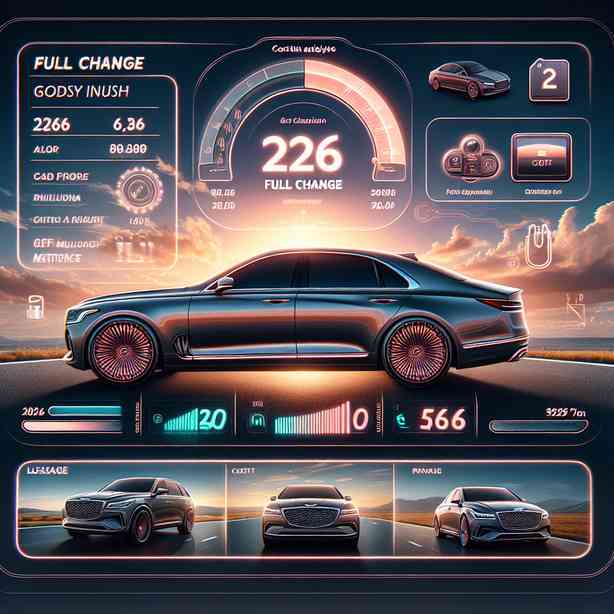
2026 Genesis G90 Full Redesign — Price and Fuel Economy Analysis
The Genesis flagship sedan, the G90, returns to the luxury market with a full redesign that makes a bold impression. The 2026 G90 brings major changes in styling, performance and technology, as well as notable shifts in pricing and fuel efficiency. Built on Genesis’s premium design language and brand identity, it reinforces the G90’s position in the full‑size luxury segment. This article breaks down pricing and fuel‑economy figures and provides practical data for prospective buyers.
Key changes and features on the redesigned Genesis G90
The redesigned G90 updates every major area compared with the previous generation — exterior, interior, powertrains and driver‑assistance systems. The new crest grille and slim dual‑row quad lamps clearly express Genesis’s revised design language, combining a luxury feel with a forward‑looking stance. The side profile emphasizes grand proportions with a gently sloping roofline, shorter overhangs and a longer wheelbase. The rear features simple yet striking taillamps that improve visual cohesion. Inside, a digital instrument cluster, a large touch display and premium materials create a cabin that blends advanced tech with high‑end finishes.
On the powertrain side, Genesis balances efficiency and performance by offering a gasoline 3.5‑liter turbo engine and a hybrid system. That approach covers a wide range of buyer preferences and produces distinct driving characteristics and fuel‑economy profiles by powertrain. Genesis also significantly upgraded advanced driver assistance systems (ADAS), boosting safety and convenience. Together, these updates position the 2026 G90 to compete strongly in the luxury sedan market.
2026 Genesis G90 full‑redesign price analysis
Pricing for the 2026 G90 varies by trim, options and powertrain. The base model starts in the low 90 million KRW range (≈ $67,500 USD). With higher trims, the hybrid system, the long‑wheelbase model and numerous advanced options, the price can rise into the high 130 million KRW range (≈ $97,500 USD). That keeps the G90 competitive with rival full‑size luxury models.
Because option packages vary widely across trims, the final purchase price can differ substantially depending on the buyer’s choices. The standard premium trim covers most essential safety and convenience items, while upper luxury trims add rear VIP seating, a Bang & Olufsen premium audio system, air suspension, AWD and other high‑end features that push the price up. Recent buyers are increasingly choosing customized option packages, so transaction prices often run about 10–20 million KRW higher than the base price (≈ $7,500–$15,000 USD).
Compared with rivals such as the Mercedes‑Benz S‑Class, BMW 7 Series and Audi A8, the 2026 Genesis G90 is priced roughly 10–20% lower for comparable specifications. That reflects Genesis’s effort to raise quality and brand value while keeping pricing rational. Residual values for recent G90s have remained stable, which helps reduce owners’ concerns about depreciation.
Genesis runs various promotions and financing programs for new buyers. Typical packages include long interest‑free financing, extended warranties and scheduled maintenance services. Those programs lower initial purchase burdens and reduce ownership costs, improving the car’s practical appeal.
2026 Genesis G90 full‑redesign fuel‑economy analysis
Fuel economy varies by powertrain. The gasoline 3.5‑liter turbo model posts a combined figure of about 9.2 km/L (≈ 21.6 mpg US), strong for a full‑size sedan. Genesis achieved this through engine downsizing with direct injection, an electric turbocharger (E‑Turbo) and optimized pairing with an eight‑speed automatic. Expect roughly 8.0 km/L (≈ 18.8 mpg US) in city driving and about 11.0 km/L (≈ 25.9 mpg US) on the highway.
The hybrid model achieves a combined fuel economy of about 13.5 km/L (≈ 31.8 mpg US), putting it among the most efficient in the full‑size segment. The hybrid system uses a high‑performance electric motor and a large lithium‑ion battery, allowing the car to accelerate and operate at low speeds on electric power alone. The engine and motor work together to minimize fuel burn, and regenerative braking further improves real‑world efficiency. In city driving the hybrid returns around 14.8 km/L (≈ 34.8 mpg US), and on the highway about 12.5 km/L (≈ 29.4 mpg US).
Long‑wheelbase and AWD choices slightly reduce combined fuel economy because of added weight and drivetrain losses. For example, the AWD hybrid posts a combined figure near 12.2 km/L (≈ 28.7 mpg US), roughly 1.0 km/L lower than the 2WD version. Even so, that efficiency remains toward the top of the full‑size class. Buyers sensitive to fuel economy should weigh powertrain, drive layout and option choices carefully.
When compared with competitors, the G90 performs well: Mercedes‑Benz S‑Class (gasoline 3.0 turbo: 9.0 km/L [≈ 21.2 mpg US], hybrid 12.5 km/L [≈ 29.4 mpg US]) and BMW 7 Series (gasoline 3.0: 9.5 km/L [≈ 22.3 mpg US], plug‑in hybrid 13.0 km/L [≈ 30.6 mpg US]) post similar or slightly lower numbers. Overall, the 2026 G90’s fuel economy ranks among the best in its class and delivers solid efficiency in everyday use.
Ownership costs and economy
The G90’s price and fuel economy directly affect ownership costs. Full‑size sedans typically carry higher fuel, insurance, tax and maintenance costs, but the redesigned G90 mitigates these through improved efficiency and manufacturer services, making overall ownership more reasonable.
Choosing the hybrid model can save about 1.5–2.0 million KRW per year on fuel compared with the gasoline model, based on 20,000 km of annual driving (≈ 12,427 miles) — roughly $1,125–$1,500 USD in annual fuel savings. That efficiency delivers clear long‑term value for frequent drivers. Insurance premiums also tend to run about 10–15% lower than comparable imported rivals, thanks to Genesis’s strong durability, safety ratings and standard safety tech.
Vehicle taxes depend on engine displacement, but the hybrid model may qualify for government and local tax incentives, lowering effective tax burdens. Service and parts costs are competitive because Genesis maintains a fast service network and reasonable parts pricing among local full‑line automakers, improving post‑purchase economy.
Genesis further reduces ownership costs with programs that cover major parts for five years or up to 100,000 km (≈ 62,137 miles), scheduled inspections and roadside assistance. Those services cut maintenance expenses and help boost customer satisfaction in the luxury segment, enhancing the car’s real economic value.
Advanced tech and premium options
Beyond price and fuel economy, the 2026 G90 competes on advanced technology and premium options. Inside, the car can include a 27‑inch panoramic display, augmented‑reality navigation, a 23‑speaker Bang & Olufsen premium sound system, rear‑seat entertainment, rear massage seats, auto‑flush door handles, air suspension, a digital key and OTA (over‑the‑air) software updates.
As autonomous driving tech advances, the G90 offers high‑level ADAS like Highway Driving Assist (HDA), lane‑keeping assist, forward collision avoidance and remote smart parking assist as standard or optional features. These systems maximize occupant protection while improving driving comfort and convenience.
Other details — enhanced cabin noise insulation, premium natural leather, wood and aluminum trims, ventilated and heated seats for all positions, and a four‑zone independent climate system — emphasize refinement. These tech and option packages, combined with price and fuel economy, are key decision factors for buyers evaluating the 2026 G90.
Performance and driving character by powertrain
The 2026 G90 delivers distinct driving experiences depending on the powertrain. The 3.5‑liter turbo gasoline engine produces about 380 PS and roughly 54 kg·m of torque (≈ 391 lb‑ft). Paired with an eight‑speed automatic, it delivers smooth, strong acceleration. The car reaches 100 km/h (≈ 62 mph) from a standstill in about 5.5 seconds, giving dynamics that rival sporty sedans despite the G90’s size.
The hybrid pairs the 3.5 turbo with an electric motor for a combined output of about 420 PS and over 60 kg·m of torque (≈ 434 lb‑ft). The electric motor’s instant torque and the engine’s high‑speed power provide quiet, forceful acceleration and excellent low‑speed refinement and efficiency.
Choosing the long‑wheelbase model or adding AWD enhances stability and ride comfort. Air suspension and active body control adapt to road conditions to maintain optimal comfort, and the chassis lowers automatically at high speed to improve stability. These performance differences, alongside price and fuel economy, contribute significantly to driver satisfaction.
Comparison with rival models
Compared with competitors like the Mercedes‑Benz S‑Class, BMW 7 Series and Audi A8, the 2026 G90 matches or exceeds rivals on quality, performance, advanced features and brand service. Genesis prices the G90 about 10–20% lower than equivalent configurations, and its fuel economy sits at the top of the class.
The S‑Class typically starts above 140 million KRW (≈ $105,000 USD), and well‑optioned examples can approach 200 million KRW (≈ $150,000 USD), making them less accessible than the G90. BMW 7 Series and Audi A8 models often top 130 million KRW (≈ $97,500 USD) depending on options. The G90 hybrid’s fuel‑ economy advantage further strengthens its cost competitiveness.
Overall, the 2026 G90 combines premium features, fuel efficiency, advanced tech and strong brand services to offer high value versus imported rivals. As perceptions of domestic premium sedans shift, the G90 could expand its market share.
Buyer and market response
Market and buyer reactions to the 2026 G90’s price and fuel economy have been positive. Luxury buyers praise its elegant design, advanced tech and reasonable pricing. Demand for the hybrid model is rising, particularly among younger buyers who prioritize eco‑friendliness and efficiency.
High customer satisfaction with Genesis service also supports market momentum. Premium care, fast service and frequent promotions differentiate Genesis from imported rivals. Pre‑orders for the redesigned G90 have sold quickly, and some popular trims have waiting lists exceeding three months.
These indicators suggest the 2026 G90 will continue to attract buyers and maintain popularity in the months ahead.
Outlook for the G90’s future value
The 2026 G90 offers competitive strengths across price, fuel economy, performance and advanced tech. Brand value is rising both domestically and internationally, and residual values have improved thanks to quality, durability and robust customer care.
As the auto industry shifts toward electrification and autonomous driving, the G90 has already adopted a hybrid system and advanced ADAS, positioning it for future trends. The 2026 G90 should solidify its place in the market and help redefine standards for full‑size luxury sedans. Expect the G90 to maintain a prominent presence in the premium segment at home and abroad.