Russia fields two nuclear-powered cruisers exceeding 23,000 tons
Refitted with heavy firepower to counter U.S. carrier strike groups
Equipped with air-defense and hypersonic cruise missiles
Part of a push to restore Soviet-era superpower naval reach
Refitted with heavy firepower to counter U.S. carrier strike groups
Equipped with air-defense and hypersonic cruise missiles
Part of a push to restore Soviet-era superpower naval reach
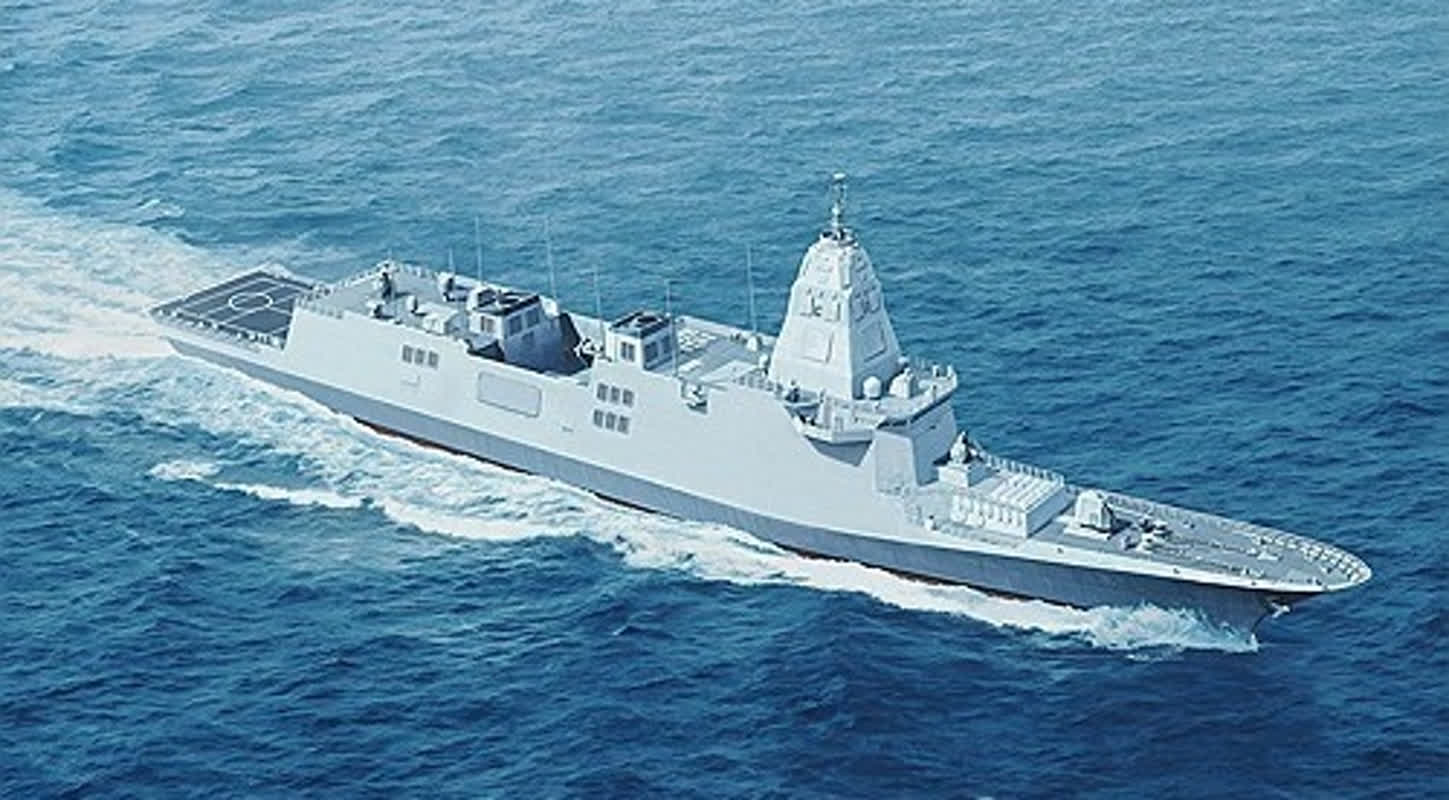
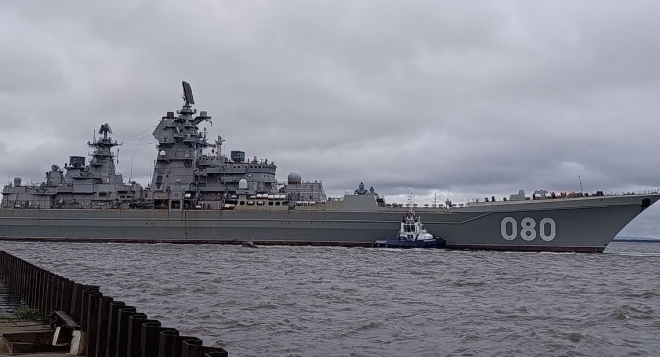 Nuclear propulsion is normally reserved for aircraft carriers and submarines among surface combatants. Russia, however, remains the only navy operating nuclear-powered cruisers. The two vessels are the 24,300-ton Admiral Nakhimov (commissioned 1988) and the 23,700-ton Pyotr Velikiy (commissioned 1998) (24,300 t ≈ 26,800 short tons; 23,700 t ≈ 26,140 short tons).
 NATO designates these ships as Kirov-class cruisers. They were conceived as escorts for Kuznetsov-class carriers to counter U.S. carrier strike groups. Plans included anti-submarine, anti-ship and anti-air variants, but when the Kuznetsov class was fitted with diesel propulsion the escort requirement diminished and budget limits left only the Kirov program moving forward.
Four Kirov-class cruisers entered service between 1980 and 1998. Some were later renamed, and the class is sometimes referred to as the Admiral Ushakov class. During the Soviet era these ships served as flagships in the Northern, Black Sea and Pacific Fleets, but reactor incidents, fires and the Soviet Union’s collapse forced three into early retirement.
Today only the fourth ship, Pyotr Velikiy, remains continuously active as the Northern Fleet flagship. Russia has since refurbished and returned one sister ship to service. Admiral Nakhimov re-entered the water after roughly 25 years of repairs and modernization, part of a broader Russian push to rebuild naval capability and reclaim a superpower posture.
Last August, the military outlet The War Zone and other foreign media reported Admiral Nakhimov conducted sea trials in the White Sea off Russia’s northwest coast. State news agency TASS said President Vladimir Putin was briefed and that the modernized cruiser will serve as a fleet flagship, replacing Pyotr Velikiy while that ship’s upgrade remains on hold.
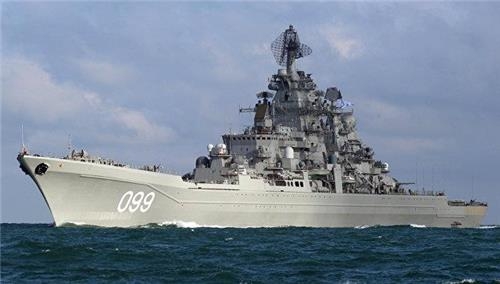 According to reports, Admiral Nakhimov was launched in 1986 as Kalinin and commissioned in 1988. The ship measures 250 m long by 28 m wide (250 m ≈ 820 ft; 28 m ≈ 92 ft). It is powered by two reactors and steam turbines, carries roughly 700 crew, and displaces over 24,000 tons (≈ 26,450 short tons). Upgrades have endowed it with the heavy arsenal intended to confront U.S. carrier groups.
 Apart from aircraft carriers and large amphibious transports, the Kirov-class remains the largest surface combatant in service worldwide. Its sheer scale rivals World War I–era battleships and later battlecruisers, prompting some analysts to call the class “battlecruisers.”
The modernized ships are reported to carry the advanced S-500 air-defense system, newer Kalibr cruise missiles, and the hypersonic Zircon cruise missile. The S-500, under development since about 2011 and nearing fielding, is reported to engage targets at speeds up to roughly 7 km/s and reach out to around 600 km. Russian sources claim it can intercept stealth aircraft, reconnaissance satellites at about 200 km altitude, and up to 10 intercontinental ballistic missiles simultaneously.
Experts describe the S-500 as a first-generation space-defense system because of its claimed ability to target reconnaissance satellites. The 3M-54 Kalibr cruise missile, deployed from 2012, reportedly reaches about 2,500 km and can carry a 500 kg high-explosive warhead or a nuclear warhead on the order of 500 kilotons.
Another high-end weapon reportedly fitted is the Zircon hypersonic cruise missile, which flies at roughly Mach 6 and is reported to have a range near 600 km. External analysts characterize the refit as part of Russia’s broader naval buildup aimed at restoring great-power status.
The War Zone reported the overhaul also added supersonic Oniks anti-ship missiles, an upgraded radar suite and a 130 mm AK-192M naval gun (130 mm ≈ 5.12 in). It noted the centerpiece of Admiral Nakhimov’s modernization is the installation of 174 vertical launch cells—giving the cruiser a missile salvo capacity that, on paper, exceeds that of any existing surface combatant or submarine.

- Iran plays a 'three-stage' card despite the Hormuz blockade…Trump: “No meeting unless you give up nuclear” [Global Morning Briefing]
- Families of the Dec. 29 victims: “Boeing airframe defect is the root cause”...call for an investigation [Incident Plus]
- “OpenAI misses revenue targets”...red flag on covering investment costs
- Cut plastic made from oil by 30% by 2030…“Expand use of recycled feedstock” [Pickconomy]
- Search for Jensen Huang’s eldest daughter sparks 7.7% stock surge…attention on Nvidia and Physical AI partnership [JupJup Report]
- Trump rejects a 'three-step peace plan'...Iran opens a Horn of Hormuz toll account [Global Morning Briefing]
- EV charging fees: lower slow-charging rates, raise fast-charging rates…display pricing like gas stations [Pickconomy]
- UAE drifts from Saudi, tightens pro-U.S. ties…China rallies the 'Global South' [Global Morning Briefing]
- Migrant worker tied to a forklift and mocked…prosecutor seeks 1-year prison term for the attacker [Incident Plus]
- Musk’s nine-hour testimony bombshell…“The tail wagged the dog,” stoking claims of OpenAI betrayal