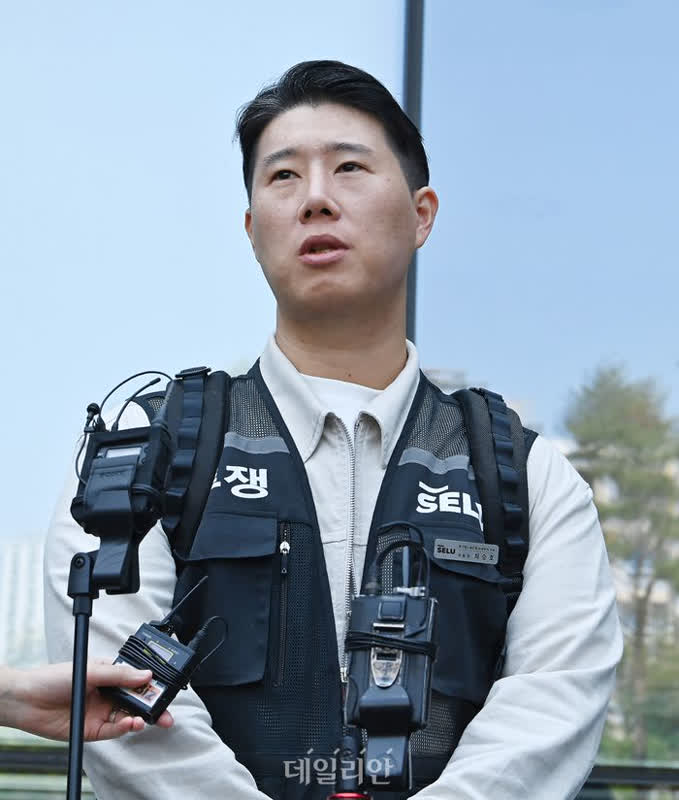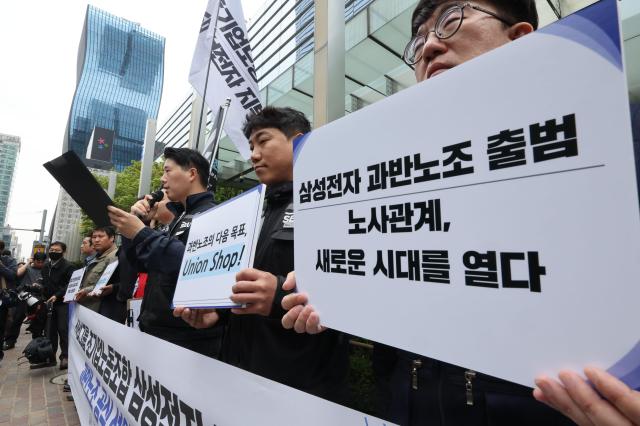
On the 17th of last month, Choi Seung-ho, chairman of the Samsung Group cross-company union’s Samsung Electronics branch (third from the right), held a formal declaration press conference in front of Samsung Electronics’ Seocho building. [Photo=Yonhap News]
Samsung Electronics now faces its largest strike threat since its founding, and growing ethical concerns about union leadership have become a focal point. Critics have zeroed in on remarks by Choi Seung-ho—the chair of the Samsung Group cross-company union’s Samsung Electronics branch, who controls bargaining and contract authority—and on allegations that he maintained a blacklist of employees who did not participate in strike actions. Those allegations have prompted even some union members to openly question his fitness to lead.
Industry sources said that on the 10th, Choi responded aggressively in a union members’ online forum to one member, asking, “Are you part of the Donghaeng executive team? Why are you acting like an informant?” and declaring, “You will be expelled.” The exchange provoked a strong backlash. Despite the member’s request for a chance to explain, Choi announced publicly that he would change the member’s status to one without membership rights and would seek the executive committee’s approval to permanently expel them. Some rank-and-file members say the move amounts to heavy-handed suppression of internal debate.
Choi’s intolerance for dissent has exacerbated tensions within the broader union movement at Samsung. On the 7th, the National Samsung Electronics Labor Union—the company’s second union—sent a formal letter to the cross-company union expressing regret over what it described as coercive remarks intended to exclude members’ views from bargaining and demanding an apology.
The National Samsung union argued that Choi’s conduct goes beyond a personal attack, saying it amounts to an attempt to erase the voices of finished-product (DX) workers from the negotiating table. It warned that such actions undermine the role of member representatives and seriously damage trust between workers and among unions, and it urged Choi to apologize and take concrete steps to rebuild inter-organizational trust.
Earlier, on the 4th, one of Samsung’s three main unions and a DX-focused group—Samsung Electronics Labor Union Donghaeng—announced it was withdrawing from the joint bargaining team. Donghaeng accused the cross-company union of abusing its majority status to willfully ignore and exclude their proposals and of repeatedly making demeaning remarks that could amount to criminal insult under Article 311 of the South Korean Criminal Code.
This is not the first time Choi’s behavior has drawn scrutiny. At the end of last month, as Samsung prepared for what could be the largest strike in the company’s history, Choi took a vacation to Southeast Asia, prompting criticism from employees and observers who called the timing irresponsible and drew attention from government officials monitoring the situation.
While advancing the union’s demands, Choi also made remarks that appeared to disparage other unions and later issued a formal apology. After President Lee Jae-myung made recent comments about Samsung’s union, Choi posted in the members’ community, “This is aimed at LG (Uplus). They’re asking for 30%. They should be asking for a reasonable level like ours (15%).”
The comment touched off a backlash when compared by bonus amounts: Samsung Electronics’ semiconductor division is reportedly seeking an average performance bonus of roughly 600 million KRW (approximately $450,000) per person, whereas the LG Uplus union’s demand is well under 30 million KRW (approximately $22,500) per person. LG Uplus’s union protested, and the cross-company union issued a formal apology, saying, “We sincerely apologize.”