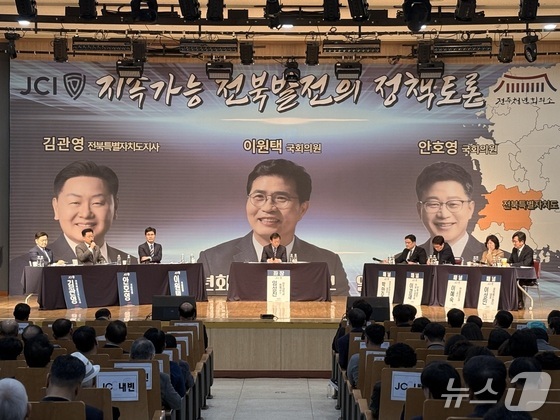
Roughly 10 days before the Democratic Party primary for governor of North Jeolla Province, candidates traded sharp attacks during the first policy debate. Although billed as a forum for policy competition, the event increasingly centered on probing opponents’ weaknesses as the discussion progressed.
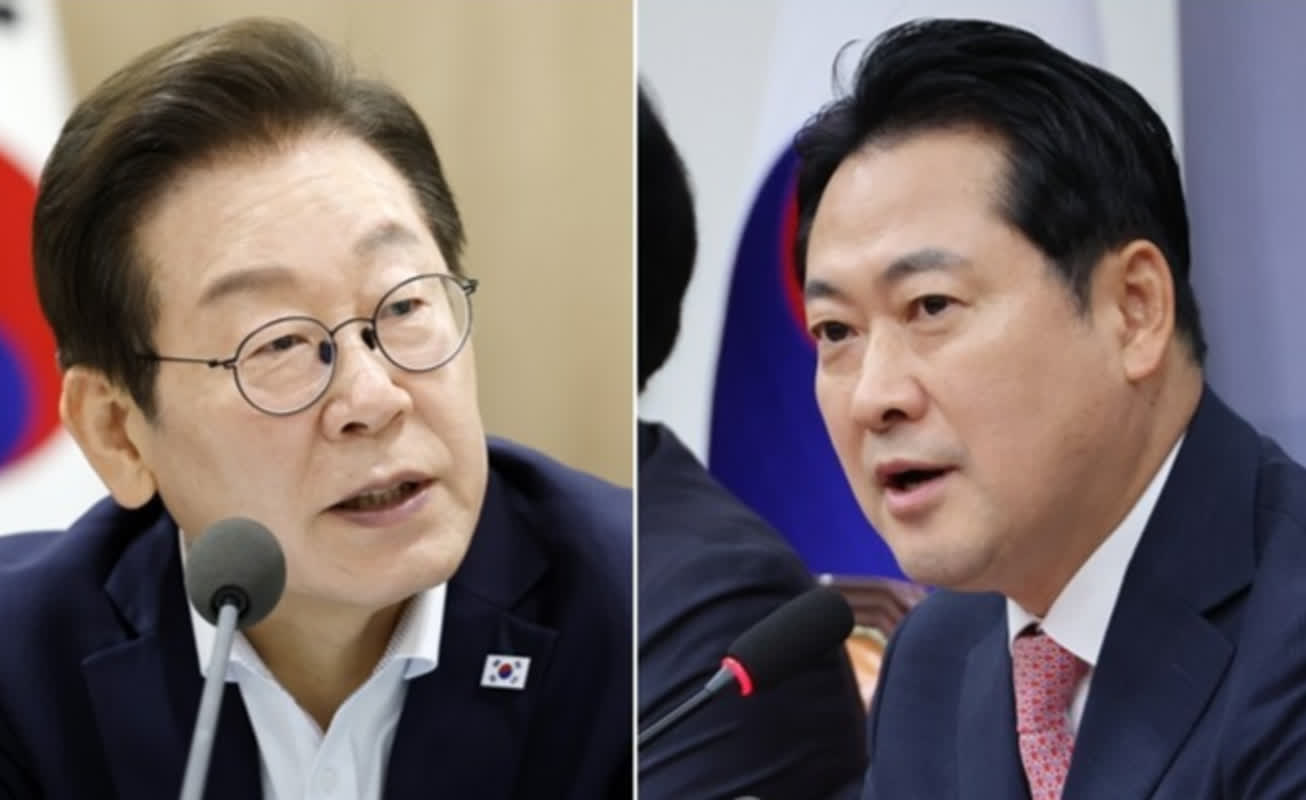
On the 27th, Jeonju University hosted a "Sustainable North Jeolla Development" policy debate co-sponsored by Jeonbuk JCI and the Jeonbuk Ilbo. Incumbent Governor Kim Kwan-young and lawmakers Ahn Ho-young and Lee Won-taek—each vying in the gubernatorial primary—outlined their vision for the province’s next elected term and presented their principal pledges.
The debate opened in a measured tone, with candidates focusing on regional development plans and core policies. But when the format moved to direct questioning, the tenor shifted. Lee launched the confrontation by noting that even the president sold a home while pursuing real estate policy. He said it has been confirmed that Governor Kim owns an apartment in the Seoul metropolitan area valued at about 2 billion KRW (approximately $1,500,000). Will you sell it?
Governor Kim replied, “I own one property in Pangyo registered in my spouse’s name that was purchased in 2008. I cannot decide unilaterally, but I will consult and consider it in light of national policy.”
Lee then pressed on personnel choices at provincial agencies, arguing that outside talent has been favored over local candidates. “Will you actively recruit talent from North Jeolla going forward?” he asked.
Kim defended his hiring approach, saying he has tried to bring professionals from North Jeolla who built significant careers in Seoul back to the province, aiming to reinvest private-sector experience in local development. He added that he would redouble efforts to identify and recruit more talent from North Jeolla.
Lee escalated his critique, saying, “You are praised for passing three state exams, but I’m disappointed that you haven’t demonstrated that capability in office.” He pointed to the World Scout Jamboree debacle, controversy over the Hansang conference results, disruptions in the Olympic bid process, and a failed public competition for an “artificial sun” project as examples that, in his view, undermine claims of competence.
Kim pushed back sharply, saying Lee understood the Jamboree controversy better than most because of his role in the initial site selection. He argued the problems began when President Yoon Suk Yeol attended the opening ceremony and security issues prevented water distribution for four hours, triggering subsequent chaos.
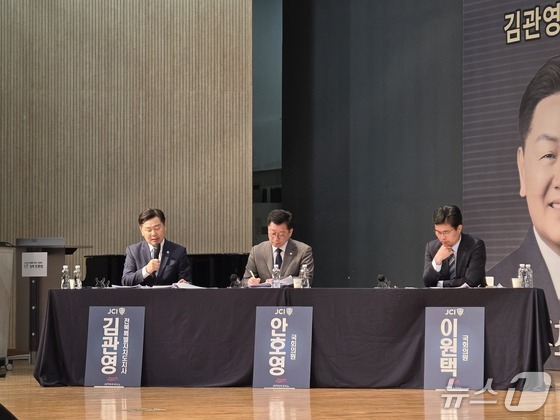
Lee attempted to raise renewed suspicions concerning alleged complicity or acquiescence related to the temporary closure of government offices, but he stopped after Kim referenced a potential violation of election law. The exchange produced a tense back-and-forth between the two candidates.
Kim then pressed Lee over the composition of a proposed Saemangeum special local government. “Last year I met with the heads of Gunsan, Gimje, and Buan and we agreed to form a joint task force, but the plan collapsed because Gimje opposed it,” Kim said. He asked whether Lee’s previous position—that he would not oppose the launch of the special entity regardless of jurisdiction—still stood, effectively highlighting Lee’s responsibility for the breakdown.
Lee responded that he has long supported moving the initiative forward but insisted the provincial government must lead in a neutral and fair manner; he argued the lack of such leadership caused last year’s failure.
When Kim suggested the task force could be formed as soon as next week and said local political circles claimed Lee would not sign off, Lee denied that account. “That’s not true,” he said. “If anything, I’ve received negative feedback about the plan.”
Kim adopted a notably more conciliatory tone toward Ahn Ho-young. He praised Ahn’s proposal to attract a KAIST Namwon AI public-medical campus, calling it “very impressive.” Kim noted that a long-sought bill to establish a medical education center in Namwon appears likely to pass the National Assembly. “If combined with this proposal, Namwon could become the heart of public healthcare in Korea and deliver a major boost to North Jeolla’s development,” he said.
But Ahn criticized the provincial government over a recent error in the benefit-cost analysis for a proposed Jeonju Summer Olympics bid, saying the consulting firm’s mistake caused embarrassment and that the province nonetheless promoted the flawed figures. “Should we treat this as a simple oversight?” he asked. “Some residents say they were misled.”
Governor Kim expressed regret, saying, “The consulting firm’s error put us in a very difficult position. Had we received correct results from the start, we would have fully explained them.”