[Point Economy] With the People Power Party’s primary for Busan mayor heating up, Mayor Park Hyung-joon formally opened a campaign office on March 28 to consolidate three key constituencies. He has recruited policy experts in their 30s and 40s, brought in incumbent politicians, and rallied senior conservative figures—moves analysts say have assembled an organization comparable to a general election campaign.
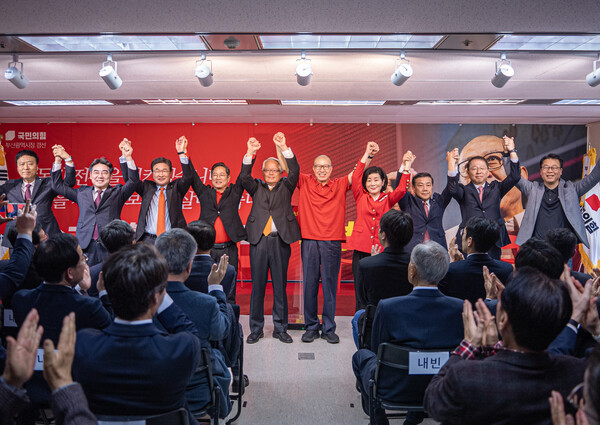
At the camp in the Donga Building in Busanjin District, Park formally launched his campaign before supporters and local residents. The atmosphere felt more like a send-off than a routine opening ceremony.
The campaign billed itself as a "melting-pot" camp. The aim is to build an integrated organization that goes beyond simple factional consolidation to bring together traditional, hardline, and centrist conservatives.
Park’s team also unveiled a second wave of appointments. Attorneys Lee Won-ha and Hong Jae-wook, both in their 30s and 40s, joined the legal support team. City Councilor Kim Hyung-chul was named policy director, Councilor Park Jin-su will lead labor affairs, and Councilor Jung Chae-sook will head the women’s policy office.
Universities supplied substantial support as well. Professor Kim Tae-hee of Youngsan University and Professor Lee Chang-geun of Pusan National University will co-lead the policy faculty group, and roughly 100 professors—including Professor Cho Yong-bok of Dong-A University—have joined the campaign’s policy team.
The mood at the event intensified amid recent political developments. After Park’s symbolic head-shaving, news that the Busan Global Hub City Special Act advanced out of the National Assembly’s Public Administration and Security Committee injected fresh momentum. Speculation that the bill could reach a plenary vote boosted supporters’ enthusiasm and helped consolidate his base, analysts said.
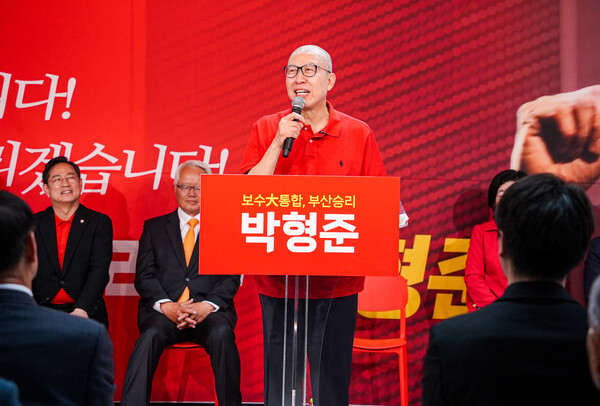
Park said, "The past five years have been a highway propelling Busan toward a global hub city. If we change direction now, the city's destination will inevitably wobble." He added, "We will push ahead with key projects—Gadeokdo New Airport, BuTX, and the Second Centum—without pause to make Busan a world-class city that residents can feel by 2030."
He also argued, "A victory in Busan will put South Korea back on the right course," and described the upcoming local elections as an opportunity to resist trends that would erode local autonomy.
The opening drew a large roster of attendees, including former National Assembly Speaker Jeong Ui-hwa; Representatives Kwak Kyu-taek, Kim Do-eup, Kim Dae-sik, Kim Hee-jung, Baek Jong-heon, Park Soo-young, Lee Seong-gwon, Jeong Seong-guk, and Cho Seung-hwan; district chiefs Kang Seong-tae, Kim Ki-jae, Kim Seong-su, Jang Jun-yong, Lee Gap-jun, and Joo Seok-su; Vice Chair Lee Dae-seok; Floor Leader Lee Bok-jo; numerous city and district council members; and senior conservative figures. Young people, small-business owners, labor representatives, and start-up leaders also attended, signaling an effort to broaden the campaign’s base.
Observers say the event underscored early jockeying for control in the primary. On the same day, Representative Joo Jin-woo also held an opening event, sharpening the competitive dynamic. Park chose a strategy that emphasized both organizational scale and a unifying message.
Bringing in policy experts in their 30s and 40s, incumbent council members, and an extended academic team signals a bid to expand generational appeal while strengthening policy capacity. With the special-law issue now in play, the primary could shift from a person-centered contest to a broader debate over Busan’s development and the changing political landscape.