President Donald Trump has launched rapid measures to impose tangible penalties on countries that effectively refused to cooperate in the Iran war. He announced plans to reimpose tariffs on the European Union (EU) and to reduce U.S. troop levels overseas. Analysts warn that if Washington applies the same measures to South Korea, Seoul could face severe consequences for both its security and its trade.
◆Tariffs barely lowered — now back to 25% after refusals to help…security and trade hit simultaneously
On the 1st (local time), Trump posted on Truth Social that he will raise tariffs on passenger cars and trucks from the EU to 25% starting next week.
In his post, he said he was pleased to announce the tariff increase, arguing the EU has not honored the comprehensive trade agreement the two sides reached.
Last July, the U.S. and the EU agreed to reduce vehicle tariffs from 25% to 15%. Observers say Trump’s move to restore the higher rate appears to be retaliation after the EU and NATO largely declined U.S. requests for support in the Iran war.
Trump repeatedly urged major European NATO members to deploy warships to the Strait of Hormuz; when those requests were not accepted, he publicly expressed his displeasure.
German Chancellor Friedrich Merz sharply criticized the U.S., saying the United States had entered the Iran war with no clear strategy and that the country was suffering humiliation at Iran’s hands.
In response, Trump decided to cut the number of U.S. troops stationed in Germany.
U.S. outlets including CNN, Reuters and The Washington Post report the administration is considering cutting about 5,000 troops in Germany — roughly 14% of the current force.
The Pentagon said the decision followed a thorough review of U.S. force posture in Europe, but media reports, citing anonymous defense officials, interpret the move as part of a retaliatory package.
CBS reported that defense officials view the cuts as signaling President Trump’s dissatisfaction with the level of support European allies have provided for the Iran war.
The New York Times reported that senior Pentagon officials unofficially indicated they wanted the action to be seen as punishment for Germany after recent comments that angered the president.
◆Are South Korea and Japan next? Trump publicly says, “South Korea didn’t help us either”
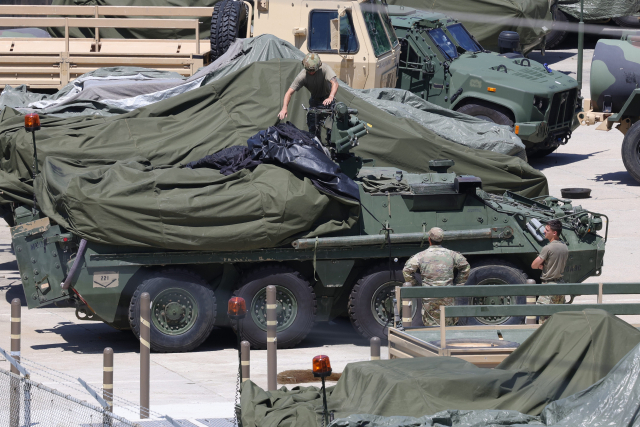
There are concerns the measures could be expanded to other countries. Reports indicate the administration is also weighing cuts to U.S. forces based in Spain and Italy.
Close U.S. allies such as South Korea, Japan and Australia could also be targeted with similar “retaliation packages,” analysts say, noting these countries have been slow to respond to some U.S. requests.
Trump has repeatedly singled out South Korea in public remarks, stepping up the pressure.
At a White House news conference on the 6th of last month, while criticizing NATO, he said, “South Korea didn’t help us,” and added that “we have 45,000 troops in a dangerous area, right next to Kim Jong-un, who has many nuclear weapons.”
In reality, U.S. forces in South Korea number about 28,500, and analysts say Trump’s inflated figure signals strong frustration.
Concerns have grown because Trump has used aggressive tactics in past negotiations. After tariff talks, he abruptly announced a surprise tariff reimposition (25%) last January, accusing South Korea of failing to follow through on concrete U.S. investment commitments.
The dispute eased after the South Korean government renewed diplomatic engagement and following related U.S. Supreme Court rulings. Still, the episode serves as a warning that failing to meet repeated demands from the administration can produce serious diplomatic fallout.
Given South Korea’s heavy dependence on the U.S. for both security and trade, analysts warn that if these measures are implemented, the country could face a major national crisis.
Seoul, however, says it has not been formally threatened so far.
At a regular briefing on the 30th of last month, the Defense Ministry said flatly, “There have been no discussions between the two countries about reducing U.S. forces in Korea.”