During election season, households receive candidate guides called election brochures. I'm usually attentive to formal politics, so when the brochures arrive I review every party and candidate carefully. Parties with no seats in the National Assembly that don't receive public funding usually send single-page leaflets, while well-funded parties in the assembly produce and mail thick booklets.
I have an important habit when I read those brochures: I spread them all out and first count how many female candidates appear. Local elections generate far more materials than national ones because voters must choose many more positions. When I spread every candidate’s brochure across the floor, I can't help sighing — across parties, there are still far too few female candidates.
After six local elections, the pattern was always the same: male candidates overwhelmingly outnumber women, and it's common for all of the major gubernatorial or mayoral candidates nationwide to be men. The imbalance is similar at the city and district council levels.
By now, no one can credibly deny that the candidate nomination system itself favors one gender. Politics is fundamentally about allocation. If we select politicians from such an unequal gender pool, our society will inevitably become less fair — structure determines outcomes.
Why the 20% share of women politicians is a problem
I can say this clearly: increasing the number of female politicians makes our society more equal. Achieving women’s representation is itself a realization of equality.
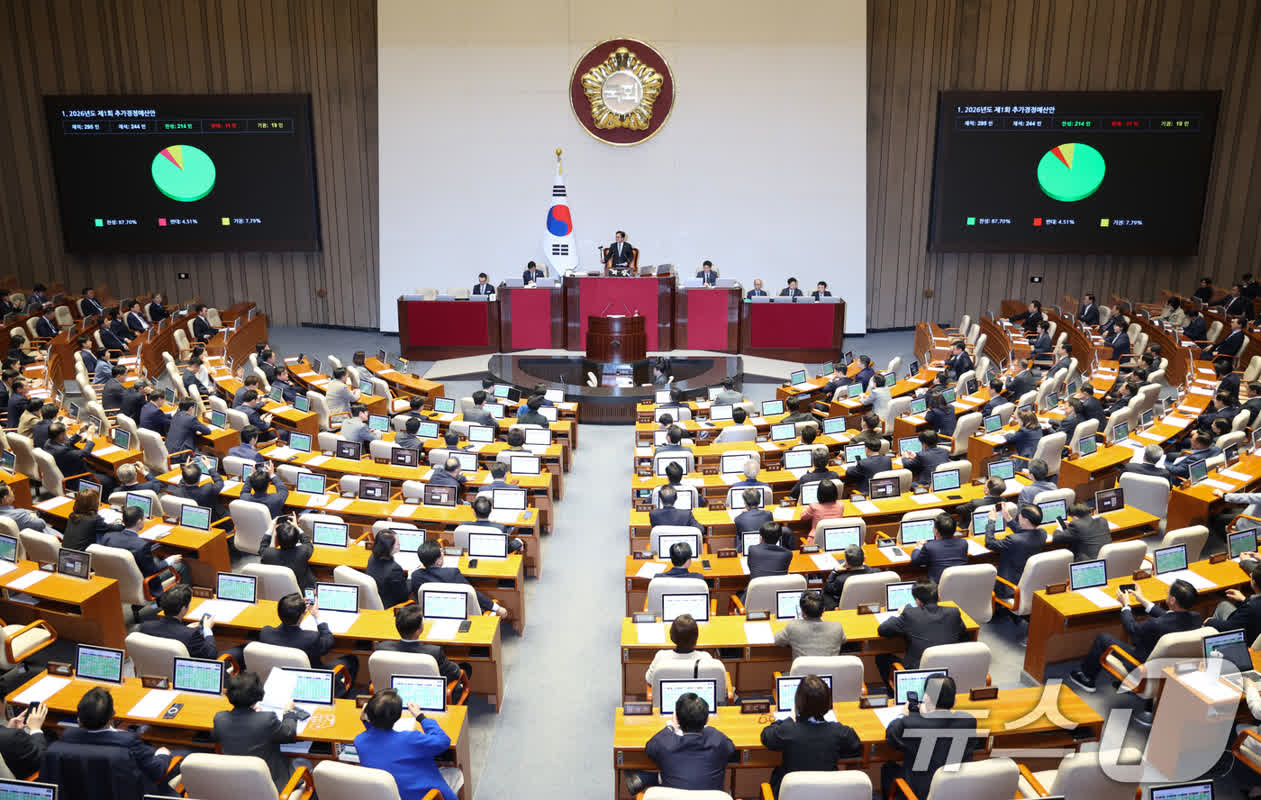
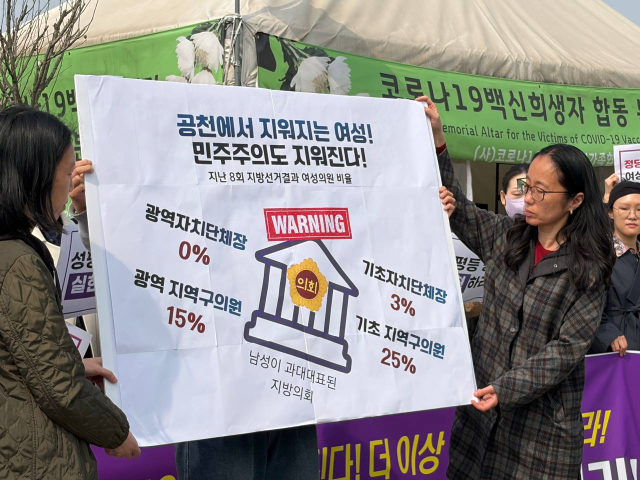
According to OECD data on women's political representation across its 38 member countries (as of March 2025), South Korea's share of women politicians stands at 20.3%. The OECD average is 33.8%, so Korea falls well short. In 2025, women accounted for 20.0% of the National Assembly, 19.8% of provincial councils, 33.4% of municipal councils, and 3.1% of local chiefs — with metropolitan-level executives at 0%.
The shortage of female politicians means women’s representation is weak. When discussing why women’s rights lag despite women comprising half the population, we cannot ignore the lack of female politicians. Female lawmakers are more likely than male lawmakers to introduce bills addressing issues that men often overlook — issues affecting women, people with disabilities, children and the elderly. In the 21st National Assembly, bills related to women averaged more than 11.5 per female member, while male members introduced only about 3.4 each. Korea’s poor showing on gender wage gaps among OECD countries and its 101st place out of 148 on the World Economic Forum’s 2025 gender-equality index (0.687) are linked to the underrepresentation of women in politics.
Cynicism toward politics and politicians runs deep in our society. That cynicism stems partly from historical and cultural factors, but it has been amplified recently because politicians, instead of mediating social conflicts, have exploited partisan divides and stoked tensions — deepening public distrust and aversion.
If political disillusionment continues, corrosive language will take root among the public. A pervasive belief that “politics and parties are all the same” breeds cynicism. Cynicism makes serious civic concerns seem trivial and opens the door to hateful rhetoric. The more that rhetoric spreads, the harder it becomes to solve problems across our political, economic and cultural institutions.
Therefore, political parties have a duty to address public disillusionment. Recruiting and promoting female politicians is the first step in fulfilling that duty. With men comprising roughly 80% of politicians, it is difficult to represent the interests of women and other vulnerable or minority groups.
If you think “Does gender matter? As long as they do politics well, that's enough.”
When people respond to calls for more women in politics by insisting that competence should be the only criterion, they ignore the reality of a deeply skewed political landscape. If gender truly didn’t matter, Korea’s politics wouldn’t be so lopsided. How do you explain men making up about 80% of elected officials? Can we dismiss the charge that gender has effectively become a qualification that overshadows attitude, ability and merit? If this isn’t discrimination, what is?
We must change the reality in which those with the power to enact institutional reforms against discrimination are themselves elected through a gender-biased system.
The 9th nationwide local elections, which will select provincial governors, local chiefs, provincial and municipal councilors and education superintendents, will be held on June 3. In the last local election, women won only 15% of provincial council seats. Parties will not elect women if they do not nominate them. Parties are currently holding primaries and making nominations for this election. Across the political spectrum, parties must deliberately nominate more female candidates. Fielding more women would be the clearest, most objective indicator of a party’s commitment to equality.