[iNews24 reporter Bae Jeong-hwa] The Jeju-style trunk Bus Rapid Transit (BRT) upgrade project has been named one of the worst policies the ninth provincial administration should halt.
On the 22nd, the Participatory Autonomy Regional Movement Coalition released a report listing 34 “worst” policies that metropolitan and municipal executive candidates should commit to stopping if elected, under the slogan “Mayor, please don’t do this!”
The coalition said the list was drawn from civic groups nationwide and targets policies currently pursued by regional and local governments. It highlighted reckless large-scale development, wasteful spending, projects that damage the environment and ecosystems, privatization that undermines public interest, and self-promotional projects by officeholders.
The Jeju Participatory Environmental Coalition singled out five projects it wants the next provincial administration to halt, including the Jeju-style BRT upgrade.
The five projects are the Jeju BRT, the forced push for a second Jeju airport, a land‑use plan change to approve the Hanwha Aewol Forest development, a large expansion of wind and solar power, and the proposed Jeju–Qingdao cargo shipping service.
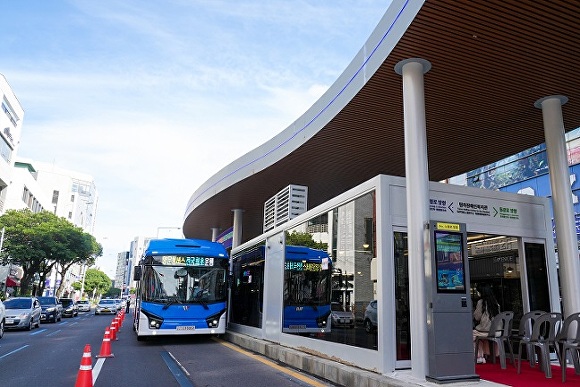
The coalition criticized the Jeju BRT as a project presented as public‑transit improvement that has instead become a civil‑engineering initiative—reconfiguring roads and installing an excessive number of stations.
The Jeju BRT combines island platforms with double‑door buses as part of efforts to restructure the island’s transit system.
Phase 1 allocates 31.8 billion KRW (approximately 23.85 million USD) to build a central bus lane, install island platforms, overhaul the signal system, and introduce a smart traffic system. The plan includes 75 double‑door buses at about 200 million KRW (approximately 150,000 USD) each. With phases 2 and 3, the total cost is expected to exceed 100 billion KRW (approximately 75 million USD).
Yet the BRT has faced criticism for rushed implementation and revealed structural limitations, leaving completion timelines uncertain. Critics say the project proceeded without sufficient consideration of the existing road network and has increased traffic disruption.
On the second airport, the coalition called for a review grounded in residents’ decision‑making rights, including a referendum.
It also criticized the Hanwha Aewol Forest development, saying the provincial government pushed an urban management plan change to secure approval for the project.
Concerns include environmental damage in mid‑slope conservation zones and questions about whether the early environmental impact assessment was merely pro forma, raising allegations of preferential treatment for a large corporation.
The coalition warned that a large expansion of wind and solar power could threaten nearshore fisheries and harm marine ecosystems. On land, it urged stopping indiscriminate approvals because projects would damage conservation areas such as grasslands and gotjawal forests, as well as farmland.
It also questioned the feasibility of the Jeju–Qingdao cargo service and called for the project to be halted.
Last year, Jeju Province signed a deal with China’s Shandong Ocean Shipping Group (hereafter Shandong Line) to operate a Jeju–Qingdao cargo route, targeting 52 sailings a year over the next three years.
But the contract requires Jeju to cover losses from insufficient import‑export volumes, raising concerns that compensation payments could balloon. Jeju reportedly paid about 700 million KRW (approximately 525,000 USD) in loss compensation for a three‑month period from October through December last year. If that trend continues, Jeju could pay roughly 7 billion KRW (approximately 5.25 million USD) per year and up to about 22.5 billion KRW (approximately 16.875 million USD) over three years.
The project also faces allegations it bypassed the Ministry of the Interior and Safety’s local fiscal investment review. Since last year, the ministry has required such review for projects exceeding 10 billion KRW (approximately 7.5 million USD) that could become guarantees, agreements, or debts.
On the 13th, the Participatory Autonomy Coalition announced six policy proposals to reform local administration and councils and strengthen residents’ right to know. It plans to deliver the “worst” list to political parties and candidates for regional and local executives and ask them to adopt pledges to halt these projects.
The Participatory Autonomy Coalition was launched on June 23, 1997, bringing together 18 civic organizations that have monitored power and promoted civic participation nationally and locally. Its goals are to expand and deepen participatory democracy, set the agenda for local civil society development, and consolidate the nationwide capacity of civic movements.