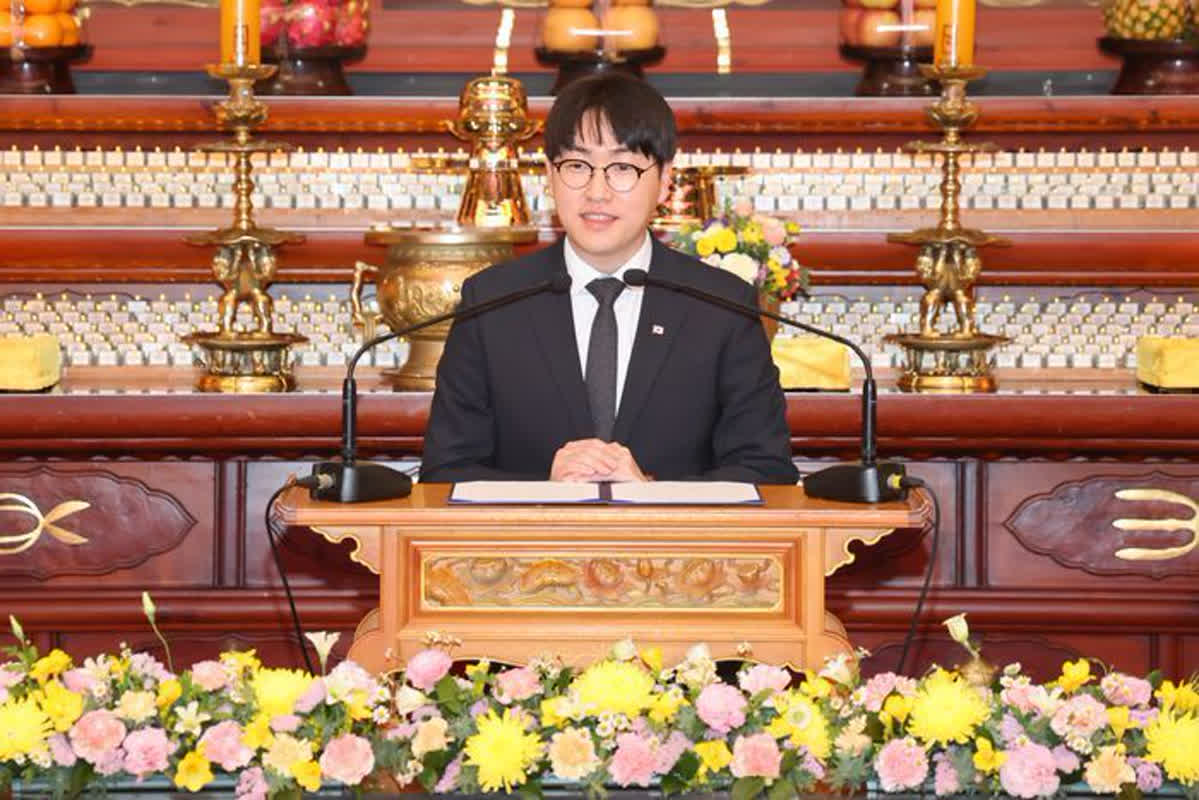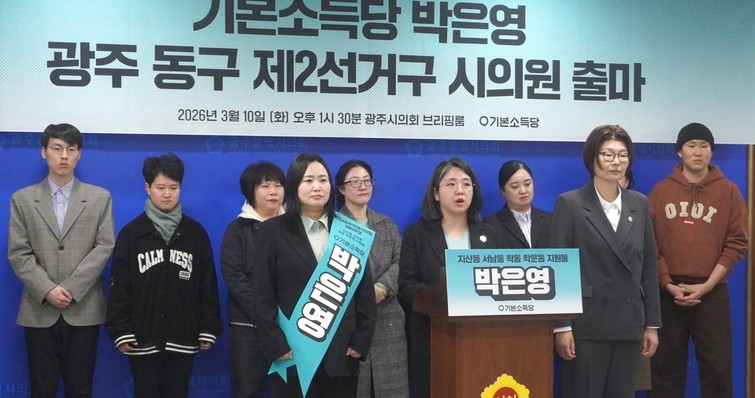
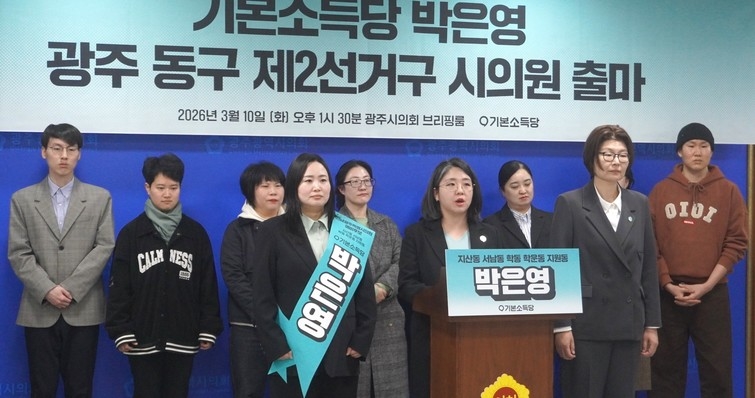
Park Eun-young, chair of the Basic Income Party’s Gwangju chapter, has officially launched her campaign for the Jeonnam–Gwangju Special City Council seat representing Gwangju Dong-gu’s 2nd district.
On the 10th, Park held a press conference in the Gwangju Metropolitan Council briefing room to announce her run in the June 3 local elections, saying, “I will change the lives of Gwangju’s youth through an education basic income.”
Yong Hye-in, leader of the Basic Income Party, attended the event to introduce Park and to unveil the party’s Honam-focused strategy (Honam refers to the southwestern region of Korea).
Born in Namwon, North Jeolla Province, Park has worked in Gwangju for 19 years since she was 25. A former alternative school teacher and human rights activist, she has served as secretary of the Gwangju Alternative Education Council, a full-time activist with the human-rights group Hwaljjak, and chair of the Gwangju Youth Union. She currently chairs the Basic Income Party’s Gwangju chapter and is vice chair of the Special Committee on Child and Youth Basic Income.
As an alternative school teacher, Park supported students who left conventional schools amid intense exam competition, defending alternative educational spaces. She also led efforts to protect youth labor rights as chair of the Gwangju Youth Union, and worked with civil society to draft ordinances supporting alternative education institutions and improving safety and working conditions for delivery workers.
Park pointed to Gwangju’s 2022 local-election turnout — 37.7% — as the lowest in the country. “Young people are leaving their hometowns, and residents who remain are losing faith in local politics,” she said. “I decided to run to put the voices of Gwangju’s youth at the center of local politics.”
She argued that under 38 years of one-party dominance by the Democratic Party, the perspectives of young people were not sufficiently reflected in local governance. “The Basic Income Party will push for new change in progressive politics in Gwangju,” she said.
Park’s principal pledge is to introduce an “education basic income.” She plans to expand the student education allowance currently available in Jeonnam across all of Gwangju and to develop the program into an education basic income that includes out-of-school youth.
She also proposes building regional innovation campuses by linking universities within the special city to strengthen industry ties, and introducing a Gwangju-style paid youth internship program that would expand the city’s existing “Young Work Experience Dream” initiative.
Park outlined additional plans to share the benefits of industrial innovation — including citizen dividends tied to advances in AI and energy sectors — and to support youth and small-business owners through long-term public leases for storefronts. She also supports enacting an anti-discrimination ordinance as part of a broader strategy to foster a cultural and human-rights–oriented city.
Yong praised Park as someone “who has always stood beside young people in classrooms, on the streets, and in public squares,” and said, “The Basic Income Party will concentrate its efforts in Honam during this local election to open a new path for progressive politics.”
Yong added that the party will establish a national campaign committee by the end of March, form a Honam campaign headquarters, and that he will chair the Honam effort personally. “We will open a Honam campaign office in Gwangju Dong-gu, where Park is running, and actively support candidates across Honam — Jeonnam, Gwangju, and Jeonbuk,” he said.
After declaring her candidacy, Park held a roundtable that afternoon at Ji-hye School in Gwangju Dong-gu with teachers and students, officially beginning her campaign activities.