A melody that has traveled across six centuries finds a new voice.
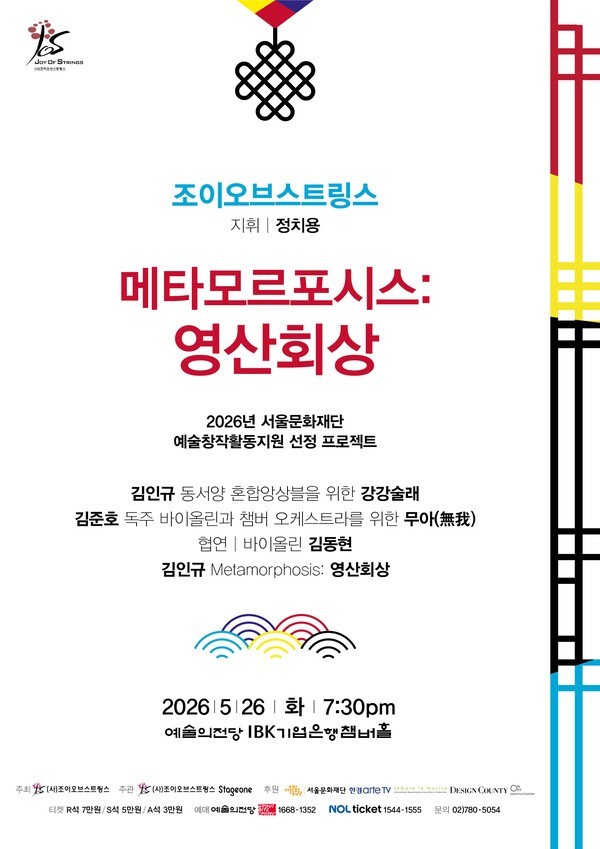
Long regarded as the touchstone of traditional Korean instrumental music, “Yeongsanhoesang” receives a Western chamber-orchestra reinterpretation. “Metamorphosis: Yeongsanhoesang” opens May 26 at the Seoul Arts Center and aims to redraw the map of Korean music history.
The string ensemble Joy of Strings mounts the project as it approaches its 30th anniversary. Since its founding in 1997, the group has widened its repertoire and pursued experimental collaborations. This project is the culmination of that work, placing the core of Korean traditional music within a Western orchestral framework.
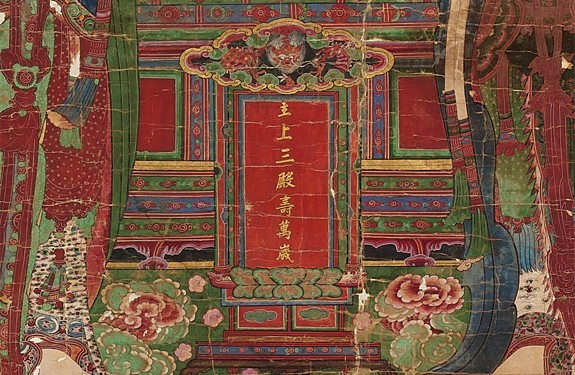
Rooted in Buddhist chant, Yeongsanhoesang evolved into an instrumental suite during the late Joseon period. Instruments such as the piri, daegeum, haegeum, gayageum, and geomungo carry its broad, sustained melodies through the pungnyu salon tradition. Few projects have attempted a full-scale reconstruction for a Western ensemble.
Composer Kim In-gyu approaches the material as re-narration rather than literal translation. Instead of simply reproducing the original melodies, he reorganizes them with Western harmonic logic and formal structures. The result preserves the source’s emotional weight while producing a distinctly new sonic surface.
Conductor Chung Chi-yong, a long-standing figure in Korea’s orchestral scene, leads the performance. With experience at the National Symphony Orchestra and the Seoul Philharmonic, he shapes a program where tradition and modernity, East and West, are braided into a single narrative arc.
Violinist Kim Dong-hyun, the soloist, provides another central axis. A laureate of international competitions, he negotiates Korean rhythmic identity and Western concerto form in Kim Jun-ho’s violin concerto “Mua.”
“Mua” unfolds in three movements, each drawn from distinct traditional concepts. Asymmetrical Chilchae rhythms, material adapted from Cheoyongmu, and shamanistic gestures surface in the tension between soloist and orchestra. The piece reframes traditional notions of time and physicality through contemporary composition.
Guest concertmaster Shim Jeong-eun adds further depth. Known for her sustained exploration of a “Korean-style ensemble sound,” she works to translate traditional breathing into Western instrumental technique. Her involvement situates the project within a longer continuum of research rather than a one-off experiment.
The program opens with “Ganggangsullae.” A repetitive rhythmic pattern gradually expands as traditional Korean instruments intersect with Western strings. Against the breathing lines of daegeum, piri, haegeum, and ajaeng, violin, viola, cello, and double bass build a layered narrative.
“Mua” follows with sharper contrasts. The solo violin propels the work while winds, brass, and strings fragment and recombine rhythmic units. Here, traditional cycles function not as ornament but as structural engines.
The final work, “Metamorphosis: Yeongsanhoesang,” serves as the culmination. A mid-size ensemble — flute, oboe, clarinet, bassoon, horn, trumpet, timpani, and strings — reinterprets the original’s slow, expansive flow through new tonal configurations.
At its core is transformation. A single melodic idea moves across instruments, timbres, and structures, generating entirely new expressions. When cyclical Korean temporality meets linear Western form, unexpected patterns of tension and release emerge.
The project joins a broader conversation about the globalization of Korean music. More than a century after the arrival of Western music, questions of identity remain central. This performance continues that inquiry.
Many works draw on traditional sources, but few attempt full structural transposition. In that respect, the program reads less like an experiment and more like a proposition.
Joy of Strings has consistently pushed beyond conventional concert formats, collaborating with film, broadcast, and regional cultural initiatives. This performance once again crosses formal boundaries.
“Metamorphosis: Yeongsanhoesang” does not aim to reproduce the past. It dismantles and reconstructs it in contemporary terms, revealing tradition not as a fixed inheritance but as a living, mutable system.
The result may feel unfamiliar. Yet that unfamiliarity points toward another possible future for Korean music.
Reported by News Culture M.J._mj94070777@nc.press