In June 2014, when Kim Jong Un toured a military-run water-slide factory, intelligence agencies grew suspicious.
Even within North Korea's military-industrial apparatus, it was unusual for the armed forces to operate recreational facilities. Crucially, Kim Yong-chol — then head of the Reconnaissance General Bureau, which oversaw operations against the South and overseas — accompanied Kim Jong Un dressed in a worker's uniform.
Twelve years later, the true purpose of that visit appears clearer. Analysts now believe the aim was not water slides but securing FRP (glass fiber–reinforced plastic) resin — a material suited to drone airframe construction.
Kim Jong Un's emphasis on drones began soon after he took power. After becoming supreme commander at the end of 2011, he picked the Western District Aviation Club as his first stop to observe military activities.
He watched a propeller-driven unmanned aircraft control competition and assessed drone capabilities — his first formal military engagement. At the 8th Party Congress in 2021, he elevated the drone program to parity with nuclear and missile projects in a five-year defense-strengthening plan.
Footage recovered from North Korean drones that flew into South Korea in 2013–2014 included images of key facilities and terrain. Analysts say Pyongyang was pursuing a strategy to counter satellite surveillance with drone reconnaissance.
Twelve years in power: a consistent priority on drones
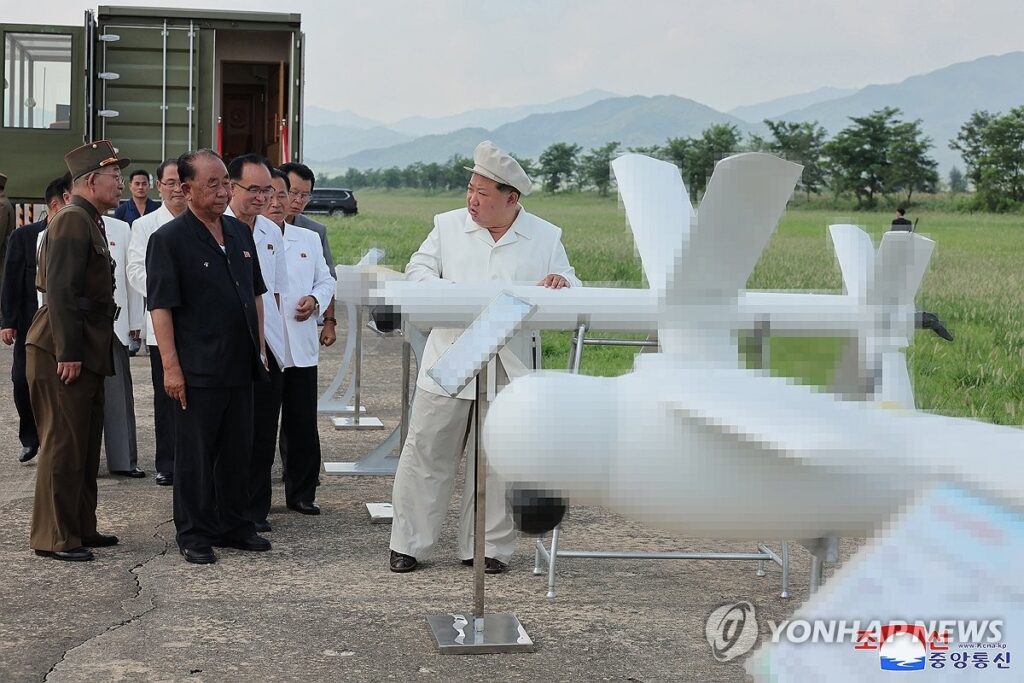
Kim Jong Un's drone strategy was not a passing interest but a deliberate, systematic effort. North Korea had shown interest in unmanned aircraft since the 1970s, acquired China's D-4 (ASN-104) in the late 1980s, and produced indigenous types such as the Banghyon-I and Banghyon-II in the early 1990s.
Under Kim Jong Un, the program shifted qualitatively. Systems once limited to reconnaissance evolved into strike-capable drones, and production moved from ad hoc procurement to organized mass manufacture.
After the Hanoi summit collapse in 2019, Pyongyang doubled down on self-reliance and accelerated military modernization. Drones emerged as a strategic force to compensate for a comparatively weaker air force versus South Korea and the United States.
Analysts estimate North Korea now operates more than 1,000 unmanned aircraft.
From FRP to carbon composites: the secret of materials advancement
The real focus of the 2014 water-slide factory tour was materials acquisition.
A defense specialist noted that the FRP resin used for water slides is widely used across automotive, maritime and military applications. He said it's highly likely North Korea applied that resin to early unmanned aircraft construction.
FRP is lightweight and durable, making it suitable for initial drone builds.
In 2017, Pyongyang announced it had independently developed carbon composite materials commonly used in drones. Carbon composites offer higher strength and lower weight than FRP, and are essential for long-range reconnaissance and strike platforms.
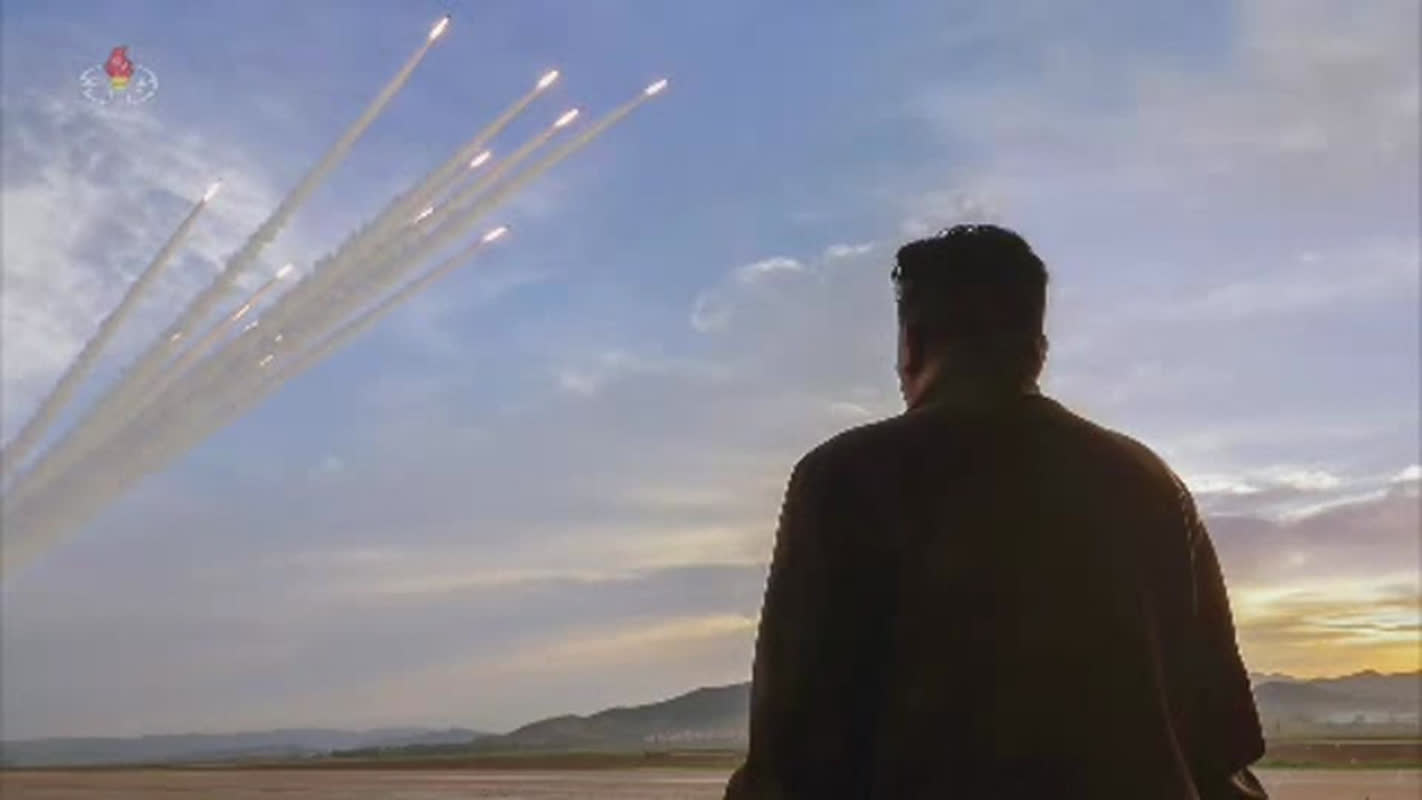
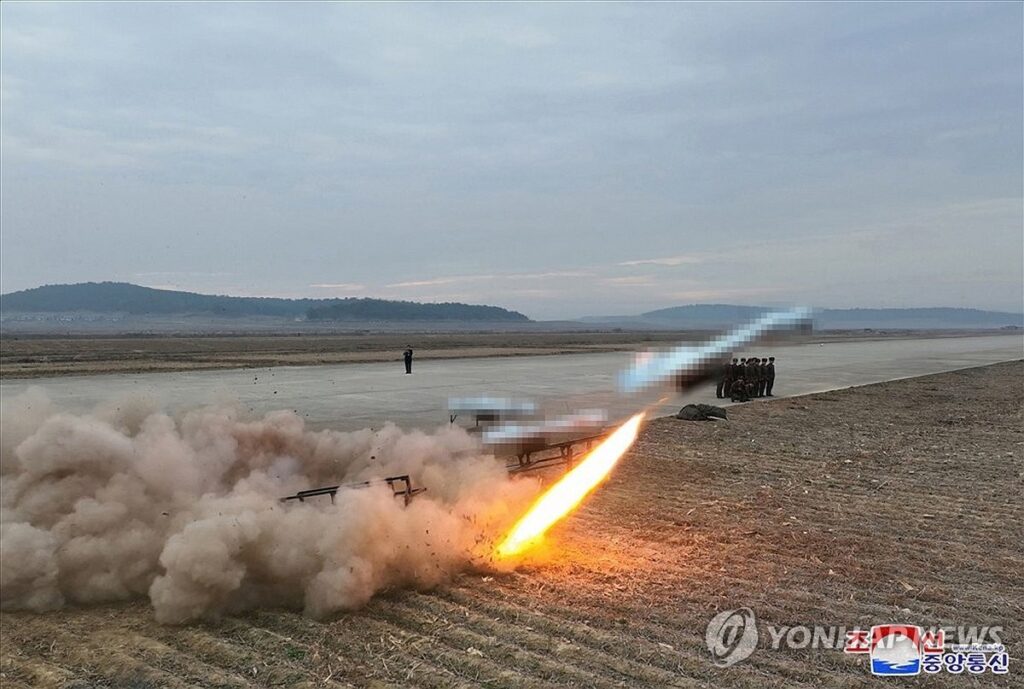
Advances in materials translated directly into improved drone capability. Observers say the kamikaze drone tests Kim Jong Un attended in March and October 2025 demonstrated an upgraded drone force built on carbon-composite airframes.
Mass-production leap with China and Russia's help: 100 drones a day
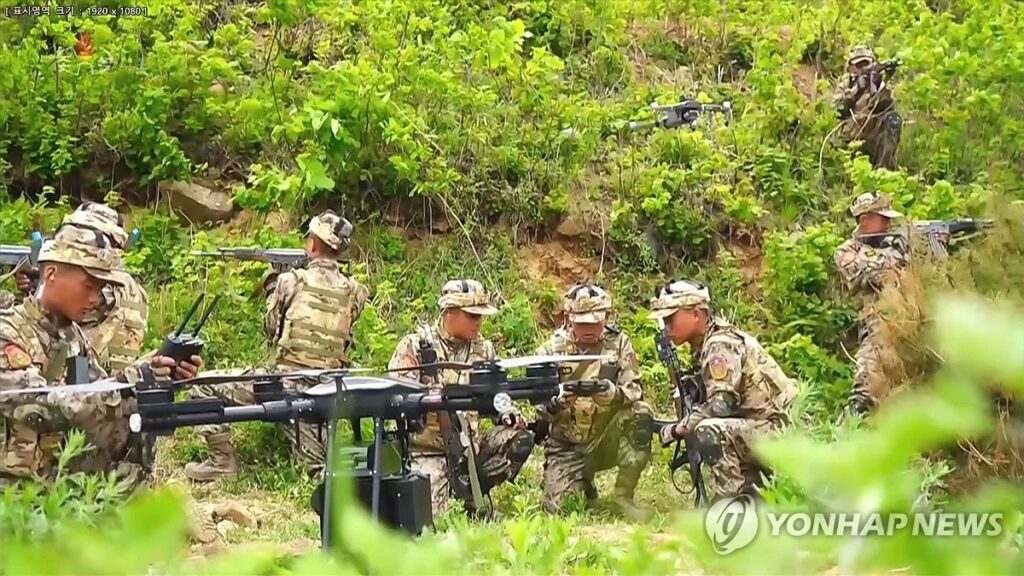
Kim Jong Un's drone strategy accelerated after North Korea deployed personnel to Russia. As unmanned systems proved a battlefield game-changer in Ukraine, Pyongyang reportedly obtained drone-related technical support in exchange for its deployments.
Foreign media report signs that, with Chinese and Russian assistance, North Korea has established facilities capable of producing roughly 100 modern drones per day.
At that rate, production would reach about 36,500 units annually — a scale that would allow Pyongyang to treat drones as expendable munitions in attrition-heavy conflicts.
On the Ukrainian battlefield, reconnaissance, attack and loitering munitions are expended by the hundreds each day and have a decisive effect. North Korea appears to have rapidly integrated those lessons into its force structure.
Even if South Korea and the United States retain superiority via satellites and stealth platforms, swarms of low-cost drones have emerged as a new axis of threat that planners must reckon with now.