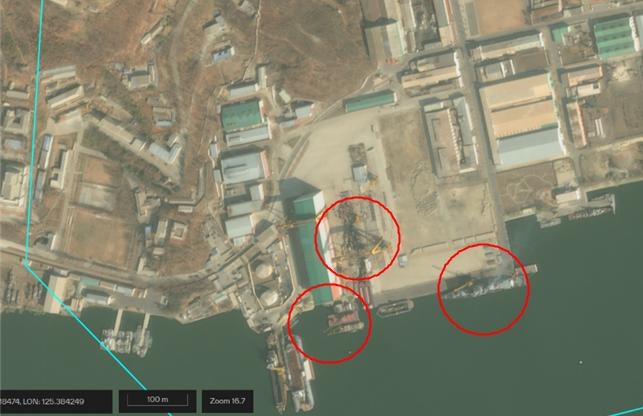
On April 2, Rep. Yoo Yong-won of the People Power Party released an analysis of images taken March 12–28 by U.S. satellite company Vantor. He said the lead ship, launched last April, appears to be moving into operational readiness.
The imagery shows clear exhaust plumes and other signs of engines running, as well as crane movements consistent with installing additional weapons or equipment.
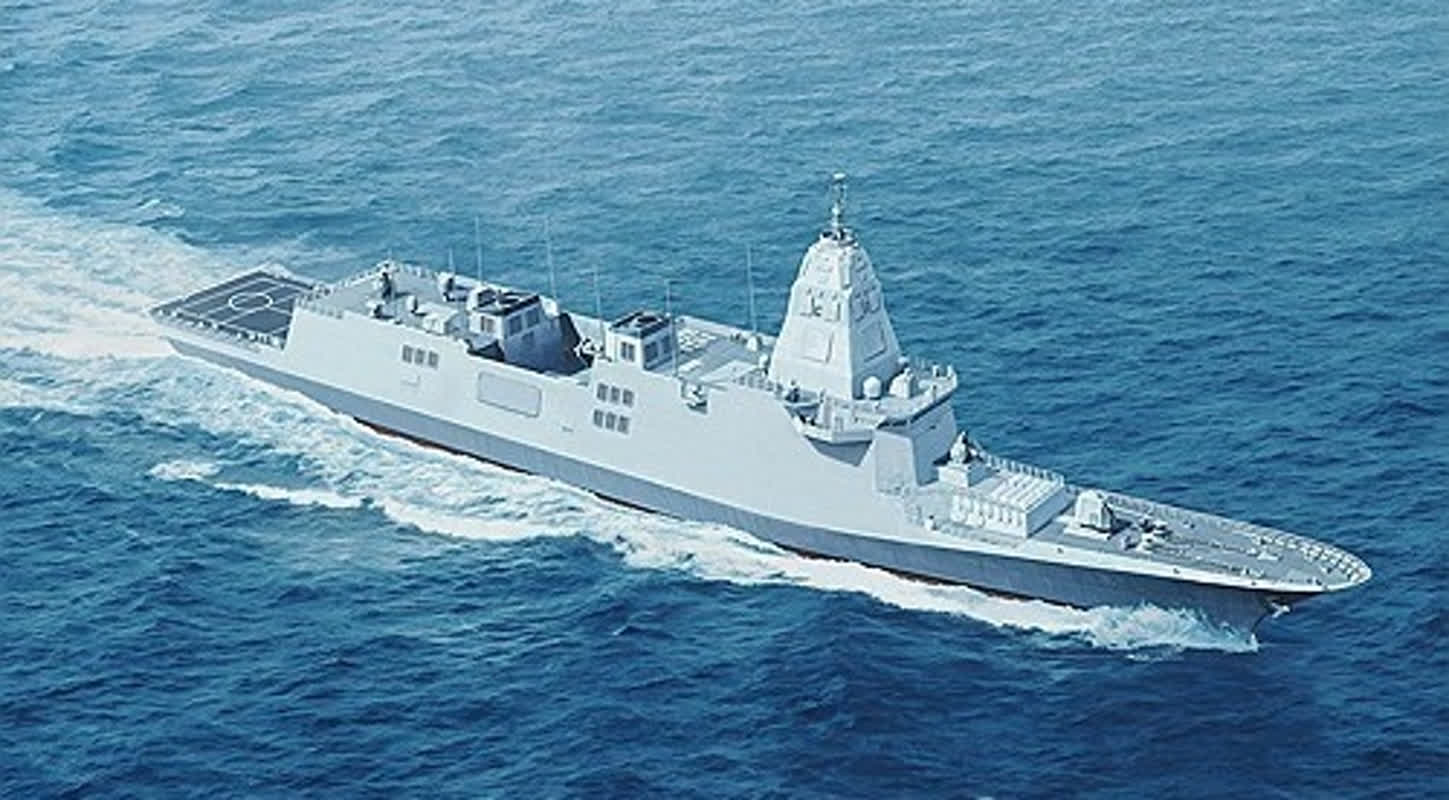
The Choehyun-class is a large surface combatant with a full-load displacement above 5,000 metric tons. It features a four-faced fixed phased-array radar mounted beneath the mast, which provides 360-degree surveillance and has drawn comparisons to an “Aegis”-style system in North Korean reporting.
Armament reportedly includes a single 127 mm gun, short-range air-defense missiles likened to Russia’s Pantsir, an anti-ship missile compared to the Spike, and a new close-in weapon system (CIWS) for point defense.
The ship also appears to carry a 54-cell vertical launch system (VLS) — 24 cells forward and 30 aft. Of those, 34 are medium-or-larger launchers that analysts say could fire long-range Hwaseol-class cruise missiles capable of carrying tactical nuclear warheads such as the Hwasan-31, as well as supersonic cruise missiles and tactical ballistic missiles.
Based on average speeds for strategic cruise missiles, analysts estimate a strike range of roughly 2,000–2,500 km, putting U.S. bases in Japan — including Okinawa — and waters near Guam within reach.
Satellite imagery also shows large cranes and a floating heavy-lift derrick operating continuously around the third Choehyun-class hull under construction at the Nampo Shipyard.
Rep. Yoo noted the cranes’ positions change regularly, which suggests the work is more than material staging. The pattern is consistent with lifting large blocks and installing superstructure elements such as radars and weapon systems — a sign of late-stage construction.
Jang Young-geun, director of the Missile Center at the Korea Institute for National Strategy, said the crane activity matches the fitting-out phase, when sensors, masts and piping are installed after the hull form is complete. “What matters is that North Korea appears to be sustaining the shipbuilding and port operations required to continue building large surface combatants,” he said.
North Korea is reportedly aiming to complete the third Choehyun-class ship by the Workers’ Party founding anniversary on Oct. 10, and the schedule appears to be accelerating to meet that target.
Rep. Yoo warned that broad Russian military-technical support has accelerated North Korea’s naval modernization. He said recent remarks by Kim Jong Un about “naval nuclear armament” signal an intent to use Choehyun-class destroyers as nuclear-capable platforms, equipping them with Hwasan-class cruise missiles and sea-launched ballistic missiles analogous to the Iskander.
Yoo added that, beyond existing ground-based TELs (transporter-erector-launchers), SLBMs (submarine-launched ballistic missiles) and 600 mm super-large rocket systems, Pyongyang is now openly pursuing Choehyun-class destroyers as an additional nuclear-projection platform. If North Korea fields sea-based strategic cruise missiles and KN-23–family ballistic missiles, he warned, it would represent a grave and destabilizing threat to South Korea’s security environment.