|
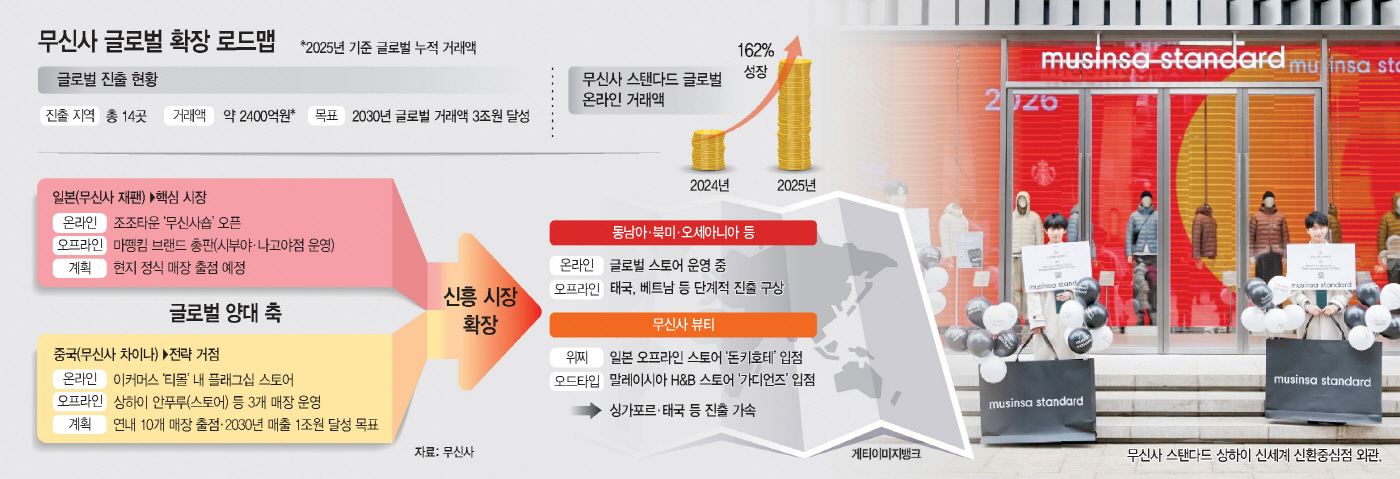
On the 30th, Musinsa said it is conducting global operations across 14 regions in key territories, including Asia, North America and Oceania. That expansion has helped the Musinsa Global Store — which hosts roughly 4,000 K-fashion brands — top KRW 240 billion (approximately $180 million) in cumulative transactions last year. Since the Global Store launched in September 2022, it has been growing at roughly three times year-over-year on average. Notably, Musinsa’s private label, Musinsa Standard, saw global online sales jump 162% year over year, becoming a core category.
Musinsa’s global strategy currently rests on two pillars: Japan and China. While many other markets rely mainly on online channels, Musinsa is using a two-track approach in these countries — combining online and offline tactics to broaden local touchpoints.
Choosing Japan as its first overseas market in 2021, Musinsa has posted steady growth there. Local transactions rose 145% last year, and monthly sales surpassed KRW 10 billion (approximately $7.5 million) for the first time in October. The company expanded its distribution by running a Musinsa Shop on Japan’s Zozotown and serving as the distributor for several Korean brands. Musinsa is also boosting offline presence: it will host a large pop-up in Tokyo again in April and plans to open an official local store down the line.
In China, Musinsa’s offline expansion has been especially rapid. Unlike the online-first strategy it used in Japan, Musinsa pursued online and offline channels from the start in China to scale quickly.
In August last year, Musinsa formed a joint venture, Musinsa China, with ANTA Sports to enter the market. After opening its first Shanghai store in December, the company has already grown to three locations (one Musinsa store and two Standard outlets) in about four months. Musinsa plans to open two more Standard stores in the first half of the year and aims to build a total of 10 local bases within the year.
This push reflects strong brand preference among Greater China shoppers. Among foreign customers at Musinsa’s domestic Standard store last year, Chinese buyers made up 19% and Taiwanese buyers 18% — the largest shares. Musinsa also hit KRW 500 million (approximately $375,000) in sales on Tmall in roughly two weeks after launching there last year.
Musinsa is also targeting emerging markets like Southeast Asia and the Middle East. The company is considering a phased offline rollout centered on Thailand and Vietnam, and plans to more than double the number of stores across major Asian markets this year.
Beyond fashion, beauty — with its lower entry barriers and wider scalability — is acting as a catalyst for Musinsa’s global push. Musinsa’s beauty private labels, Oddtype and Wichi, are aiming at markets from Japan and Southeast Asia to North America. Global beauty sales rose 161% year over year last year.
Born out of the Japan launch, Oddtype has expanded distribution to Malaysia, Vietnam and Singapore and is slated to enter the U.S. and Australia in the first half of the year. Wichi broadened its offline reach by entering 300 Don Quijote stores across Japan in November.
◇ Introducing C-level leadership to manage expansion and culture at once
To manage risks from rapid scaling and speed up expert decision-making, Musinsa introduced a C-level governance system at the end of last year.
Park Jun-young, the company’s chief global officer (CGO), oversees global operations. Mike Ikeda, head of the Japan unit, and Kim Dae-hyun, head of the China unit, run autonomous local operations tailored to their markets while following HQ guidelines to keep the brand consistent — a balance that enables fast local responses without losing a unified global direction.
Appointing Cho Nam-seong, a recognized organizational-management expert, at the same time reinforced that strategy. Cho serves as CEO and chief human resources officer (CHRO), tasked with transplanting Musinsa’s distinctive organizational culture into overseas teams.
Musinsa’s ultimate aim is more than selling products: it wants to become a growth partner that exports Korea’s entire fashion ecosystem abroad. With strong brand power and a systematic management structure, Musinsa’s global expansion is likely to gain further momentum.
A Musinsa spokesperson said, Alongside cross-border commerce centered on the Global Store, Musinsa is diversifying its global portfolio with local businesses in Japan and China, brand distribution and beauty. We will actively expand offline bases in China and other markets to link online and offline organically, strengthen our brand business and sustain our global growth momentum.