Estée Lauder Acquires Stake in Indian Beauty Brand
L'Oréal, Sephora Make Moves into India
K‑Beauty Players Like Amorepacific and APR Join the Race
L'Oréal, Sephora Make Moves into India
K‑Beauty Players Like Amorepacific and APR Join the Race
According to industry sources on the 9th, Estée Lauder Companies recently struck a deal to acquire the rest of Indian beauty firm Forest Essentials. Estée Lauder first took a minority stake in Forest Essentials in 2008 and increased its holding to 49% in 2020. The company plans to buy the remaining shares and complete the acquisition by the second half of this year.
Forest Essentials, founded in 2020 and based in New Delhi, blends Ayurveda—India’s traditional medical system—into its skincare line, similar to how hanbang influences Korean herbal cosmetics. It positions itself as a premium brand: a single jar of cream can cost roughly 40,000–50,000 KRW (about $30–$38). Estée Lauder said the acquisition should help it win share in India’s prestige beauty segment, calling the market one of the world’s most dynamic.
Other global beauty players are also betting on India. In January, L'Oréal announced plans to build a beauty tech hub in India with an initial investment of 35 billion rupees (about $421.3 million). The hub is meant to be a global center for AI-driven beauty innovation, speeding the rollout of advanced AI beauty solutions and creating roughly 2,000 tech jobs by 2030. Last January, Unilever’s India unit acquired local brand Minimalist, and Sephora forged a partnership with Indian retailer Reliance Retail.
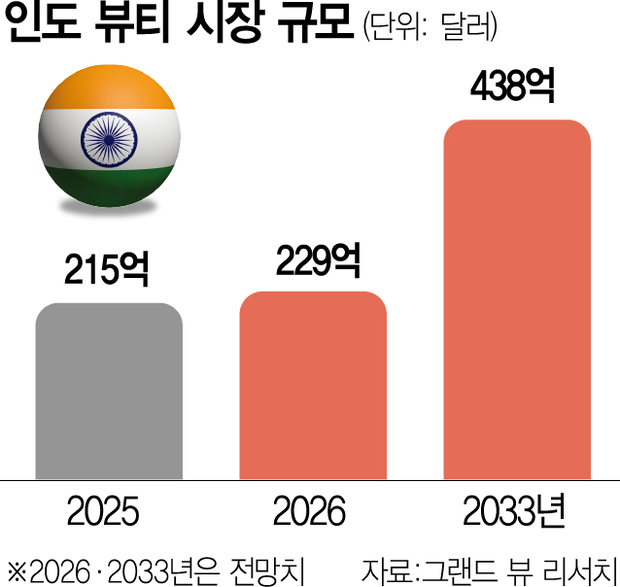
The appeal is India’s rapid growth potential. Market researcher Grand View Research estimated the Indian beauty market at $21.5 billion in 2025 and projects a compound annual growth rate of 9.3%, reaching $43.8 billion by 2033. A young population with growing incomes and keen interest in beauty products — plus faster e‑commerce and quick‑commerce delivery — are all fueling stronger consumer demand.
Korean companies are accelerating in India, too. Amorepacific, which set up its India unit in 2013 and introduced brands like Innisfree, Laneige and Sulwhasoo, launched dermocosmetic label Illiyoon this month. APR, which had focused on North America, signed a strategic partnership last month with Indian beauty retailer Nykaa to enter the market. Cosmetics ODM Cosmax is also moving ahead with plans to establish an India subsidiary. An industry source noted, “India is being eyed as the next China, but last year K‑beauty exports to India totaled only $95 million, ranking 23rd. Given the market’s potential, we expect more Korean beauty firms to accelerate their expansion.”

Kim Yeonha’s Killing Issues dives deep into major topics and trends across the food, fashion and beauty industries, unpacking company strategies and market shifts. It delivers practical insights for industry insiders and curious readers alike. Subscribe to get the latest updates fast.