 |
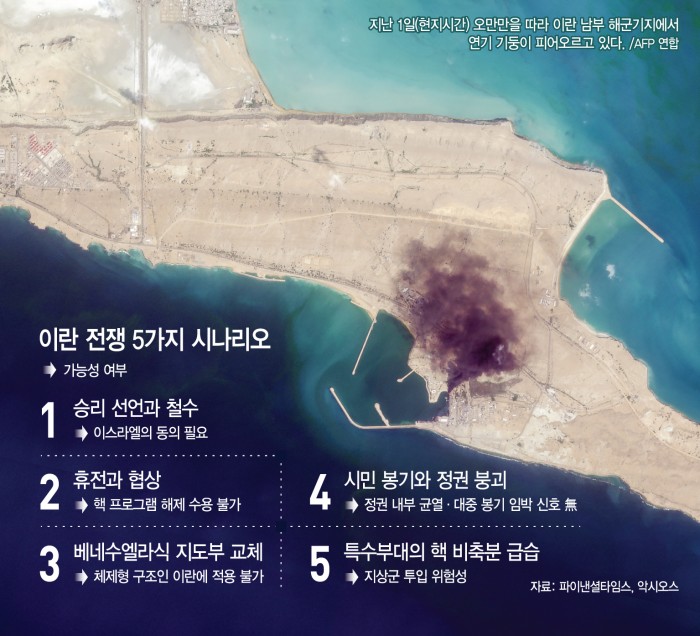
◇ Iran endgame scenario ①: Trump declares victory and withdraws to blunt domestic pressure
The first scenario envisions President Donald Trump declaring an end to hostilities and proclaiming victory. The FT reported that U.S. political analysts expect Trump to claim success regardless of how the fighting concludes. Michael Doran, a senior fellow at the Hudson Institute, told the paper Iran has applied maximum pressure on the United States by targeting U.S. allies, degrading regional defenses and driving up global energy costs.
Axios likewise cited a possible outcome in which Trump declares victory and withdraws. Axios noted that such a move might still require Israeli buy-in and that Israel would likely press on independently to permanently eliminate Iran’s nuclear threat.
◇ Scenario ②: A negotiated truce and a nuclear agreement
The second scenario foresees a cease-fire reached through negotiations and a renewed nuclear deal. Axios reported that rolling back Iran’s nuclear weapons program was a core objective for Trump and that three rounds of indirect nuclear talks were held in Geneva up to the brink of war. In a Fox News interview, Trump said negotiations could resume. Axios added that Omani intermediaries had reported Tehran agreed not to stockpile enriched uranium before the fighting began, but it cautioned the war’s impact on future talks is unclear.
The FT argued that as long as U.S. and Israeli strikes continue, Iran is unlikely to agree to a cease-fire. It also noted that U.S. demands for complete nuclear dismantlement and the disbanding of Iran-aligned Shia militias represent red lines for Tehran.
◇ Scenario ③: A Venezuela-style leadership change — unlikely to work in Iran
The third scenario follows a “Venezuela model.” Trump has pointed to the January arrest of Nicolás Maduro and subsequent dealings with interim leader Delcy Rodríguez as an example.
Analysts caution the analogy is weak. Axios, quoting experts, said Iran’s power is deeply embedded across military, religious and political institutions, so removing a single leader is unlikely to produce regime change. Installing a U.S.-backed internal figure could be perceived by Iranian protesters as betrayal rather than liberation.
◇ Scenario ④: Popular uprising and regime collapse — or a weakened regime that endures
The fourth scenario is a mass uprising that topples the regime. Axios pointed to the reported death of Ayatollah Ali Khamenei, severe economic collapse and large pre-war protests in Iran as factors that could make regime collapse plausible. Still, it noted the opposition lacks a unified leader and an organized ground force.
The FT found no clear signs of an imminent split within the ruling system or an immediate mass uprising. It sketched longer-term outcomes in which the regime survives in a much-weakened form — comparable to Iraq after the first Gulf War — or fractures into a fragmented civil war, with a rump state controlling parts of the country while militias backed by external actors fight over territory.
◇ Scenario ⑤: Special-operations raids on nuclear caches and a continued Israeli offensive
The fifth scenario involves special-operations forces raiding Iranian nuclear stockpiles. Axios reported U.S. and Israeli planners discussed inserting special forces to physically secure or destroy caches of highly enriched uranium. That approach would remove the nuclear threat by force rather than by agreement, but it carries high risk because it would require ground operations inside Iran.
The FT said that even if the U.S. ends its campaign against Iran, Israel is preparing an extended offensive to keep pressure on Hezbollah in Lebanon. The paper warned Israel’s actions could both further degrade Hezbollah’s capabilities and deepen political and social instability inside Lebanon.