![AI-generated image [Photo: ChatGPT]](https://contents-cdn.viewus.co.kr/image/2026/03/CP-2023-0070/image-49e197fa-c625-46b8-8c1c-1ee194e8fbf5.png)
AI is rapidly reshaping the fashion world. What started as simple product recommendations has expanded into everything from curated campaign creation to virtual-model marketing—spreading across day-to-day operations. Brands are leaning on AI not just to boost efficiency but to build hyper-personalized shopping experiences for customers.
On March 15, industry sources said fashion platform Ably has been refining its AI-powered personalization to better match users’ tastes. Rather than just comparing prices or listing lookalike items, Ably cross-references behavior from users with similar preferences to surface smarter picks. So if one user clicks a floral dress, the system might suggest tweed dresses or blouses that others who liked that floral dress also checked out.
That smarter recommendation engine runs on massive data. Ably has about 10 million monthly active users (MAU), generating roughly 400 million behavior records a day on average. The company accumulated about 150 billion records last year alone. Ably says it plans to use that pool of data to create a “preference graph” shopping experience across fashion, beauty and lifestyle—so it can read tastes more precisely and personalize the entire discovery-to-purchase journey.
Zigzag, the style-commerce platform run by KakaoStyle, is also expanding its AI playbook. It has strengthened personalization using click, favorite, cart and purchase data, and it’s brought AI into campaign production. What began as simple related-item suggestions when someone added a product to their cart has evolved: AI now generates campaign banner images and automatically surfaces tailored product selections for each user.
A KakaoStyle spokesperson said, "We currently run more than 70% of our campaigns as AI-automated events, and we plan to raise that share to 90% this year." They added that AI cuts repetitive production work while letting the company roll out campaigns that reflect individual preferences much faster.
LF has introduced an AI automation system for product descriptions on its online store, LF Mall. Where merchandisers once wrote descriptions by hand, AI now assists and automates that copy, making description writing about ten times faster. That saves repetitive time during product registration and lets LF publish product information more quickly.
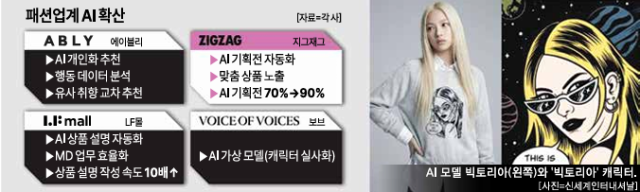
In marketing, AI models are front and center. Bobe, a brand under Shinsegae Tom Boy, unveiled Victoria, a photorealistic virtual model brought to life from the brand’s character. Brands have used AI in lookbooks and ads before, but putting a virtual figure forward as the brand’s main model is still fairly rare—a bold move that’s drawing attention.
Industry insiders say the real edge in AI comes down to data: how much you collect and how well you use it. Recommendation tools are becoming standard, but outcomes depend on the quality and depth of a company’s data and its analytical finesse. "As AI becomes more common, what ultimately determines performance is how much high-quality data you accumulate," one industry source said, adding that AI adoption is improving shoppers’ experiences and accelerating the broader shift to an AI-driven transformation (AX).