|
Attitudes toward marriage, childbirth, childrearing, and family have diverged sharply between older and younger generations. Even as a culture that avoids marriage and childbearing takes hold, government policy remains focused on visible institutional fixes and expanded financial incentives. The current approach, which assumes a simple, linear link between program spending and higher fertility, misses the complex, long-term shifts in social and cultural values.
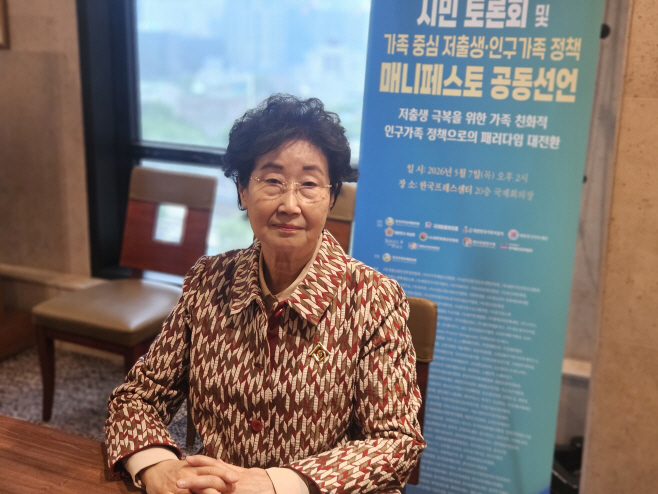
Hwang In-ja, executive director of the Korea Family Council, raised these concerns on the 7th at the Korea Press Center in Jung-gu, Seoul, during the \"9th Nationwide Local Elections Citizens' Debate and the Joint Declaration of a Family-Centered Low-Birthrate and Population-Family Policy Manifesto.\" Hwang argued that more than two decades of low-fertility policy have leaned too heavily on economic support and failed to restore the family as a community.
-The birthrate has ticked up slightly recently. Why do you continue to emphasize the low-fertility problem?
A brief uptick is not a reason for complacency. I felt that candidates running for Seoul mayor in this local election were not treating low fertility as a major issue. We need to revive public attention. Since late last year, experts and I have been preparing a manifesto.
-Why focus specifically on Seoul?
Seoul's total fertility rate is 0.63, the lowest in the country. It is the city with the largest concentration of young people, yet it has the highest share of young people reluctant to marry or have children. If Seoul changes, other regions can use it as a model.
-Why do you think past low-fertility policies failed to produce results?
Over the past 20 years, the government has invested more than 380 trillion KRW (approximately 285 billion USD). Still, the impact on fertility has been limited. Policymakers treated families as collections of individuals rather than as communities. Women's, youth, and elder policies operated in silos. We need policies that restore family values by treating the family as an integrated unit.
-Are you pointing to the limits of policies focused on financial support?
Yes. Policy has emphasized cash payments, but money alone is insufficient. Young people increasingly view having and raising children not as a blessing but as a cost and burden. We must build social structures that allow people to form families without risking their livelihoods. Schools should include family values in character education, and the media should move away from excessively negative depictions of family life.
-What is the core of this manifesto?
We have recomposed scattered policies through a family-centered lens. The manifesto addresses intergenerational integration, comprehensive caregiving, work–family balance, and housing stability. Governance is especially important: we need an integrated command center to coordinate population and family policy.
-What are the Korea Family Council's next steps?
We will monitor how much of the manifesto is reflected in actual campaign pledges and continue to track policy implementation during the next Seoul mayoral term. Seoul is only the starting point; we plan to expand these efforts nationwide.